
Notebook saves First World War soldier’s life
Advertisement
Read this article for free:
or
Already have an account? Log in here »
We need your support!
Local journalism needs your support!
As we navigate through unprecedented times, our journalists are working harder than ever to bring you the latest local updates to keep you safe and informed.
Now, more than ever, we need your support.
Starting at $15.99 plus taxes every four weeks you can access your Brandon Sun online and full access to all content as it appears on our website.
Subscribe Nowor call circulation directly at (204) 727-0527.
Your pledge helps to ensure we provide the news that matters most to your community!
To continue reading, please subscribe:
Add Brandon Sun access to your Free Press subscription for only an additional
$1 for the first 4 weeks*
- Enjoy unlimited reading on brandonsun.com
- Read the Brandon Sun E-Edition, our digital replica newspaper
*Your next Free Press subscription payment will increase by $1.00 and you will be charged $20.95 plus GST for four weeks. After four weeks, your payment will increase to $24.95 plus GST every four weeks.
Read unlimited articles for free today:
or
Already have an account? Log in here »
Hey there, time traveller!
This article was published 03/11/2018 (2781 days ago), so information in it may no longer be current.
More than a century ago, a young soldier’s letter to his mother made the front page of The Brandon Sun — the details of his narrow escape from death almost as mysterious at the time as to how he won the Victoria Cross.
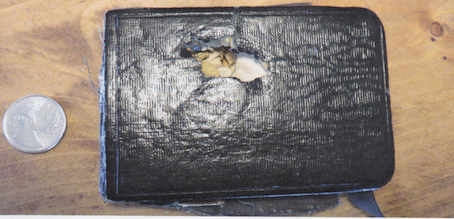
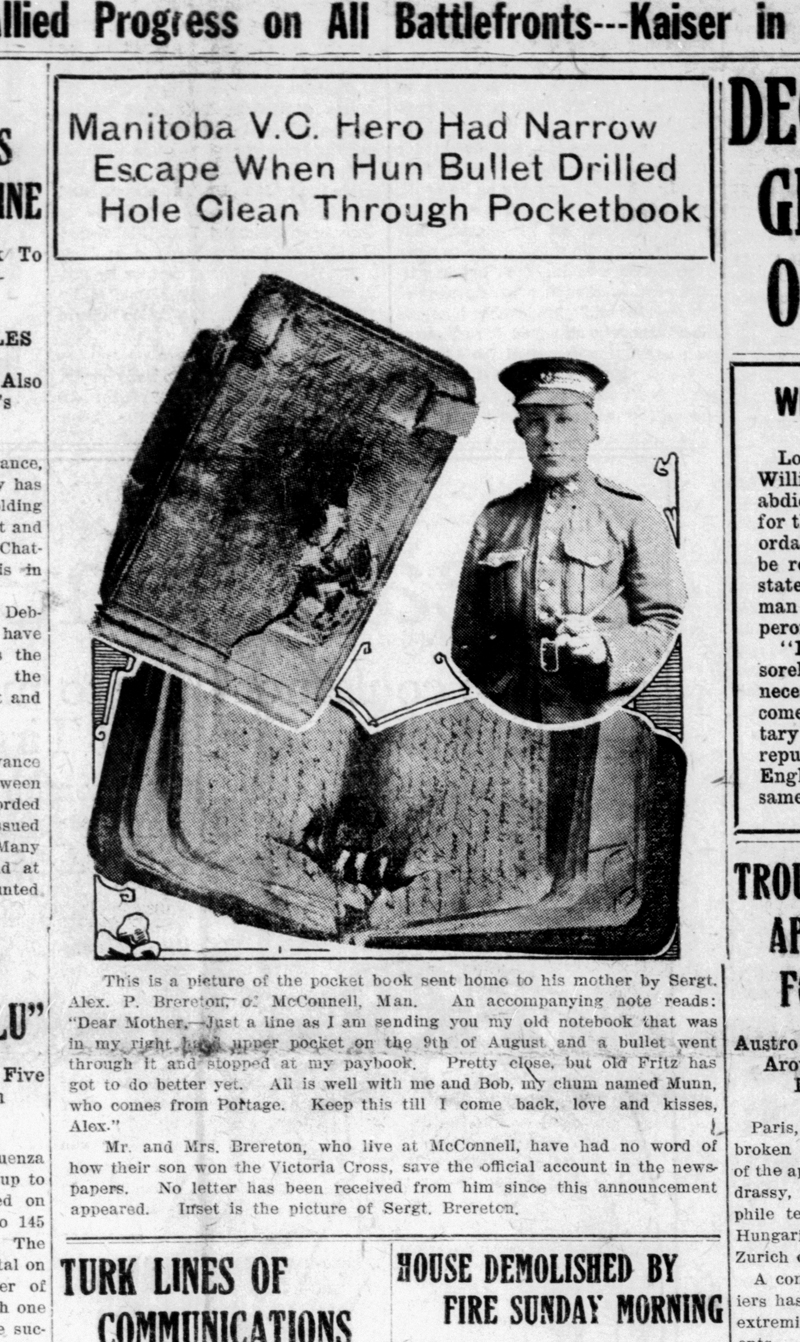
“Dear Mother — just a line as I am sending you my old notebook that was in my right hand upper pocket on the 9th of August and a bullet went through it and stopped at my playbook,” the note reads. “Pretty close, but old Fritz has got to do better yet.”
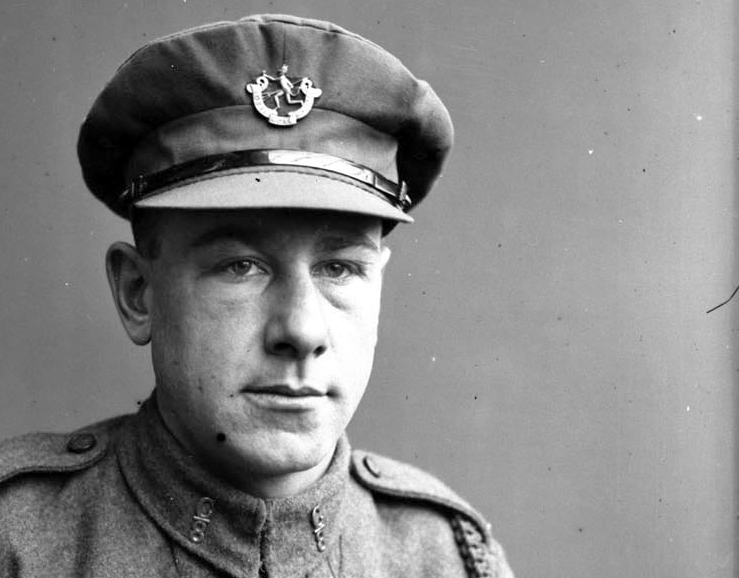
The letter and attached photo of a notebook with a single bullet hole through it was sent by Alexander P. Brereton, who had also just earned the Victoria Cross.
His parents, however, “had no word of how their son won the Victoria Cross, save the official account in the newspapers.”
Born in Oak River and raised in nearby former community of McConnell, Brereton signed up for the First World War in January 1916 when he was 23 years old, said author and historian Susan Raby-Dunne, who has researched and written about Brereton.
It was Raby-Dunne’s personal interest in Brereton — he had been mentioned occasionally by both sides of her family who did not know each other — that led her to the Alexander Brereton VC Branch of The Royal Canadian Legion in Elnora, Alb., where the infamous notebook was being kept.
They allowed her to borrow the notebook for research purposes, making her the first person in approximately 100 years to open it.
“It was quite exciting to be the first person to read those words since (the First World War),” Raby-Dunne said. “He didn’t really write much of a diary. There was a few times where he made note of some of the actions he did, but not in much detail.”
Brereton noted some tourist attractions he visited when he arrived for training in in London, England, Raby-Dunne said. He also had the names of some friends and relatives in who had joined the military, a few women and their addresses and information on soldiers he had met along the way.
Brereton first joined the 144th Battalion — which often had Winnipeg Rifles in brackets listed beside it — in 1916, Raby-Dunne said. He was transferred to the 18th Reserve Battalion and then to the 8th Battalion, otherwise known as the Little Black Devils, in 1917 until the end of the war.
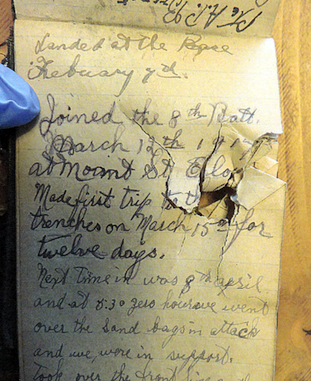
In the early years, according to Raby-Dunne’s research, Brereton spent a lot of his time digging trenches and building railway lines, which ultimately led to Brereton requiring a double hernia operation in the summer of 1917.
He was also hospitalized at least once for trench fever.
“(Brereton) did mention some battles because he had quite a problem with hernias. That was a very common ailment to (First World War) soldiers that weren’t used to digging and carrying heavy things and straining their abdominal muscles like that,” Raby-Dunne said. “He would have been doing that kind of grunt work for probably the first many months of the war.”
Brereton was promoted from corporal to sergeant in the field the day of his Victoria Cross actions, Aug. 9, 1918, Raby-Dunne said.
It was in the beginning of the famous “last hundred days,” and the Canadians were advancing on the Germans and breaking enemy lines. However the German machine guns were wreaking havoc on them, Raby-Dunne said.
It was this make-or-break scenario that Brereton single-handedly charged a German machine gun, shot the operator and in one fell swoop, bayonetted the man who rose up to take his place.
Nine German soldiers were compelled to surrender.
“It was a pretty amazing thing, to run straight a machine gun by yourself,” Raby-Dunne said. “The Germans were probably just so stunned that they didn’t react as fast as they might have otherwise. One guy galloping straight toward you would be kind of unnerving and probably cause you to be immobilized briefly while trying to figure out what the hell this guy was doing.”
Raby-Dunne doesn’t believe this was when Brereton’s notebook saved him from a bullet, she said, as the last entry in the book was toward the end of August, 1918, when he noted being on the line in front of Arras for 16 days before being posted onto the flats of the Scarpe River.
Brereton also used to tell his daughter-in-law, Margaret Brereton, to never let anyone tell her Friday the 13th was an unlucky day, because that was the day he was shot and he was still alive, Raby-Dunne said.
“It was right over his heart, he would have died if it wasn’t for those two notebooks,” Raby-Dunne said.
Brereton returned in 1919 and eventually returned to farming, settling in Elnora.
He never spoke about the war, Brereton’s grandson, Darryl Brereton said, who learned of his grandfather’s bravery by reading it in a book.
Darryl’s memories of his grandfather mainly involve playing cards, he said, as the two would get together every night after supper and play a game of rummy or cribbage.
“Apparently when they renamed the Elnora Legion after him, during the course of the ceremony he was supposed to get up and say a few words,” Darryl said. “He recited the Cremation of Sam McGee (by Robert W. Service) from memory because that’s what they used to do … 50 to 60 years previous and he still remembered it, word for word.”
» edebooy@brandonsun.com
» Twitter: @erindebooy