
Province responds to horse racing recommendations
Advertisement
Read this article for free:
or
Already have an account? Log in here »
We need your support!
Local journalism needs your support!
As we navigate through unprecedented times, our journalists are working harder than ever to bring you the latest local updates to keep you safe and informed.
Now, more than ever, we need your support.
Starting at $15.99 plus taxes every four weeks you can access your Brandon Sun online and full access to all content as it appears on our website.
Subscribe Nowor call circulation directly at (204) 727-0527.
Your pledge helps to ensure we provide the news that matters most to your community!
To continue reading, please subscribe:
Add Brandon Sun access to your Free Press subscription for only an additional
$1 for the first 4 weeks*
- Enjoy unlimited reading on brandonsun.com
- Read the Brandon Sun E-Edition, our digital replica newspaper
*Your next Free Press subscription payment will increase by $1.00 and you will be charged $20.95 plus GST for four weeks. After four weeks, your payment will increase to $24.95 plus GST every four weeks.
Read unlimited articles for free today:
or
Already have an account? Log in here »
Hey there, time traveller!
This article was published 24/11/2018 (2893 days ago), so information in it may no longer be current.
By Chelsea Kemp
The province announced Friday that it will not be following through on the recently released sustainability review of the Manitoba horse racing industry, and will instead chart its own course with the affected parties.
Commissioned in March and prepared by BlueSlate Inc., the 2018 Sustainability Review for the Manitoba Horse Racing Industry was released Nov. 16, with a focus on the short and long-term viability of the industry.
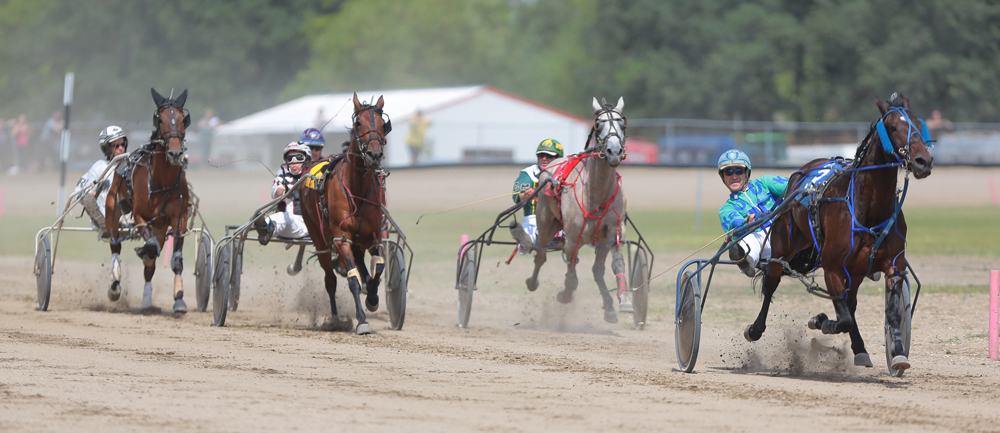
Agricultural Minister Ralph Eichler told reporters that the government will continue to move forward to ensure the horse racing industry maintains security and stability now and into the future.
“Through the next three years we’ll find a new funding model and make it more sustainable in the long term,” Eichler said.
Eichler did not state if future government support would be a part of the conversation, and could not predict what model would work best.
The BlueSlate report proposed a renewable five-year funding term, initially capped at $450,000 annually, be provided to the industry.
The province will instead maintain funding at its current level for the next three years.
“This will make them sustainable,” Eichler said.
Pleased to see a temporary plan in place, even it did not match the proposals from the study, Trevor Williams, Manitoba Harness Horsemen Inc. vice president, said the proposed funding will at least provide stability for the industry.
“We were hopeful we were going to get some more money and use additional tools to help the industry grow a little bit. But, now with just receiving the same amount of money it limits our ability to think outside the box right now,” Williams said.
He remains confident that the government will continue working toward establishing the long-term viability of the industry after the three-year transitionary phase has expired.
As of now, the Manitoba Great Western Harness Racing Circuit hosts 10 days of racing over the summer, generating about $164,500 in purses and $62,300 in breeder support, based on 2017 figures.
Williams sees Friday’s government announcement as a tiny victory, as this if the first time in more than two decades the industry has had predictable year-to-year funding. Focusing on growing the industry, the report provided insights regarding steps that could be taken to help Manitoba horse racing grow.
A one-time grant of $300,000 was recommended in 2018 to help supplement purses, combined with six additional days of racing, in an effort to help establish a foundation for the industry to grow.
These additional days will not be possible without the financial support recommended in the report.
“The funding just simply will not allow for that,” Williams said, “We definitely would have liked more … but we’re confident we will be getting more; that this is just a transition until we figure out an option for ultimate sustainability.”
A partnership with Red River Exhibition in Winnipeg was recommended in the report — an option that will now be difficult to pursue Williams said.
As an agricultural society based in an urban setting, the provincial report states that a partnership between the Exhibition and the horse racing circuit has the potential to promote the industry to a larger market.
Originally hoping to begin work with Red River as soon as possible, these plans will be put on ice, Williams said, with the province failing to provide the funding recommended by the BlueSlate Inc. report.
“They’re still be a big player in our future, we just don’t know how far into the future that looks,” Williams said.
With money being the toughest challenge the standardbred industry faces, the group will remain stagnant after failing to receive the recommended support from the province.
However, after years of an industry in decline, Williams said the Manitoba Great Western Harness Racing Circuit is ready to push through.
“We need to look at other options and partnerships,” Williams said.
Darryl Mason, Manitoba Great Western Harness Racing president, is disappointed with the funding allocation from the province, but remains hopeful for the industry’s future as a whole, with the release of the report.
A competitive racer since the 1980s, Mason has seen both ebbs and flows in the industry.
Living and racing in Killarney, Mason travels to Glenboro and Miami as part of the summer circuit.
Having faced many challenges over the years, one of the most difficult aspects of the industry has been breeding a race horse population that can put on competitive races. Mason hopes the new stability will encourage breeding, as breeders know there will be races to enter.
“With a few years substantiality we can plan a little bit better,” Mason said.
Small towns have suffered the most in the face of a declining industry, Mason said — a statement supported by the provincial report.
“The races contribute financial support to the local agricultural societies … and provide a boost to local economies,” the report said.
Going forward, the economic support of rural Manitoba will be of chief concern in terms of supporting the horse racing industry, the report said.
In one of the biggest shakeups Mason has seen in the industry, horse racing was hit especially hard with the introduction of VLTs into restaurants, hotels and lounges in the early 1990s, increasing the competition the industry has faced in terms of gambling.
That issue was further compounded when standardbred racing in Saskatchewan came to an end, resulting in a significant decrease in revenue and available horses, Mason said.
Willing to work with the province, Mason hopes to see the industry grow when a plan is set in place.
As of now, he expects to see little to no changes in standardbred racing. His greatest concern is that with rising inflation rates, the industry will begin to lose more money.
“Everything is going to stay the same for the next three years, which will mean very little growth in the industry,” Mason said.
»ckemp@brandonsun.com
»Twitter: @The_ChelseaKemp