
RIDES: Safety top of mind in big rig driver training
Advertisement
Read this article for free:
or
Already have an account? Log in here »
We need your support!
Local journalism needs your support!
As we navigate through unprecedented times, our journalists are working harder than ever to bring you the latest local updates to keep you safe and informed.
Now, more than ever, we need your support.
Starting at $15.99 plus taxes every four weeks you can access your Brandon Sun online and full access to all content as it appears on our website.
Subscribe Nowor call circulation directly at (204) 727-0527.
Your pledge helps to ensure we provide the news that matters most to your community!
To continue reading, please subscribe:
Add Brandon Sun access to your Free Press subscription for only an additional
$1 for the first 4 weeks*
*Your next subscription payment will increase by $1.00 and you will be charged $20.00 plus GST for four weeks. After four weeks, your payment will increase to $24.00 plus GST every four weeks.
Read unlimited articles for free today:
or
Already have an account? Log in here »
Hey there, time traveller!
This article was published 30/11/2018 (2711 days ago), so information in it may no longer be current.
By Chelsea Kemp
CORNWALLIS — A local training centre is pushing for industry change in an effort to create better semi tractor-trailer drivers and, as a result, safer roads.
Jim Campbell, president and general manager of First Class Training Centre Inc., wants to see the drivers who come out of his course become some of the best in Canada.
Dissatisfied with the available truck driver training schools in the province, Campbell set out to launch a training school with higher standards of education that focused on intimate training between students and teachers.
“We’re fairly new,” Campbell said. “I enjoy doing what I do. It’s rewarding.”
Motivated to change the industry, Campbell launched First Class Training Centre Inc. on Jan. 3, 2012.
The first school opened in Winnipeg, and they have since branched out throughout the province. The Brandon office is located about five kilometres south of the city in Cornwallis.
In Brandon, the office will see new students every six weeks, with instructor Calvin Davy offering two-on-one training with students.
Instructors have a minimum of 500,000 kilometres driving experience in the last four years and training through the Manitoba Trucking Association to be a Manitoba Public Insurance-permitted instructor.
“We became the most recognized school in a very short period of time, and became the biggest in two years, basically,” Campbell said. “That was never my intention.”
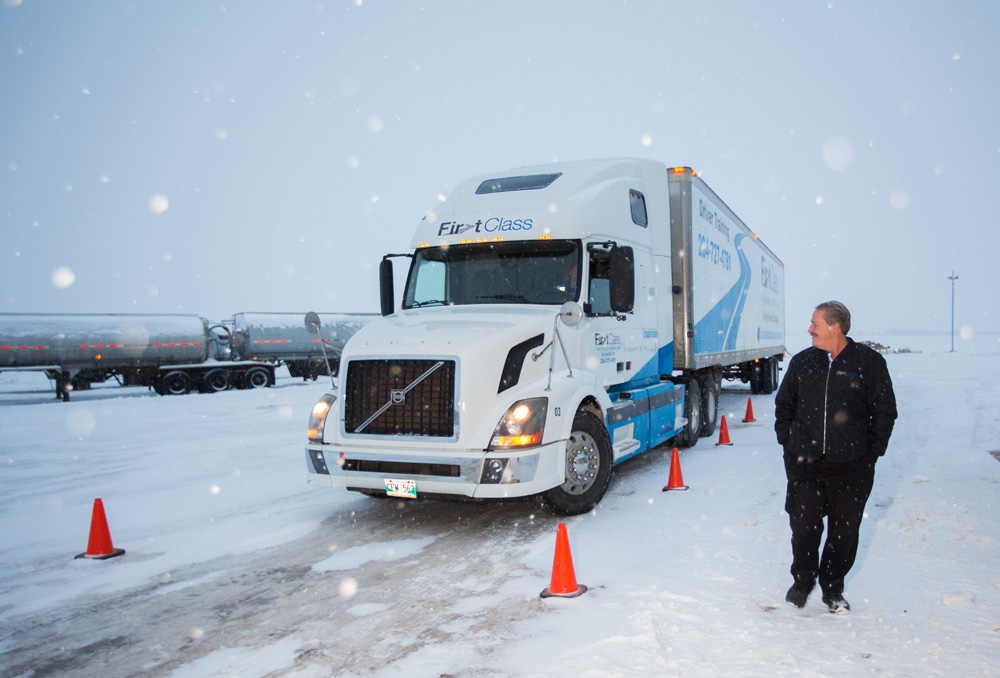
Offering Class 1 and Class 3 driver’s-licence training, First Class has air-brake training, driver evaluations and a mobile classroom that features a driver simulator.
First Class provides in-depth driver training over the course of six weeks, giving students 244 hours of training.
“We don’t set you up to fail,” Campbell said. “We focus on standards and what the industry is looking for.”
After presenting and having a training plan approved by MPI, private vocational institutions and Employment Manitoba, the school now receives funding from the province.
With a growing demand for drivers as baby boomers retire, the industry could potentially be facing a shortage of up to one-third of the workforce.
Costing $8,950 to take the course, students can receive provincial government funding because the need for new drivers in the industry is so great.
Campbell has seen countless students enter the classroom after leaving dead-end jobs, coming out trained to find success in a business that can support their family.
“We don’t throw you in a trailer and take you downtown right away,” Campbell said, explaining the training course is designed to build a student’s confidence and comfort driving the cab.
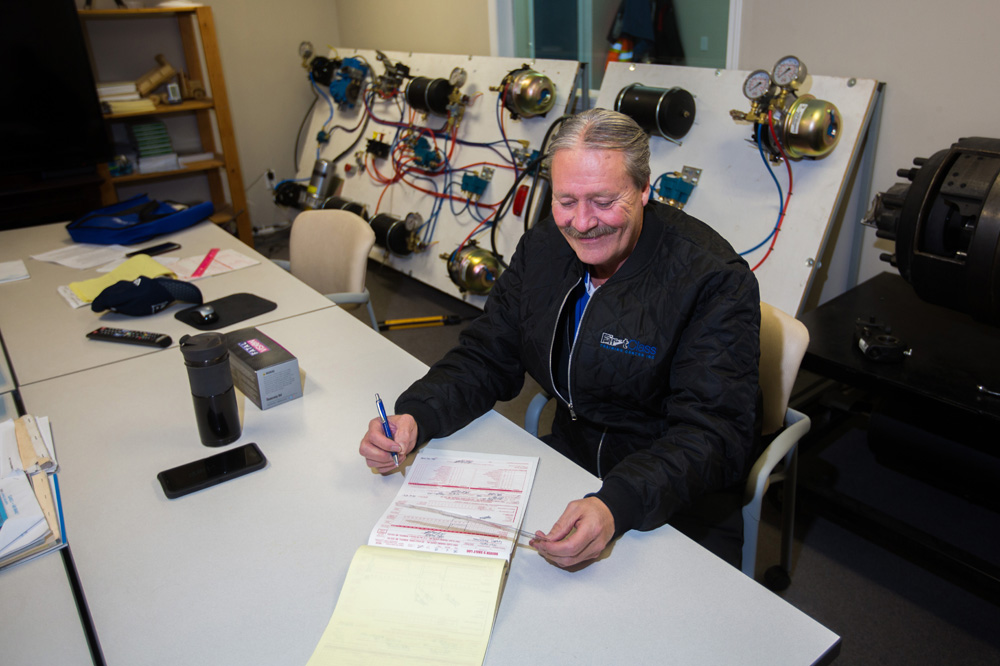
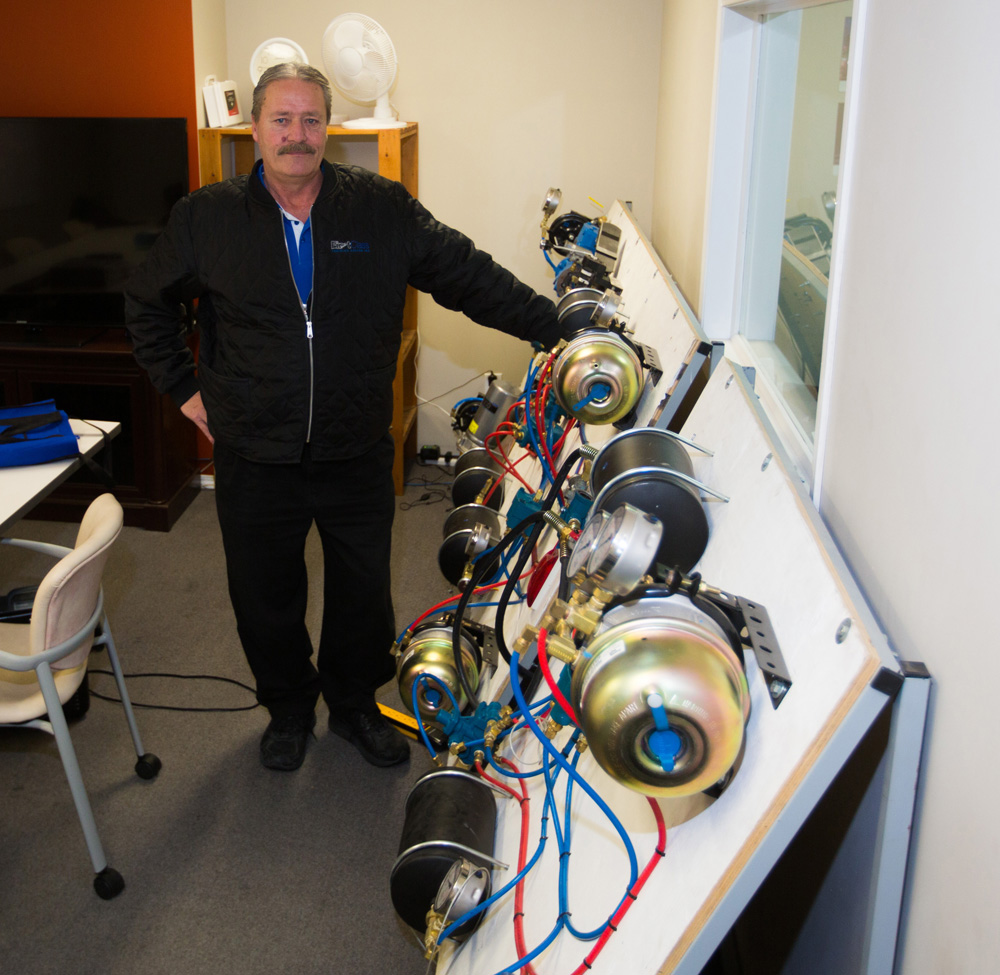
The first three days are spent in the classroom, where students learn about air brakes. Using a fully functional air board approved by the government, students learn first-hand how the tractor and trailer work.
The next step is learning the theory of driving over the course of 10 days.
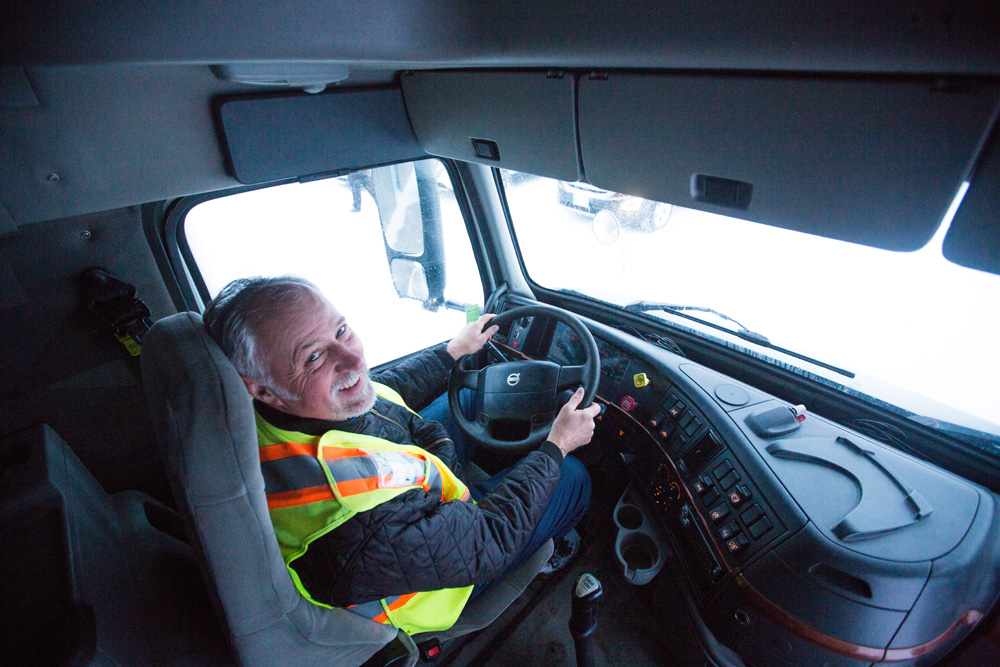
Finally, the students get in the rig, spending 17 eight-hours days learning to negotiate the big machine.
With the hands-on practical experience, coupled with intensive theory training, Campbell hopes to see his students pass the MPI driver test the first or second time.
Anyone who passes their test on the first try gets a First Class Training Centre Inc. jacket to mark the special occasion, a token Campbell introduced four years ago as an incentive.
“You wear one of these jackets… they know you passed the first time,” he said.
The key to success, Campbell said, comes down to having a good attitude and good attendance.
Campbell’s goal is to have companies seek out the students who graduate from his training centre.
Technology has transformed the experience of driving a semi, and this has bled into the classroom, especially in regards to the prolific expansion of GPS and cellphones.
Giving students the basics with traditional hands-on analog training, with hand-written log books and map reading, Campbell uses these skills to help students build solid practical skills that can be applied to modern technology.
“When I ran North America, I didn’t have GPS. I had a big atlas. We didn’t have cellphones, we’d had to stop and ask for directions,” Campbell said.
Map reading is still essential, as many GPS routes will not take semis on appropriate routes.
His biggest pet peeve is the lack of clear minimum entry-level training course standards, and he remains a strong advocate for standardized Class 1 and Class 3 licence training in the province.
There are only five registered schools in all of Manitoba, he said.
“There’s 17 other school out there that are not registered,” Campbell said. “They don’t have to have a minimum amount of training. We need mandatory training in Manitoba.”
Campbell wants to see a standard six weeks of 244 hours intensive standardized training introduced in the province.
“Right now, you could go get a Class 1 licence and call yourself a trucker (after 20 hours training),” said Campbell. “You can go get a driver’s licence, drive around North America and possibly kill someone. Twenty hours is not near enough.”
The Humboldt bus crash earlier this year further galvanized Campbell in his quest to push for standardized training hours in Manitoba.
Sixteen people were killed and 13 others injured after a bus taking the Humboldt Broncos junior hockey team to a playoff game collided with a transport truck on a highway north of Tisdale, Sask., in April.
Calling it an eye opener, Campbell wants to see changes made to training in Manitoba.
Once a man who trusted other truckers he met on the road, Campbell said, he gets nervous when he sees other semis as he does not know the driver’s ability level.
“We need better training,” Campbell said, “I want better-quality drivers out there.”
»ckemp@brandonsun.com
»Twitter: @The_ChelseaKemp