
Mediators to speak at international conference
Advertisement
Read this article for free:
or
Already have an account? Log in here »
We need your support!
Local journalism needs your support!
As we navigate through unprecedented times, our journalists are working harder than ever to bring you the latest local updates to keep you safe and informed.
Now, more than ever, we need your support.
Starting at $15.99 plus taxes every four weeks you can access your Brandon Sun online and full access to all content as it appears on our website.
Subscribe Nowor call circulation directly at (204) 727-0527.
Your pledge helps to ensure we provide the news that matters most to your community!
To continue reading, please subscribe:
Add Brandon Sun access to your Free Press subscription for only an additional
$1 for the first 4 weeks*
- Enjoy unlimited reading on brandonsun.com
- Read the Brandon Sun E-Edition, our digital replica newspaper
*Your next Free Press subscription payment will increase by $1.00 and you will be charged $20.95 plus GST for four weeks. After four weeks, your payment will increase to $24.95 plus GST every four weeks.
Read unlimited articles for free today:
or
Already have an account? Log in here »
Hey there, time traveller!
This article was published 09/05/2019 (2569 days ago), so information in it may no longer be current.
A pair of mediators from the John Howard Society of Brandon will be sharing their insights into restorative justice at an international conference next week in Kortrijk, Belgium.
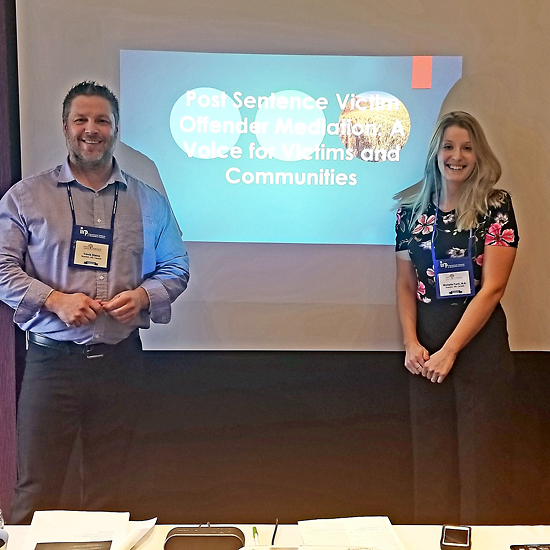
Travis Blaine and Michelle Funk, who are mediators with the John Howard Society’s Westman Mediation Service, were invited to the conference for the International Institute for Restorative Practices.
Their breakout presentation is titled “Post Sentence Victim Offender Mediation: A Voice For Victims and Community.”
“Right now, that we’re aware of, we’ve kind of been at the forefront (in Manitoba) dealing with loss of lives and arson cases and very severe matters where the victims have an opportunity to be part of the process,” Blaine said Wednesday.
This will be the first time Blaine has spoken at an international conference on the subject.
Restorative justice has been typically utilized for first-time offenders in minor cases.
In 2011, Blaine was involved in the first restorative-justice case in Manitoba involving a more serious crime when two Manitoba offenders were sentenced for burning down a historic grain elevator in Fleming, Sask.
“Part of their conditions was that they meet with the community and give an explanation to why they did what they did,” Blaine said, “so to provide closure to the community, not just an individual.”
Since then, judges in western Manitoba have continued to send victim-offender mediation cases to Westman Mediation Service.
“Currently, they don’t do any of this in Winnipeg,” he said, “so we’ve been approached by Crowns and judges in Portage and in the Parkland to deal with these kind of matters.”
Restorative justice is not a new concept. It has connections to Indigenous and many other cultural traditions, which historically used forms of restorative justice to resolve community issues. What is now considered a criminal act was dealt with as a violation of people, relationships and the peace of the community as a whole. The community considered healing, reintegration and preventing future harm to resolve the issue.
The Truth and Reconciliation Commission of Canada recently highlighted that offenders may themselves be victims of historical wrongs stemming from residential schools or the ’60s Scoop, in which Indigenous children were taken from their families and communities for placement in foster homes or adoption. Despite the reference to one decade, the Sixties Scoop began in the late 1950s and persisted into the 1980s.
The TRC has tasked governments across Canada to find ways to reduce overrepresentation of Indigenous people in the justice system, both as offenders and as victims.
The John Howard Society of Brandon maintains contracts with the Manitoba Department of Justice for the provision of restorative justice solutions through out Westman and The Parkland regions.
» brobertson@brandonsun.com
» Twitter: @BudRobertson4