
Documentary shows the reality of addiction
Advertisement
Read this article for free:
or
Already have an account? Log in here »
We need your support!
Local journalism needs your support!
As we navigate through unprecedented times, our journalists are working harder than ever to bring you the latest local updates to keep you safe and informed.
Now, more than ever, we need your support.
Starting at $15.99 plus taxes every four weeks you can access your Brandon Sun online and full access to all content as it appears on our website.
Subscribe Nowor call circulation directly at (204) 727-0527.
Your pledge helps to ensure we provide the news that matters most to your community!
To continue reading, please subscribe:
Add Brandon Sun access to your Free Press subscription for only an additional
$1 for the first 4 weeks*
*Your next subscription payment will increase by $1.00 and you will be charged $20.00 plus GST for four weeks. After four weeks, your payment will increase to $24.00 plus GST every four weeks.
Read unlimited articles for free today:
or
Already have an account? Log in here »
Hey there, time traveller!
This article was published 02/11/2019 (2342 days ago), so information in it may no longer be current.
A man appears on screen, recording himself as he rubs the skin on his forehead, face and neck while marvelling at the disappearance of his wrinkles with each pull.
Fast forward a couple minutes and the man has rubbed his neck raw. His face is bleeding, but he continues to press his hands into his skin, pulling it back in fascination with his perceived new appearance.
The audience learns the man’s name is John, and he died of an overdose in 2013.
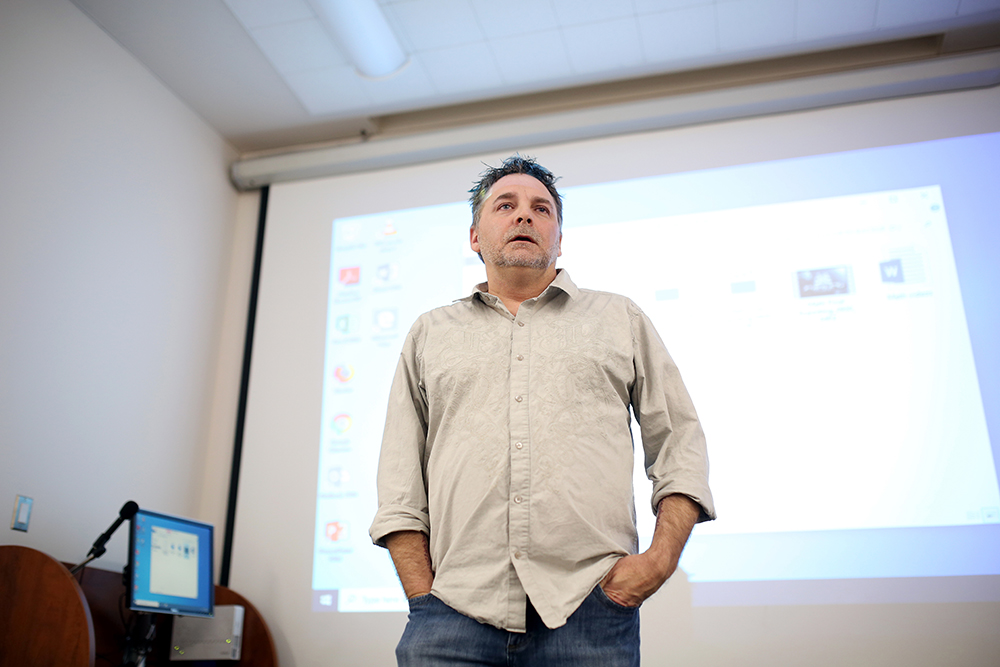
He filmed himself while on methamphetamine, the narrator says, because he wanted people to see what happens to people while on the drug.
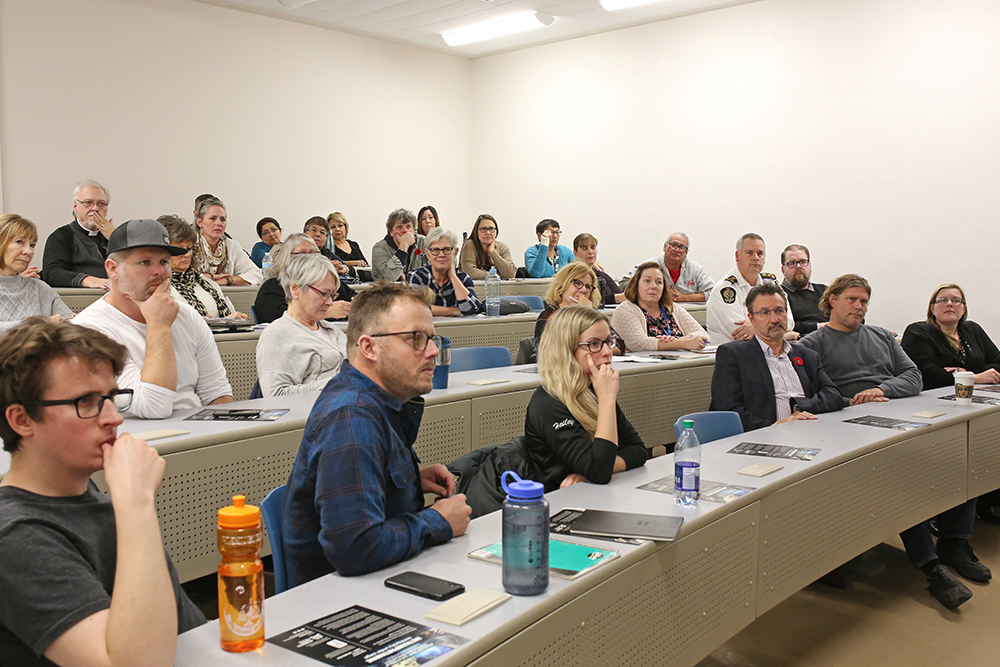
These are the first minutes of Rodney Bodner’s documentary “Methamphetamine: Community Under Siege,” which was screened at the Brandon University on Friday for a crowd of approximately 45 people — including Mayor Rick Chrest, Brandon police Chief Wayne Balcaen and members of the community.
The documentary was filmed in Winnipeg and took a year to make, Bodner said, following individuals who have struggled with methamphetamine addiction and the organizations working in harm reduction, recovery and community safety.
“I’ve been a paramedic for 15 years, and I’ve had my fair share of calls for overdoses,” Bodner said. “I’m getting closer to the end of my career and I wanted to do more. … I wanted to make sure the people that are addicted to methamphetamines, that their story was told. I wanted to show they’re actual people.”
In the beginning stages of filming, Bodner said he was turned away by most government services.
Fellow paramedics of Bodner’s told him Shared Health put out a letter instructing employees not to speak to him, Bodner said, adding he had to file Freedom of Information requests for information.
“At first I was a little discouraged … but I understand,” Bodner said. “This is my first major production, they probably were unsure of how I was going to represent them and what kind of information I was going to put out there.”
The roadblock prompted Bodner to shift gears in how he filmed, he said, excluding government talking heads and going straight to the ground level where people were working to make a difference, such as the Bear Clan Patrol, St. Boniface Street Links and the Main Street Project.
Bodner also spoke with methamphetamine addicts, recovering addicts and a drug dealer.
The final production is a raw and eye-opening look at a city in the grip of a methamphetamine crisis and the people trying to fill in the glaring gaps in the system.
“The system that is currently there for people doesn’t seem to be working,” Bodner said. “Something has to change.”
Local advocate Kim Longstreet, who organized the documentary screening, said the conversation has come a long way since she started advocating in 2017, but there are still missing pieces.
“There’s a lot of things that are being addressed, there’s no doubt about that, but there’s still more that needs to be done,” Longstreet said, noting the six detox beds that opened in Brandon last month as a positive step.
Long-term medical treatment is still desperately needed, Longstreet added, as 21 or 28-day treatment programs aren’t helping.
“I see we’re progressing, and there’s a willingness to try more options,” Longstreet said. “I’m hoping this film today helps people recognize that this isn’t something that can be fixed in 21 days … I don’t think people always have a clear understanding. Sometimes we lose sight of the fact that these are people, everyday people, who are struggling.”
So far, Bodner said screenings of the film in Winnipeg have been very well received, with the Manitoba School Boards Association committing to have the documentary put in every high school in Manitoba.
“That was my original intention, to have kids watch it and start a conversation,” Bodner said. “The more I watch the film and listen to people ask questions, I see that it could also be used at a university level in faculties such as social services, justice and psychiatry.”
The audience in Brandon was equally as receptive, asking questions about what more could be done to help.
“This (film) needs to be seen soon,” one viewer said after inquiring the timeline for the documentary’s release.
“Methamphetamine: Community Under Siege” will be available on Amazon Prime in January.
» edebooy@brandonsun.com
» Twitter: @erindebooy