
Brakes Boissevain hockey’s heartbeats
Unsung small town hockey heroes
Advertisement
Read this article for free:
or
Already have an account? Log in here »
We need your support!
Local journalism needs your support!
As we navigate through unprecedented times, our journalists are working harder than ever to bring you the latest local updates to keep you safe and informed.
Now, more than ever, we need your support.
Starting at $15.99 plus taxes every four weeks you can access your Brandon Sun online and full access to all content as it appears on our website.
Subscribe Nowor call circulation directly at (204) 727-0527.
Your pledge helps to ensure we provide the news that matters most to your community!
To continue reading, please subscribe:
Add Brandon Sun access to your Free Press subscription for only an additional
$1 for the first 4 weeks*
- Enjoy unlimited reading on brandonsun.com
- Read the Brandon Sun E-Edition, our digital replica newspaper
*Your next Free Press subscription payment will increase by $1.00 and you will be charged $20.95 plus GST for four weeks. After four weeks, your payment will increase to $24.95 plus GST every four weeks.
Read unlimited articles for free today:
or
Already have an account? Log in here »
Hey there, time traveller!
This article was published 07/11/2020 (2056 days ago), so information in it may no longer be current.
Ask nearly any Boissevain local and they’ll tell you hockey in the community is synonymous with Bob and Betty Brake.
The couple has been a fixture in the culture of the town’s sports scene for decades.
“I don’t think you can think of sports, whether it be hockey or baseball in Boissevain, without thinking of both Betty and Bob,” said Wheat Kings play-by-play announcer, Branden Crowe.
Crowe moved to Boissevain for Grade 8 in the mid-2000s, spending the rest of his school years in the town. He quickly got to know the Brakes, who were also a big part of his dad’s memories from growing up as a child, playing hockey in Boissevain.
Betty and Bob met in the summer of 1969, during family camp at Camp Wannakumbac in Clear Lake. Betty was turning 18 that fall, Bob was 20.
The two married on Feb. 20, 1971, and Betty moved to Boissevain from her hometown of Elm Creek that year.
Soon after, the couple had their first son, Junior; three years later their second son, Glenn. The family worked long hours throughout the year, farming cattle. When winter came around, it was a little bit of a reprieve.
“That was our holiday, chasing our kids at the rink,” Bob said.
“We chased them in the wintertime with hockey and in the summertime with ball,” Betty added.
“At that time when our oldest son started playing … we just kind of started living at the rink it seems, especially when (Glenn) started playing hockey as well. You started watching the other teams, then you got hooked.”
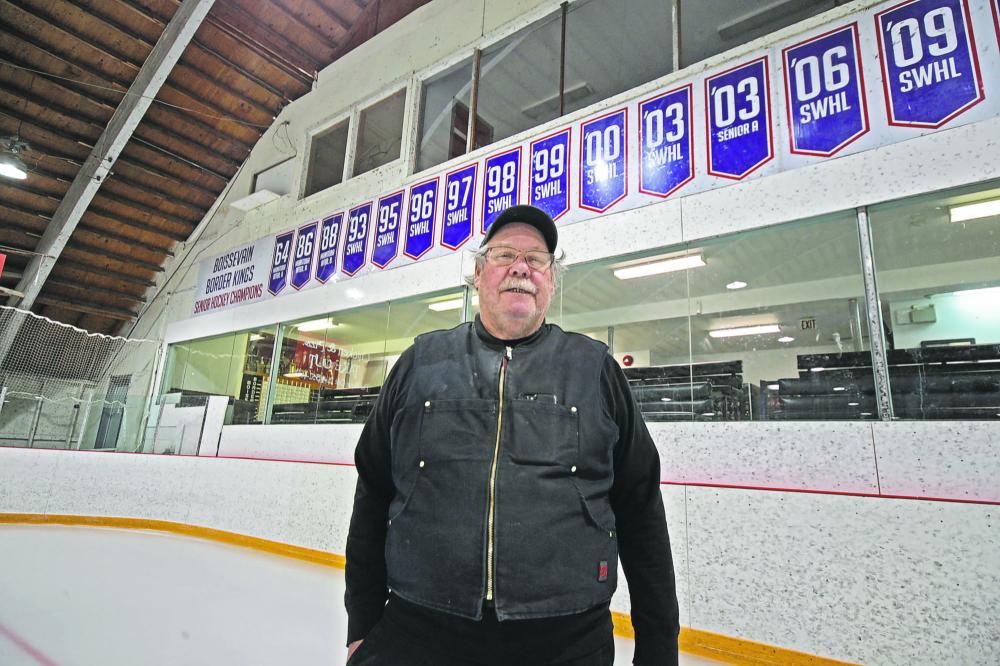
That’s how Bob ended up managing the town’s senior hockey team, the Boissevain Border Kings.
He took over the job from someone who decided they were ready to move on. At that point, the Border Kings hadn’t won any type of championship since 1964, more than 10 years.
Bob led the Border Kings to two Manitoba Intermediate Hockey championship titles in the 1980s, before the team shifted to to the now defunct SouthWest Hockey League.
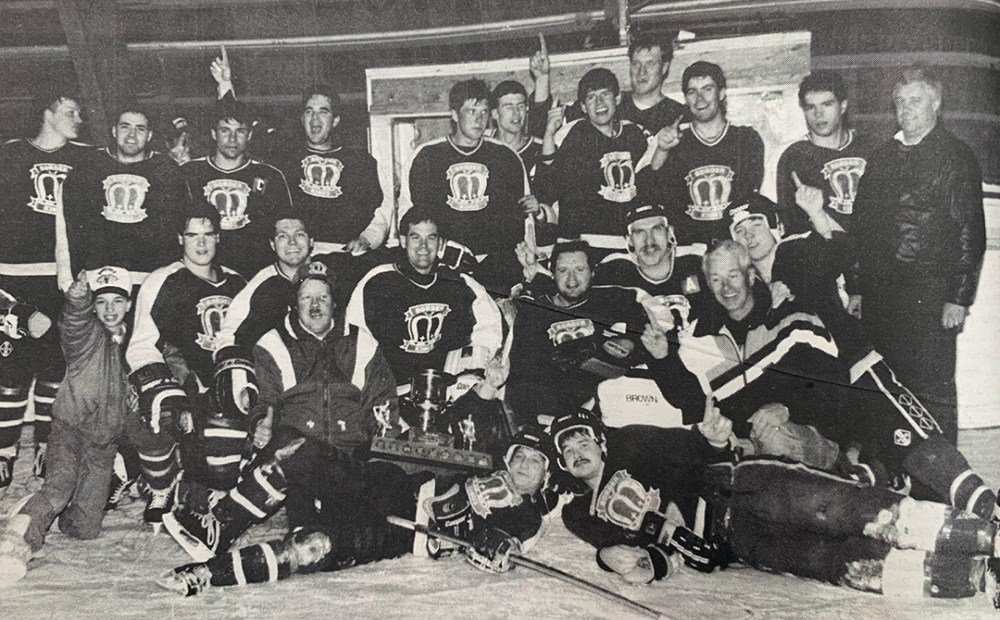
With his management, Bob helped guide the team through an illustrious era in Border Kings history. The team went on a winning streak in the 1990s, claiming six-straight SouthWest championships.
“The first championship was quite exciting, the Border Kings had gone a long time without winning one. After that was OK, but the first time was probably the best time,” Bob said.
“The other good thing about it was that it was in Cartwright, one of the main foes of the Border Kings in those days, so that added a little extra to it.”
The team’s 1993 win — their first in Southwest league history — was a come-from-behind win against the Cartwright Clippers to take the championship series.
While the Elkhorn Canadians took the top honour a year later, Boissevain went undefeated for the rest of the 1990s and the year 2000. In 2001, the Souris Elks stole their crown and went on a winning streak of their own.
But the Brakes went through some tumultuous times before the Border Kings’ successes of the 1990s.
At one point Betty and Bob got divorced, only to find their way back to each other years later and re-marry in 1989, on the same date as their first wedding.
“It’s an easy date to remember,” said Betty. “Then you don’t have to have another date in your mind.”
By that time, the couple had wrapped up their farming gig and Bob was working full-time as caretaker of the Boissevain Agricultural Arena — having come across the job by chance.
He’d spend the next few decades juggling his caretaker job with his duties as the Border Kings’ manager.
“We came to all the games, the other guy retired and he asked me to do it, so I did it … you start off thinking it’s going to be a one-year thing and then all of a sudden it’s 29 years later and I have a pension out of it, so it wasn’t all bad I guess,” he said.
Bob started off his days by going out for coffee and breakfast in the morning, getting to the rink around 9 a.m. He’d work until noon, not do too much in the afternoon and then work at night until the hockey games were over.
“In this rink you do everything. Maintain the ice, clean the dressing rooms, wash the floor, all that stuff,” he said.
The best part of the position?
“Getting to watch the hockey games.”
Driving the Zamboni was another highlight. He noted how the first few times he had to practice when nobody else was at the rink, but after that it just became something fun to do.
Since Boissevain’s rink isn’t heated, maintaining the ice gets a little trickier once colder months like January and February roll around. When it gets too cold, the ice gets brittle and cracks. It’s also harder to peel the ice, which doesn’t help since you don’t want it too thick.
But, despite the finicky nature of the ice, Bob was always more than happy to make sure the rink was ready for a game.
He completely retired from the position in 2016, but usually fills in once a year, “just for fun.”
While Bob was at the rink working hard on the ice, Betty was working hard off of it.
“It didn’t matter where you went sports-wise, one of the two of them or both of them were there,” Crowe said. “You just knew that when you went to the rink, they were gonna greet you with a smile.”
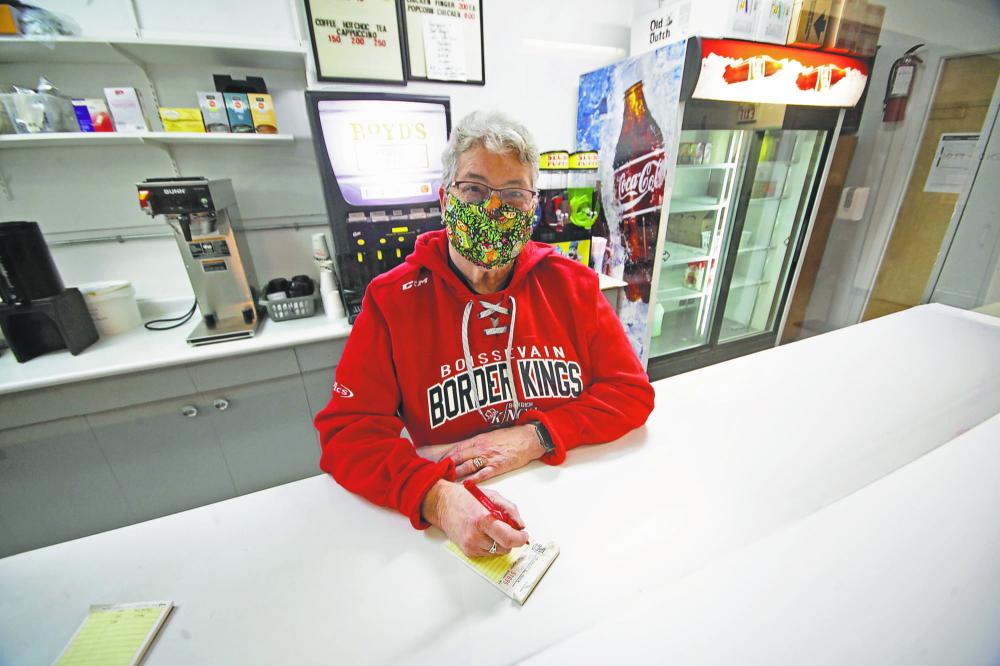
Betty spent 15 years managing the rink’s concession stand, starting the job in the early 2000s. She retired from it in 2016, but decided to to come back this year.
The canteen recently closed by order of the local council because of the region’s COVID-19 code orange restrictions, so she’s not sure when it will get back up and running, but she’s hopeful that it will.
“I kind of missed the people, I giggled the first year I was retired from here and said ‘Oh, I figured out what I missed about the rink… my parking spot.’ That was just the biggest joke for years,” Betty said.
“I’m kind of enjoying having my parking spot back, but I like the people and it gives me something to do, so it’s kind of a win-win.”
This season it’s a little different because of COVID-19, but in years previous Betty would roll up to the rink long before fans even arrived.
For an hour-and-a-half prior to the start of a game, Betty would prep for the night ahead — slush machine up and running, candy bags filled, coffee brewed, cappuccino machine stocked. By the time she cashed out and cleaned up, it’d be at least an hour after the evening’s game ended.
“I don’t think people realize how much time it takes just to get everything all set up and in it’s place,” she said. “I’m generally working when there’s nobody here. I mean, the custodians will be here and they see me doing stuff but that’s about it. Most people don’t really have a clue as to the amount of time it takes to do it, and do it properly.”
Betty worked the concession job on evenings and weekends, in addition to her day job as a sewing machine operator making horse blankets for Glover Equine. She’s retired now, but worked there for about 30 years.
“I was usually kind of excited to see the summer come along, because then I only had one job to go to,” she said.
While you may see Betty at the concession stand on minor hockey game nights, during Border Kings home games you’ll probably hear her. The 68-year-old is the voice of the team, and has been for the past 20 years.
She’ll announce the goals, penalties and tally up the score sheet too.
“I’d like to say I’m one of their biggest fans, just saying … Hopefully there aren’t too many (penalties) for the Border Kings and lots for the opposition, sometimes it doesn’t work out that way,” she said.
The announcer also has no problem putting the skills she used in her former job to use — on Thursday, she spent the afternoon sewing the name bars onto the backs of this year’s Border Kings’ jerseys.
The extra task was no big deal for Betty — to her, it’s just another part of her duty as loyal hometown fan.
“Boissevain differs from some other small towns in that we have an extremely loyal fan base. When it comes to Border King hockey or even the (Centennials) baseball team, they have a huge following,” she said.
“There have been some times, in some rinks where I get to go to an away game, that Boissevain fans outnumbered the home team when they were away.
“That to me is kind of a sad thing, that players in other towns aren’t getting the support that they probably should have, because it’s an expensive sport. You have to pay for your ice time, the referees, equipment, it all adds up. So unless you have some pretty deep pockets, it can all go south in a hurry.”
Like Betty, Bob was quick to brush off his contributions to Boissevain’s hockey community.
“You don’t really think much about it, but a lot of those kids could come and skate just about whenever they wanted,” Bob said. “That’s what it takes to be a hockey player, I guess. I won’t take much credit though.”
Unfortunately, because of the pandemic, this year the arena is locked all the time. There’s 15-minute window when it’s open for parents to get their kids in and out of practice, but that’s about it. There are no open-ice times, which the community has grown to love over the years.
Crowe noted all the times Bob would go down to the rink and let the kids in for a skate, no matter the day.
“Before cell phones, you still had your house phone and I remember there were two numbers that I remembered,” Crowe said.
“One was my grandparents down the road, and the other was Bob and Betty’s house phone, because you knew if there was a snow day or it was Boxing Day or Christmas day morning and you wanted to go for a skate you could just call the house. Bob would answer the phone and either tell you the code to the door or he’d make sure it was open for you.
“All of us kids knew where the light switches were. We’d go in there and as long as we put the nets away and picked up our pucks, he was more than happy to keep the rink open anytime.”
The Brakes have, directly or indirectly, created countless memories in Boissevain sports.
“I just think people like that are are kind of the main cog in the small-town sporting wheel. I mean, I think if it wasn’t for (Bob) a lot of us kids may not have been able to skate as much as we did, or take advantage of just being at the rink and having fun, it probably kept us out of a lot of trouble,” Crowe said.
“It’s just people like that, that make small towns so great.”
Do you have an unsung hero in your small-town hockey community? Email dshewchuk@brandonsun.com for a chance to have them featured.
» dshewchuk@brandonsun.com
» Twitter: @devonshewchuk