
Each step prepped Hemmings for success Brandon University alumni series: Through the decades
Read this article for free:
or
Already have an account? Log in here »
We need your support!
Local journalism needs your support!
As we navigate through unprecedented times, our journalists are working harder than ever to bring you the latest local updates to keep you safe and informed.
Now, more than ever, we need your support.
Starting at $15.99 plus taxes every four weeks you can access your Brandon Sun online and full access to all content as it appears on our website.
Subscribe Nowor call circulation directly at (204) 727-0527.
Your pledge helps to ensure we provide the news that matters most to your community!
To continue reading, please subscribe:
Add Brandon Sun access to your Free Press subscription for only an additional
$1 for the first 4 weeks*
- Enjoy unlimited reading on brandonsun.com
- Read the Brandon Sun E-Edition, our digital replica newspaper
*Your next Free Press subscription payment will increase by $1.00 and you will be charged $20.95 plus GST for four weeks. After four weeks, your payment will increase to $24.95 plus GST every four weeks.
Read unlimited articles for free today:
or
Already have an account? Log in here »
Hey there, time traveller!
This article was published 14/11/2020 (2032 days ago), so information in it may no longer be current.
Throughout the regular 2020-21 season, present and past members of The Brandon Sun sports department, along with Brandon University players and coaches, will reflect the careers of great BU Bobcats and make their case for the best lineup from each star-studded decade of CIAU, CIS and U Sports history.
Jerry Hemmings is a Canadian coaching anomaly.
The Brandon University Bobcats legendary bench boss took the reins at age 26 and graced the BU sideline for 26 seasons, in part, because of one shining year as the Bobcats’ star forward.
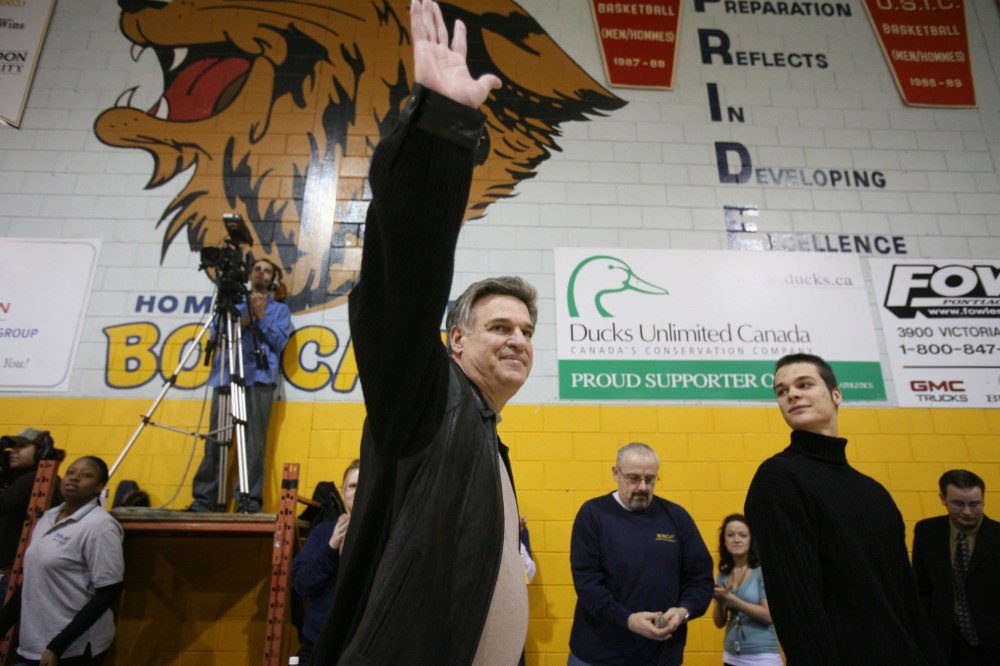
His 736 wins, among the best in the country’s history, and four national titles topped only by two men are a product of a roller coaster of a playing career that started back in Mount Airy, N.C., in Grade 5.
The 73-year-old said baseball was actually his first love but when five high schools in his area consolidated to form one with 1,000 students, kids had to specialize early to make a team.
“You got to look at basketball in North Carolina as compared to hockey in Manitoba. I always told people basketball in North Carolina is bigger than religion and religion is pretty big in the south,” Hemmings said.
“Basketball was bigger in my high school … a lot of places in North Carolina always football was the number one thing, basketball was number two and baseball was number three.”
Hemmings helped North Surry High School to a 2A state title in 1966. (The state’s top tier is 4A.)
Playing under coach Bill Atkins was a massive boost in Hemmings’ development. He said the biggest things the coach emphasized included organization, repetition and punctuality.
“If you’re five minutes early you’re 10 minutes late,” Hemmings said, adding effort topped the list.
“At that time there was a transition from wooden courts to basically tile floor. I have tremendous scar tissue on my knees because if you don’t get on the floor for a loose ball you don’t play, so you had to learn to commit yourself and you had to play hard.
“No matter how good offensively you may have been, you’re expected to get in the trenches. (Atkins) instilled habits that are so critical in terms of being successful as an individual player that transfer to the team.”
The six-foot-four forward was recruited to a local junior college out of high school but found himself in a role he didn’t particularly enjoy.
“I was an inside player and I was an outside face-up player,” Hemmings said. “His system of play was a 1-3-1 offence but I had to play in the high post and basically my role was setting screens on the ball. It didn’t fit in. I could stay there another year if I really wanted to go on and get a scholarship to a four-year school. Is this the road to my success? No.”
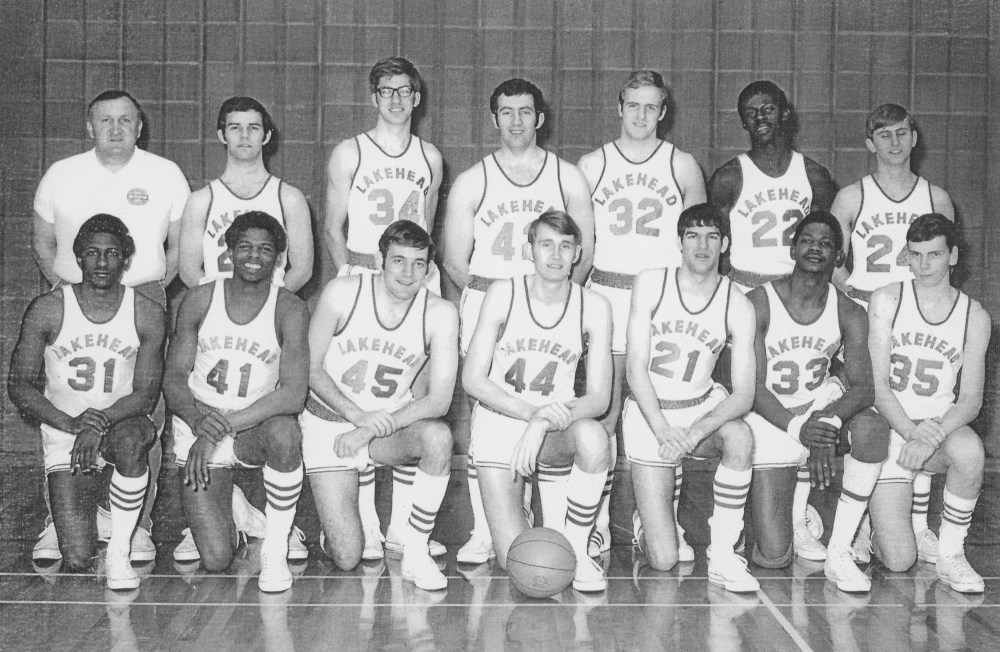
So he transferred to Surry Community College and dropped more than 29 points per game to finish second in conference scoring and earned a first-team all-state nod. He racked up a whopping 97 points in the three-game state tournament, including 47 in the bronze-medal contest.
“That was a good move for me. Now my skills were able to be used,” he said.
Once again, he picked up and moved on after that season, this time crossing the border to join the Lakehead University Thunderwolves in Thunder Bay, Ont. He was recruited by none other than George Birger, who eventually served as athletic director at BU during Hemmings’ rise to coaching success.
Hemmings liked the way Birger used him as Lakehead compiled a 23-2 record in National Association of Intercollegiate Athletics play predominatly against Minnesota and Wisconsin teams. But Birger was already set to go on sabbatical the following year, and coach Howard Lockhart, who was coming off a CIAU title at Waterloo Lutheran — now Wilfrid Laurier — took over. Coincidentally, Hemmings was thrust back into the high post. He handled it better this time.
“I tell people one of the toughest positions in basketball is being a high-post player because you’re playing 16, 17, 18 feet away with your back to the basket,” Hemmings said.
“It was a situation where this was his system of play and I was so much better in it than the position I was in my first year of junior college. I understood it because I had already been there … at that time being a fourth-year player, you’re a lot more mature and say ‘Hey, I got it down.’”
Having exhausted his eligibility in American competition, Hemmings looked to the CIAU to get a fifth year in. Future national team coach Ken Shields recruited him to play at Laurentian University in Sudbury, Ont. But he wanted to move with Lakehead teammate Joe Parks, who Laurentian deemed ineligible.
Birger put a word in with BU coach Gary Howard, and the duo departed for the Wheat City for the 1971-72 season. Joining the likes of Dave Bauman and Mike Vaira, they had a group with 11 Americans and no shortage of kids straight out of high school.
Despite Hemmings’ best efforts — he posted 24.6 ppg to sit second in Canada in scoring — the Bobcats posted a dismal 3-13 record. Hemmings left with an all-Canadian honourable mention to his name and one critical mental note in the back of his mind for future consideration.
“A lot of other teams like Manitoba and Winnipeg had more of a core of returning players,” Hemmings said. “From a coaching perspective, continuity is so critical … you win if you can get guys in their third, fourth and fifth year.”
He went back to Lakehead to finish up some courses and help with the basketball program, then took off for Voiron, France in the summer of 1973. Hemmings had a fantastic rookie year in the Championet des Alps, averaging 30.3 ppg in the town 25 kilometres northwest of Grenoble, earning the semi-pro league’s MVP award.

“That was great because that’s your first time being an import player, you’re getting paid money to play,” he said.
“You’re working out a lot on your own and some things don’t change over there and that is if you don’t produce, you’re not around for long.”
At the end of the season, he played one of the top clubs from Belgium, which featured American Artie White, who would find his way into Canadian basketball lore soon enough.
The University of Waterloo was destined for a national title when MVP Mike Moser was hospitalized in January 1975 and died suddenly from endocarditis. The Warriors brought in White — who had one year of eligibility left — to win a title dedicated to Moser. They did just that with a one-point win over Martin Riley and Manitoba, with White claiming tournament MVP honours.
Moser was honoured with the inaugural Mike Moser memorial award for player of the year, one three of Hemmings’ future stars captured in the decades to follow.
Before Hemmings went home he was told he’d be the first player the club would re-sign for the following season, claiming one of two import spots. That agreement was good for nothing.
Voiron brought in six-foot-nine Louisiana State University big man Charles Legler and informed Hemmings in a letter that he would not have a spot anymore.
“I didn’t understand the politics and came from a place where if you played well, there was a loyalty part,” Hemmings said.
But it meant Hemmings was in the job market as Howard left Brandon to take the men’s head coaching job at the University of Calgary. Lockhart and Birger urged Hemmings to consider the BU position.
“I’m 26 years old, where’s my heart at? Is my heart in coaching? No. My heart was ‘Hey, I’m a player and I’m going to play,’” Hemmings said.
“But then at that time not knowing if I’m going to get the job … but let’s go after it, and I did.”
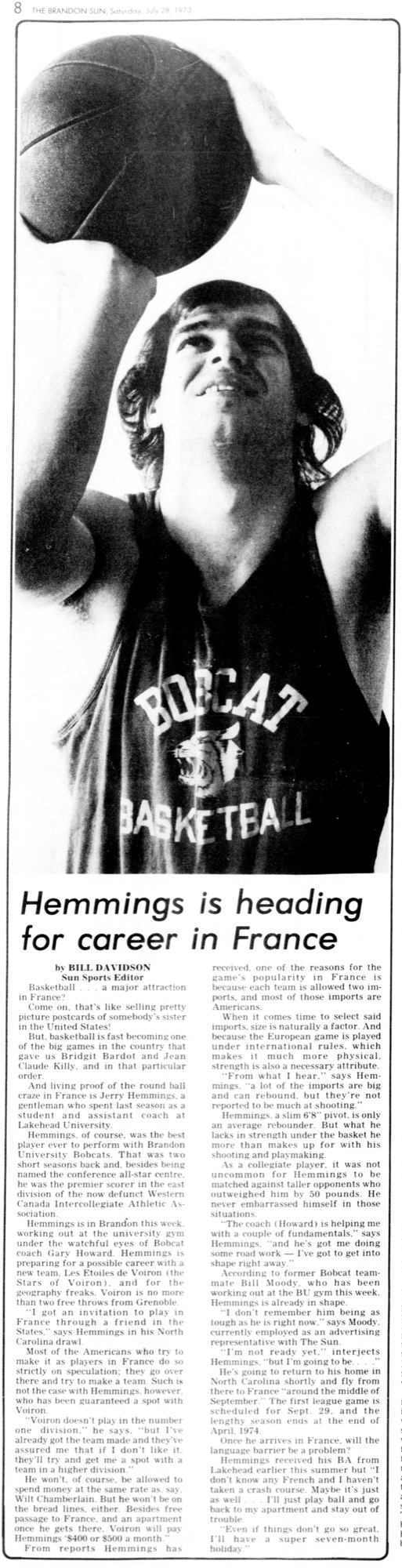
“… I always say one thing that helped me get the job was I had been here before but I had gone away. Sometimes it’s tough to get the job being here and staying here but maybe doing something else.
“I made decisions on what I thought was best for Jerry Hemmings but also had the opportunity to be exposed to five different coaches with unique and individual skill levels I learned from.”
The team wasn’t great by any means, and AD Doug Steeves didn’t exactly have high expectations of Hemmings at the outset, much to the chagrin of one of the most competitive individuals you’ll ever meet.
“(Steeves) in the first couple of weeks said ‘Jerry, I’m not putting any pressure on you to win, I just don’t want you to lose to Manitoba by more than 50 points,’” Hemmings recalled with a wry grin and one simple thought on his mind.
“He doesn’t know me.”
» tfriesen@brandonsun.com
» Twitter: @thomasmfriesen