
Vickery a true hoops lifer Brandon University alumni series: Through the decades
Read this article for free:
or
Already have an account? Log in here »
We need your support!
Local journalism needs your support!
As we navigate through unprecedented times, our journalists are working harder than ever to bring you the latest local updates to keep you safe and informed.
Now, more than ever, we need your support.
Starting at $15.99 plus taxes every four weeks you can access your Brandon Sun online and full access to all content as it appears on our website.
Subscribe Nowor call circulation directly at (204) 727-0527.
Your pledge helps to ensure we provide the news that matters most to your community!
To continue reading, please subscribe:
Add Brandon Sun access to your Free Press subscription for only an additional
$1 for the first 4 weeks*
- Enjoy unlimited reading on brandonsun.com
- Read the Brandon Sun E-Edition, our digital replica newspaper
*Your next Free Press subscription payment will increase by $1.00 and you will be charged $20.95 plus GST for four weeks. After four weeks, your payment will increase to $24.95 plus GST every four weeks.
Read unlimited articles for free today:
or
Already have an account? Log in here »
Hey there, time traveller!
This article was published 10/12/2020 (2002 days ago), so information in it may no longer be current.
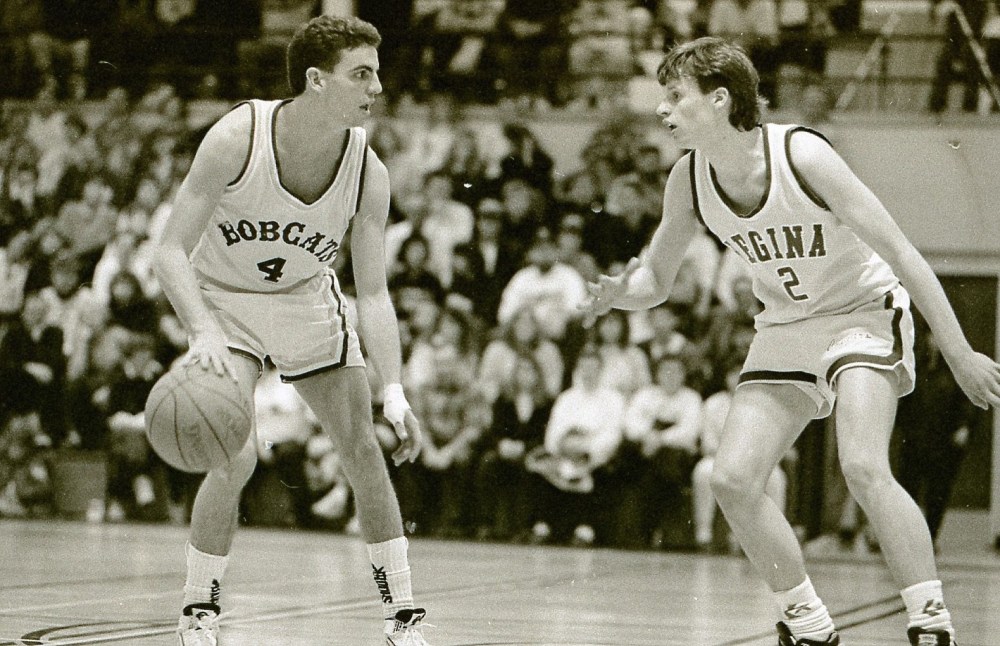
One three-pointer stands out above the thousands Joey Vickery knocked down throughout his ultra-marathon basketball career.
It was 1994, Team Canada’s opening game at the Berlin Cup — an eight-team tournament featuring a handful of high-ranked national teams — when NBA all-star Rick Fox deferred to the five-foot-nine former Brandon University Bobcat from Winnipeg to provide an offensive spark.
“He just flew in for that tournament. Right off the bat I hit one, two threes and he set a screen for me and I nailed another one. He goes ‘I’m screening for you from now on,’” Vickery recalled via Facebook messenger call from Austria.
“That’s kinda neat when you got a guy who’s a big-time player in the NBA at that time … and he’s like, ‘I’m screening for you,’ because I was hitting some shots from pretty deep.”
Vickery famously went 17-for-20 from beyond the arc that tournament, claiming MVP honours.
Vickery made his way back to Europe the following year and carved out a professional career that lasted nearly until his 50th birthday in 2017. From start to finish, the sharpshooting guard says he stayed in the moment and took it one step at a time.
Winding the clock back a few years, it’s crazy to think Vickery was hardly recruited out of Westwood Collegiate.
“It’s funny how people have paths now and they can see it. I never had any path. I just played, played, played anything when I was younger, any sport,” Vickery said.
“I didn’t even imagine going to university before and eventually I got there. I went one step up the ladder each time, something opened up and eventually I got to play on it.”
Vickery grew up with five brothers, playing any and every sport they could. He streamlined into volleyball and basketball around age 13 and grinded his way onto the provincial basketball team for the 1985 Canada Games after Grade 12. Playing with second-year university athletes, he came off the bench and received an all-star nod in Saint John, N.B.
“Even though I got an all-star and got MVP of Manitoba Basketball, I didn’t get recruited,” Vickery said.
The standout volleyball left side did get a look from the University of Winnipeg as a setter, but wasn’t even five-foot-seven until growing a few inches a month before university.
“I could jump, that was the thing that made me tall,” Vickery said. “I kept adapting to any level.”
He had an all-Westwood starting lineup for a bit with the Wesmen, and was named an all-Canadian his second year but struggled academically and missed the 1987-88 season. During that year, former Wesmen coach Bruce Enns, who moved to UBC in 1985, recruited him out to Vancouver. He’d have to spend a year at Douglas College to improve his grades, however, and he wanted to play at the highest level he could.
Bobcats coach Jerry Hemmings knew what Vickery could bring to a team and made a pitch.
“Hemmings always had me on the radar, he got in contact with me and we kept in contact,” Vickery said. “He kept in touch with me the whole time even though everything was set. It just made sense the first day of school in September. I was like ‘I don’t want to waste a year in community college.’ That’s when I told the coach there I wasn’t going to stay.”
The fit couldn’t have been much better in Brandon. Former Bobcat and five-time first-team all-Canadian John Carson helped Vickery settle in and told him about the city. As for the two-time defending national champs, he conveniently joined when point guard Courtney Bailey was on the way out.
That put him in a starting lineup featuring player of the year Patrick Jebbison, all-Canadian centre Whitney Dabney, CIAU tournament MVP David Dominique and a tenacious perimeter defender in Marvin Russell.
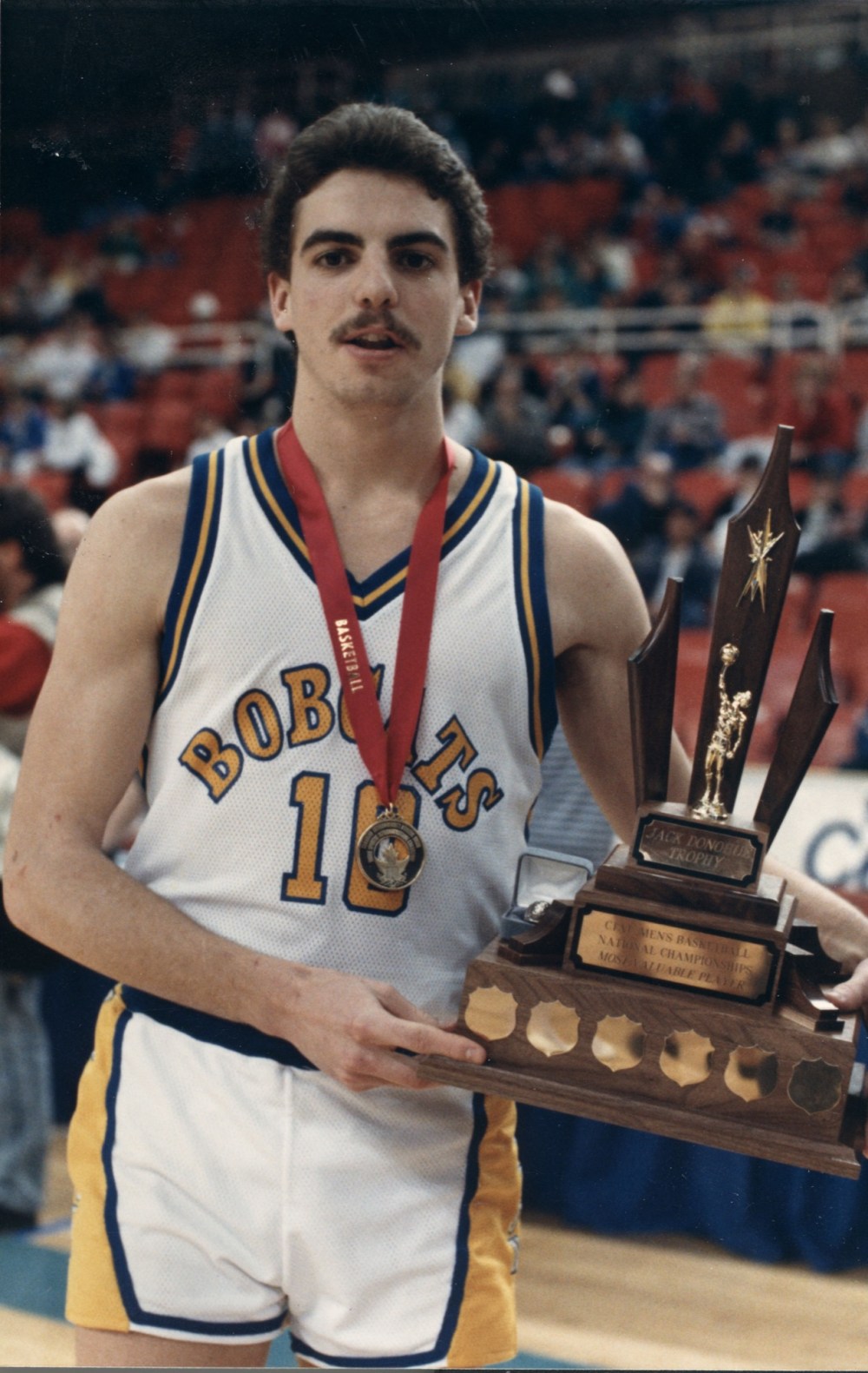
Of course, that group completed Brandon’s three-peat. But the moment of glory doesn’t stand out for Vickery quite like the countless hours of practice behind the scenes.
“We battled. It was just a great mix of everybody. You got your stars but you’re only as good as your teammates and your practices,” Vickery said. “Jerry makes these practices so competitive. We had the guys on the bench always want to prove themselves, we always want to prove them wrong, and it made everybody better.
“I was an all-Canadian already, Jebbison’s an MVP, Dabney’s one of the best centres in the country, David Dominique, there’s nobody else like him that’s six-seven and can play the point. Marvin Russell just gets things done.”
BU won the Great Plains Athletic Conference, and rode an 18-point second half by Vickery to beat the University of Toronto in the national semifinal. That set the stage for a final against coach Ken Shields and Victoria, which won the seven national titles before Brandon’s first.
“Basically the only time I’ve ever been cut was by Ken Shields, twice,” Vickery recalled.
Brandon led 50-36 early in the second half before Victoria clawed back and had it to 74-72 with less than a minute to play. The final 54 seconds could not have gone slower, taking about 11 minutes in real time as Hemmings and Shields exhausted all their timeouts. Shockingly, the final four seconds played out over a span of six minutes. But Hemmings using timeouts to ice free throw shooter Kevin Ottwell on both his attempts proved vital as he missed the second and Brandon held on for a 74-73 win.
“You work so hard and when the final buzzer goes and you got that win, that’s just forever. You don’t forget it. All the guys, we still talk about it when we get together,” Vickery said.
“It’s not everything, it doesn’t totally define you because we did everything right to get there and sometimes people don’t get it … I feel for some people who don’t get it because they did all the right things but as long as you do that, you know you’re successful.”
Hemmings took a sabbatical the following year, and Vickery went on to become Brandon’s third two-time first-team all-Canadian with back-to-back nods in 1990 and 1991. He stuck around to help Hemmings coach the team for a year and that’s when he really figured out how his teams were so successful.
“I get some of the things coaches do because I’m a good extension of a coach on the court,” Vickery said. “It’s just amazing how much time he puts in thinking of the Xs and Os and how the ball is moved within the shot clock, where a player is getting the ball within their strengths. He controls a lot of that and you don’t even realize it.
“He doesn’t have an offence and go ‘the players gotta do this.’ He finds it where it fits the strength of the players and that’s what really sets him apart.”
After that, Hemmings helped Vickery land a spot with a group of national team hopefuls centralizing in British Columbia to train with Shields, who put a group of Maple Leaf hopefuls through the ringer for the better part of a year. He told them one, maybe two of them could make the roster. They shattered that ceiling.
“As it turned out when tryouts came the next summer 10 months later, you could hand pick the guys that were in the centralization because our conditioning was so much better than everybody else. Three or four of us cracked the team, which is amazing,” Vickery said.
“That centralization with Team Canada put my level of basketball higher than I thought I’d ever achieve. It gets your body very solid so you’re able to sustain that level a long time. If you look at the other guys that were with that centralization, they had a long career and also I think almost injury-free.”
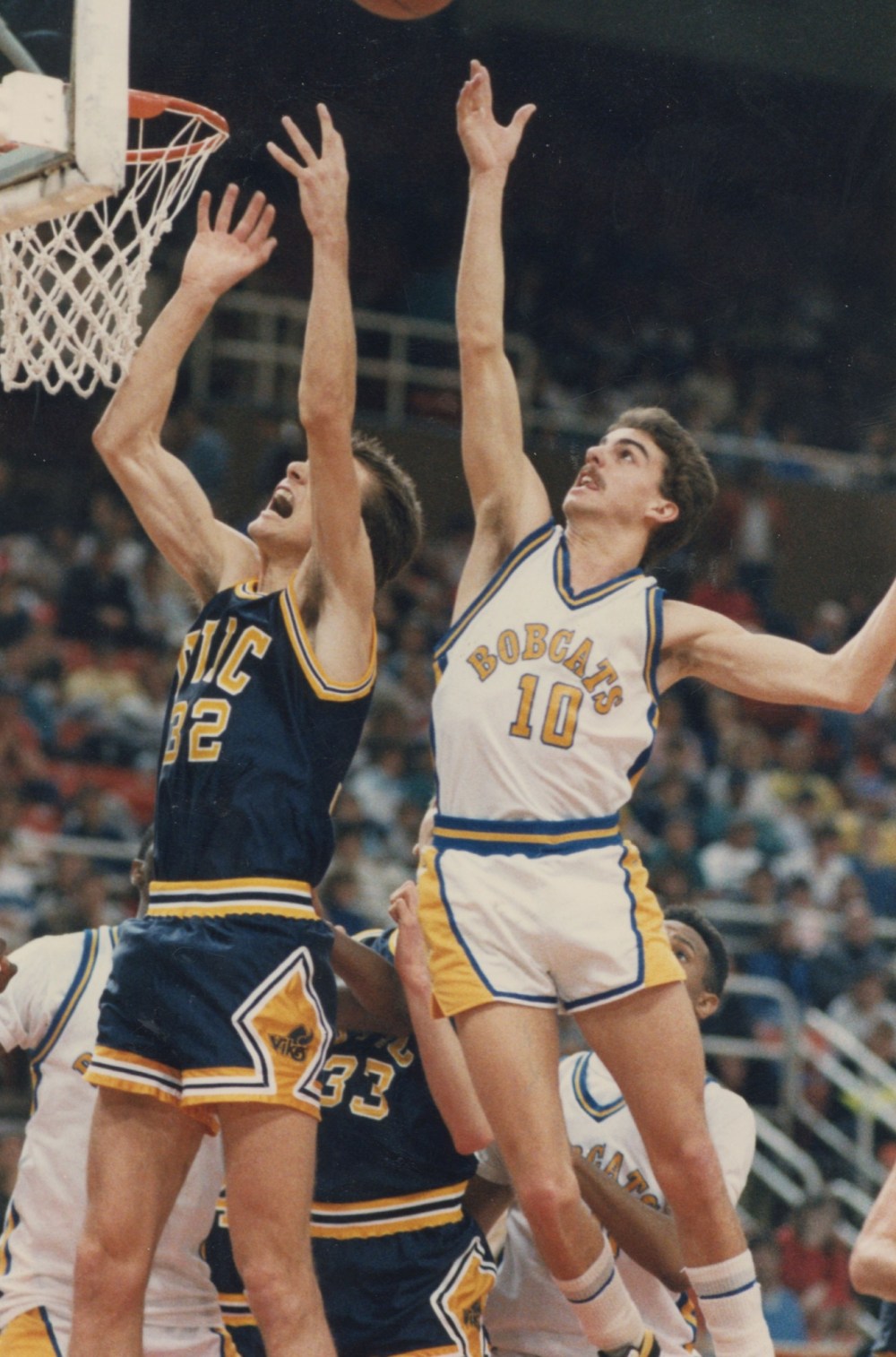
In 1995, Vickery was off to Europe for, longevity-wise, one of the most impressive European professional careers. It started with a terrific first pro season in Lithuania as a runner-up for league MVP. Then he wasn’t offered a new contract with the club and had to look elsewhere.
He landed with Ciudad de Huelva in Spain, this time being named MVP. Same story.
“Every year was, you don’t know. One year I win the second-league championship in Spain, MVP, average a lot of points in the playoffs and no job the next year,” Vickery said.
“I can’t say anything good about agents, or not too much good about agents. My friends were the ones that got me jobs.
“… I ended up just getting a decent reputation in a couple of countries and was able to keep playing, but you never know when it’s your last year. If I knew it was going to be like this I would have treated it probably different.”
Thankfully the next job he landed in Paris led to a two-year extension. Then in 2000, his friend Eric Butler was headed to Algeciras, back in Spain. The duo played there together, and Butler followed him to Mattersburg, Austria the following season. Interestingly, Enns, the coach who tried to recruit him to UBC was running that club.
“I wasn’t excited because it’s not a basketball country, so it could hurt me a little bit, but I thought it would be more fun playing for a coach that knows me and with a friend,” Vickery said.
The move proved to be a significant one for a number of reasons. Primarily, Vickery met his wife Julia there.
He ended up playing a few more seasons in Spain and one in Sweden before heading back to Mattersburg, where he still lives today. At age 41, he finally decided he was done with first-division ball. His transition out of it was becoming a player-coach in the second division, plus joining a men’s league hockey and starting his teaching career.
“I figured it was time to make a move into the real world, if you will,” Vickery said. “… I didn’t want to do the two-a-day practices anymore. I wanted to be able to walk away from the game and didn’t want it to damage my body.”
Then Vickery had his “(Michael) Jordan-esque moment.”
“I was like, yeah, I’m going to play baseball. Never played baseball. I played when I was a little kid, got hit by pitches and quit,” said Vickery, who started coaching a kids program and playing shortstop/third base for a men’s team.
“In Canada every kid plays soccer, baseball and hockey before 10. I felt like I wanted to do that (for them) with baseball.
“I’m by far the oldest in the league.”
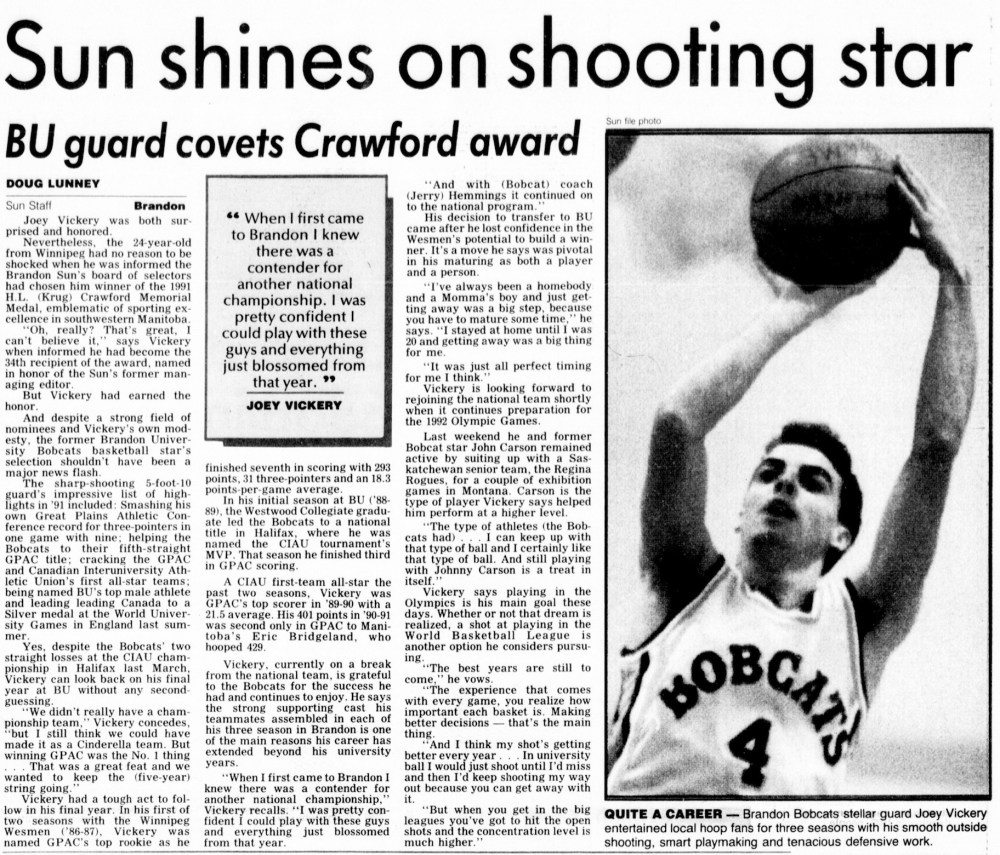
Now 53, Vickery has a 14-year-old daughter, Samantha, and is a little over a decade into his teaching career. While it was a much later start than most, he said he felt more than prepared to step into the English and physical education classes because of all his past experiences, from BU classrooms to hundreds of hardcourts.
“With all the coaches and mentors, my family, the education I had at BU and other courses I had, it was not a problem to get into teaching,” Vickery said.
“I say these three things to the kids all the time: Listen with your eyes and ears, give your best and think of others. If you do that, I think you can have a lot of fun in sports and a lot of fun in life.”
Vickery credits the move to Brandon with setting up much of his future. It led to coach Hemmings helping him land with Team Canada at the 1989 and 1991 World University Games, playing alongside some of the game’s greats and leading to one fantastic basketball adventure.
Looking back, he chuckles at his final game as a Bobcat in 1991. Following that loss at nationals, he sat in the locker room in tears, thinking “This is my last time playing basketball.”
Boy was he wrong, and glad to be wrong.
“I love the game, I love everything about it,” Vickery said. “I truly do love all my teammates and opponents and it’s just a nice way to live, playing a game I love until I’m 50.
“That’s pretty lucky.”
» tfriesen@brandonsun.com
» Twitter: @thomasmfriesen