
Moderna vaccine headed to First Nations, personal care homes
Advertisement
Read this article for free:
or
Already have an account? Log in here »
We need your support!
Local journalism needs your support!
As we navigate through unprecedented times, our journalists are working harder than ever to bring you the latest local updates to keep you safe and informed.
Now, more than ever, we need your support.
Starting at $15.99 plus taxes every four weeks you can access your Brandon Sun online and full access to all content as it appears on our website.
Subscribe Nowor call circulation directly at (204) 727-0527.
Your pledge helps to ensure we provide the news that matters most to your community!
To continue reading, please subscribe:
Add Brandon Sun access to your Free Press subscription for only an additional
$1 for the first 4 weeks*
- Enjoy unlimited reading on brandonsun.com
- Read the Brandon Sun E-Edition, our digital replica newspaper
*Your next Free Press subscription payment will increase by $1.00 and you will be charged $20.95 plus GST for four weeks. After four weeks, your payment will increase to $24.95 plus GST every four weeks.
Read unlimited articles for free today:
or
Already have an account? Log in here »
Hey there, time traveller!
This article was published 02/01/2021 (2081 days ago), so information in it may no longer be current.
The Moderna vaccine — which requires less stringent measures to keep it viable as compared to the Pfizer vaccine — is arriving in Manitoba and 5,300 of 7,300 doses are destined for First Nations people.
According to a provincial news release, Manitoba’s vaccine supply is based on a federal per capita allocation. Two hundred twenty-eight thousand of the Pfizer and Moderna vaccines are destined for Manitoba by March 31.
The province did secure 9,600 additional doses of the Moderna vaccine in the first quarter of 2021 for Manitoba’s Indigenous population.
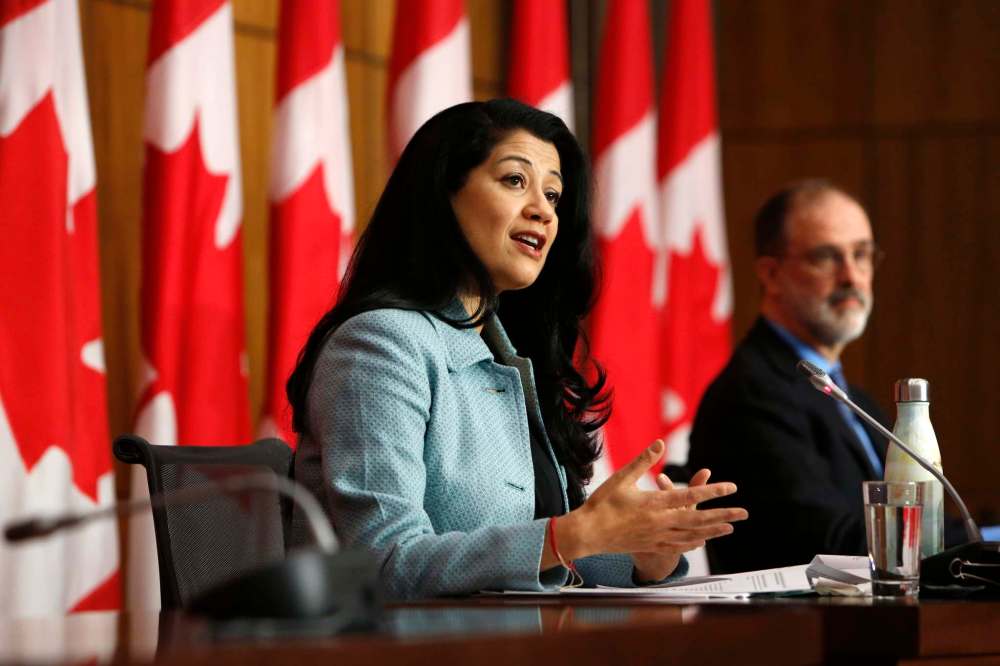
During the final technical briefing of 2020 for members of the press Thursday, Dr. Jazz Atwal, the province’s acting deputy chief provincial public health officer, confirmed that news Thursday. Deployment is a team effort.
“And what that looks like will be decided by First Nations experts,” Atwal said.
As many experts have noted, including Dr. Joss Reimer, the Moderna vaccine is better suited for delivery to northern and remote communities as compared to the Pfizer offering, which currently has more stringent storage and transportation requirements.
Reimer is the medical officer of health for Manitoba Health, Seniors and Active Living, and a member of Manitoba’s COVID-19 Vaccine Implementation Task Force.
The province deployed its first vaccine doses in Winnipeg in mid-December. Those were from Pfizer, which produces the first vaccine approved by Health Canada.
The First Nations team making vaccine decisions for First Nation members in the province stem from the Manitoba First Nations Pandemic Response Co-ordination Team and the Keewatinohk Inniniw Minoayawin (KIM) Inc., and include Dr. Marcia Anderson, Dr. Barry Lavallee, Melanie MacKinnon and Cindy Garson — all appointed health leads of their various First Nations’ governments and organizations.
“We were all waiting… to see this, this moment where we can see some hope in terms of trying to change the narrative as it relates to COVID-19,” said Jerry Daniels, grand chief of the Southern Chiefs’ Organization, according to The Winnipeg Free Press.
“We’re happy that our communities are going to be able to be quite a bit more protected now.”
Several “super-centre sites” or “super immunization centres,” as Atwal called them, are slated to open in January — including one at the RBC Convention Centre Winnipeg this coming week. That’s where the Pfizer vaccine will be deployed “in general,” Atwal said.
A second site is expected at Brandon’s Keystone Centre mid-month, and a third in Thompson.
Atwal said, in conjunction with these central hubs, vaccinations would take place at personal care homes.
As the COVID-19 vaccination programs roll out in Manitoba and across the world, he message remains that supplies will be limited at first. Vulnerable populations and healthcare workers are the immediate concern.
“The successful collaboration between the province and First Nations health experts and representatives will ensure equitable access to vaccination treatments for all Manitobans,” Reimer stated.
“Our shared priority is to distribute vaccine doses, beginning with the Moderna vaccine, to protect vulnerable First Nations populations in northern and remote regions of the province.”
Officials from the Canadian Armed Forces, the Public Health Agency of Canada, Indigenous Services Canada and the chief medical officer of public health for Indigenous Services Canada also took part in discussing deployment of the vaccine in northern and remote First Nation communities.
The province, according to a news release, committed to arranging for planes to be available to ship the vaccine to priority locations.
“We are pleased at the partnership and spirit of collaboration that has developed and will continue as the delicate decisions around the deployment of this vaccine are made,” stated Lavallee, appointed health lead for MKO and chief executive officer for Keewatinohk Inniniw Minoayawin.
“It is important that Indigenous voices are heard. As Indigenous health experts, we are at this table in support of First Nations people. We are needed at the table. This is very historic work. If the dialogue aids in creating a sense of partnership between First Nations and the provincial government as this process moves forward, that too will benefit everyone.”
According to statistics from the Manitoba First Nations Pandemic Response Co-ordination Team, First Nation people, both on and off reserve, account for 40 per cent of new cases, 49 per cent recovered cases and 24 per cent of total cases.
First Nations also account for 32 per cent of current hospitalizations, 42 per cent of patients in intensive care units and 14 per cent of deaths.
As Daniels has previously stated, centuries of colonization has meant generations of First Nations people have been dealing with an infrastructure backlog — including in housing and health.
“Add to that the challenges of a global pandemic and you have a recipe for disaster,” he said.
Garson stated the federal and provincial partnership with First Nations is important, “because we will be looking more broadly at all First Nations populations across this province as more vaccines become available.”
Overall, the vaccination plan in Manitoba is focused on safe and convenient access to immunization for health-care providers, prioritization of First Nations elder care facilities, along with personal care homes throughout the province and vulnerable First Nation populations.
» mletourneau@brandonsun.com
» Michele LeTourneau covers Indigenous matters for The Brandon Sun under the Local Journalism Initiative, a federally funded program that supports the creation of original civic journalism.