
Chartrand insulted by Pallister’s approach with Métis
Advertisement
Read this article for free:
or
Already have an account? Log in here »
We need your support!
Local journalism needs your support!
As we navigate through unprecedented times, our journalists are working harder than ever to bring you the latest local updates to keep you safe and informed.
Now, more than ever, we need your support.
Starting at $15.99 plus taxes every four weeks you can access your Brandon Sun online and full access to all content as it appears on our website.
Subscribe Nowor call circulation directly at (204) 727-0527.
Your pledge helps to ensure we provide the news that matters most to your community!
To continue reading, please subscribe:
Add Brandon Sun access to your Free Press subscription for only an additional
$1 for the first 4 weeks*
- Enjoy unlimited reading on brandonsun.com
- Read the Brandon Sun E-Edition, our digital replica newspaper
*Your next Free Press subscription payment will increase by $1.00 and you will be charged $20.95 plus GST for four weeks. After four weeks, your payment will increase to $24.95 plus GST every four weeks.
Read unlimited articles for free today:
or
Already have an account? Log in here »
Hey there, time traveller!
This article was published 15/01/2021 (1937 days ago), so information in it may no longer be current.
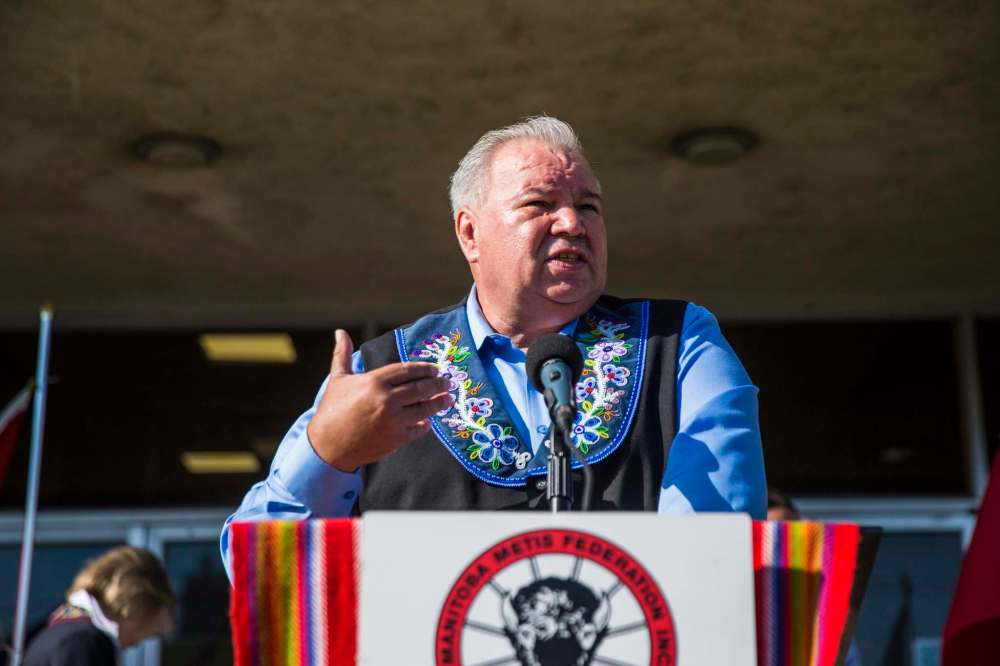
Calling Métis an “interest group,” as Premier Brian Pallister did Wednesday after touring the Brandon vaccination site, does not sit well with Manitoba Metis Federation David Chartrand.
“It’s insulting,” said Chartrand.
When The Brandon Sun asked Pallister to explain the lack of a COVID-19 data sharing agreement with the federation, including the lack of a partnership to ensure Métis are prioritized for vaccines as First Nations have been, he was quick to bristle.
But instead of answering the question, the premier spoke about Indigenous people generally, First Nations and reconciliation.
“Well, Métis representatives have been at the table and have been part of this. But, of course, Métis people live integrated, for the most part, with the rest of us in the province, as opposed to a lot of the Northern Indigenous communities that do not. And, so, the considerations are not identical, as you would recognize,” he said, when pressed.
When pressed again, he said, “There are significant efforts being made to work with our interest groups in our province, in particular with the Indigenous and Métis people to make sure that we’re doing what’s culturally appropriate, what works well for their population, what’s acceptable, agreeable, sensitive to their needs. That work is ongoing.”
But Chartrand objects to Pallister’s statements. He said the only committee the federation – a self-governing political representative for Manitoba Métis – has been asked to sit on is about how best to communicate about vaccines, which has nothing to do with the roll-out.
To begin with, Chartrand explained, in some villages, the clear majority will be First Nation and Métis, with very few non-Indigenous people living in them.
Chartrand offers Camperville, on the western shore of Lake Winnipegosis, St. Laurent, established as Fond du Lac in 1824 by Métis, and St. Eustache as examples of predominantly Métis villages.
“Those are Métis villages. The vast majority (of people) are Métis. These are historical Métis villages which existed even before Canada existed, before the Province of Manitoba,” Chartrand said.
“Excuse me, but I can tell you where every Métis person lives. I can tell you their chronic illnesses. I can tell you their education level. I can tell you what universities they’re going to. I can tell you what colleges they’re going to.”
Further, Chartrand said Pallister has a responsibility to establish a distinct process with Métis, and that he’s making excuses not to engage with Métis as a rights-holding Indigenous population.
NDP leader Wab Kinew weighed in, after Pallister’s appearance in Brandon.
“Unfortunately, Mr. Pallister has politicized his relationship with the Métis people in Manitoba. And I think, in this instance, it’s getting in the way of public health,” he said.
He said due to the strong work of First Nations health leaders, the benefits of data sharing and strategizing can be seen, and that the Métis community being able to participate in the same kind of arrangement would probably benefit all Manitobans.
“If there is one group in society that – whether it’s a cultural group, a geographic region, a socio-economic group – that gets left behind, and that becomes the opening by which the virus can spread, then that affects all of us,” Kinew said.
“Then we all have to live with the virus or the public health restrictions that are attempting to combat it.”
He thinks the Métis are raising an important issue and Pallister would do well to dramatically improve his working relationship with them.
Jerry Daniels, the Grand Chief of the Southern Chiefs’ Organization (SCO), concurs.
“SCO supports our Métis relatives in their efforts to have allotments of COVID-19 vaccines that they can distribute to their own people,” stated Daniels by email.
“COVID-19 has impacted the Métis population in Manitoba and there needs to be accountability for this. There also needs to be a facts-based approach to vaccine distribution, to ensure they receive a fair amount of vaccines and can keep their most vulnerable people safe. So far, the province has been unwilling to collaborate with the Metis Nation.”
Meanwhile, in a follow-up email from a Pallister spokesperson, Chartrand’s previous statements on this matter were denigrated.
“Contrary to the inaccurate and inflammatory comments made by the president of the Manitoba Metis Federation, the Government of Manitoba appreciates the willingness of the MMF to assist in Manitoba’s COVID-19 response,” stated the spokesperson later Wednesday afternoon.
“We have invited them to work with us, in partnership, to discuss how Métis communities can be supported to enhance their ability to access Manitoba’s three COVID-19 vaccination super sites. We have yet to receive a response to this invitation, but remain optimistic about the prospect of working together on this pivotal aspect of the vaccination strategy.”
But that’s not what Chartrand wants. He wants an allocation of vaccine, and he would partner with pharmacies to deliver them to vulnerable Métis, likely much the same way the science has dictated priority groups so far.
“We’d pay them (pharmacies) to give the vaccines. We’d put up the resources to make sure it’s there. We know where our people live, we know their ages, we know their locations, we know the communities. We can quickly put an action team together and a plan – overnight,” Chartrand said.
When asked about a possible “plan B” if the Province of Manitoba continues to exclude the federation from meaningful participation in the COVID-19 vaccine roll-out in the province, to ensure the most vulnerable Métis are adequately protected, Indigenous Services Canada (ISC) stated the federal government places great importance on including Indigenous voices in the priority-setting for early vaccination.
“ISC is working collaboratively with all provinces and territories to encourage inclusion of Indigenous perspectives to ensure an integrated and coordinated approach to support the administration and planning process of the COVID-19 vaccine for Indigenous peoples,” stated a spokesperson by email.
“The logistics of a COVID-19 vaccine roll-out require coordination amongst partners and provinces and territories; an efficient and effective roll-out requires co-planning and is dependent on full collaboration.”
» mletourneau@brandonsun.com
» Michele LeTourneau covers Indigenous matters for The Brandon Sun under the Local Journalism Initiative, a federally funded program that supports the creation of original civic journalism.