
Habitat for endangered spiny softshell turtle protected southeast of Montreal
Advertisement
Read this article for free:
or
Already have an account? Log in here »
We need your support!
Local journalism needs your support!
As we navigate through unprecedented times, our journalists are working harder than ever to bring you the latest local updates to keep you safe and informed.
Now, more than ever, we need your support.
Starting at $15.99 plus taxes every four weeks you can access your Brandon Sun online and full access to all content as it appears on our website.
Subscribe Nowor call circulation directly at (204) 727-0527.
Your pledge helps to ensure we provide the news that matters most to your community!
To continue reading, please subscribe:
Add Brandon Sun access to your Free Press subscription for only an additional
$1 for the first 4 weeks*
*Your next subscription payment will increase by $1.00 and you will be charged $20.00 plus GST for four weeks. After four weeks, your payment will increase to $24.00 plus GST every four weeks.
Read unlimited articles for free today:
or
Already have an account? Log in here »
Hey there, time traveller!
This article was published 13/05/2021 (1695 days ago), so information in it may no longer be current.
MONTREAL – The Nature Conservancy of Canada said Thursday it acquired two hectares of land southeast of Montreal to protect the habitat of the endangered spiny softshell turtle.
The conservation group said the properties along the water in Pike River, Que., about 70 kilometres southeast of Montreal, are close to one of the few known spiny softshell turtle egg-laying sites.
About 100 turtles were released into the water of the Rivière aux Brochets in Pike River on Thursday, joining more than 1,600 other turtles that have been reintroduced in the area since 2010.
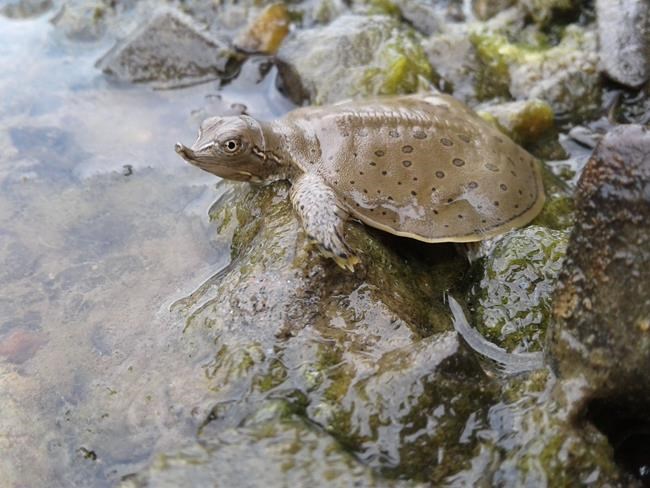
Conservancy vice-president Joel Bonin said the newly protected land is critical for the future of the species that has been classified as endangered by the federal government in 2005.
Quebec Environment Minister Benoit Charette said on Thursday the provincial government gave the nature conservancy $40.1 million to help protect natural environments, and that part of that money went to purchase the two hectares of land.
“We are seeing another beautiful initiative that derives not only from the Quebec government through the projects … but also from the natural areas conservation program by the Canadian government,” Charette said.
Lyne Bessette, federal Liberal member for the region, said the Canadian government wants to protect a quarter of Canada’s land and oceans by 2025. “It’s important to take actions as fast as possible, for today and future generations,” Bessette said.
One of the previous owners of the newly protected land in Pike River is David Gasser, whose family owned two dairy farms in the community. “We need to take care of the environment if we want it to take care of us,” Gasser said.
Conservancy project coordinator Valérie René said a protected natural area offers a quieter place for turtles to grow safely.
She said that the spiny softshell turtles are slow to adapt, making it harder for them to survive in highly urbanized environments. It can take more than 12 years before a turtle’s reproduction process begins, René said.
“This gives them a protected oasis where they can continue to survive, eat and live their turtle life,” she said.
This report by The Canadian Press was first published on May 13, 2021.