
Timmons compiles running adventures into book
Advertisement
Read this article for free:
or
Already have an account? Log in here »
We need your support!
Local journalism needs your support!
As we navigate through unprecedented times, our journalists are working harder than ever to bring you the latest local updates to keep you safe and informed.
Now, more than ever, we need your support.
Starting at $15.99 plus taxes every four weeks you can access your Brandon Sun online and full access to all content as it appears on our website.
Subscribe Nowor call circulation directly at (204) 727-0527.
Your pledge helps to ensure we provide the news that matters most to your community!
To continue reading, please subscribe:
Add Brandon Sun access to your Free Press subscription for only an additional
$1 for the first 4 weeks*
*Your next subscription payment will increase by $1.00 and you will be charged $20.00 plus GST for four weeks. After four weeks, your payment will increase to $24.00 plus GST every four weeks.
Read unlimited articles for free today:
or
Already have an account? Log in here »
Hey there, time traveller!
This article was published 07/06/2021 (1746 days ago), so information in it may no longer be current.
Mark Timmons doesn’t pretend to be the most gifted ultra runner in the world, and that’s why he thinks his adventures, including a life-threatening experience on Mount Everest, might strike a chord with readers.
The retired teacher has chronicled his experiences around the world into his new book Man On The Run, which was released today and is available at Brandon’s A&L Cycle and Dauphin’s Prairie Cycle Works for $20.
“The emphasis of my whole book is about being ordinary and pursuing extraordinary things,” said Timmons, who is 61. “You don’t have to be special to experience special things and most of the people I know are not extraordinary. They just do it because they’ve chosen to, and it’s one of those sports that if you do make a commitment to doing it, you’ll get as much out of it being an average runner that they can as an exceptional runner.”
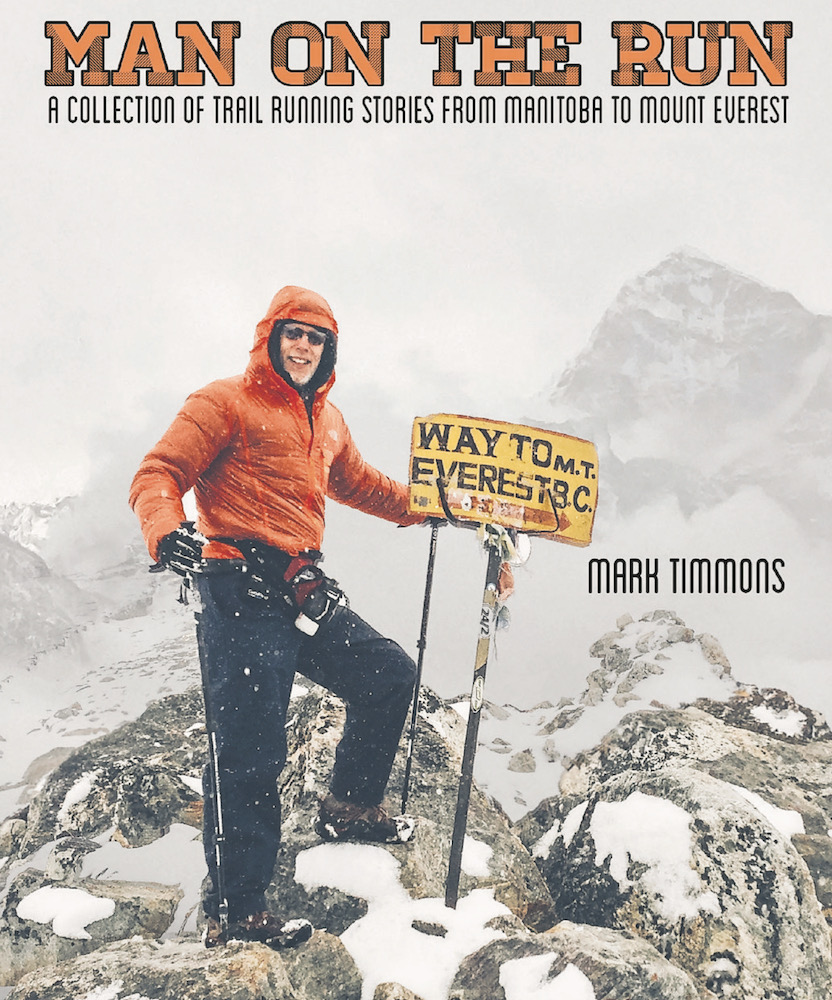
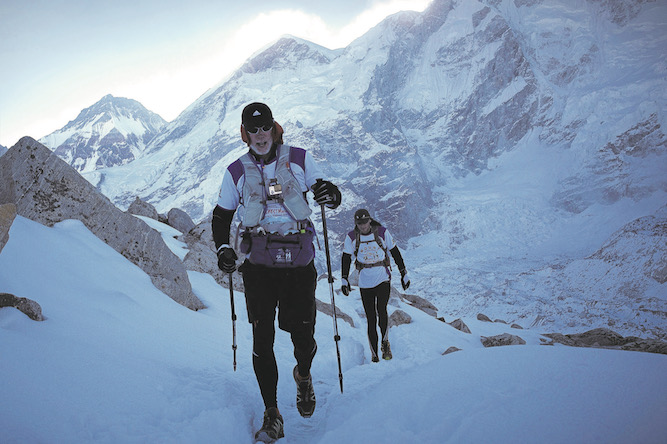
The genesis of the book began in 2014 when he went to Nepal to Mount Everest’s base camp after he had first started into trail running. He began compiling his memories from the adventure when he returned.
He wrote it in short-story form with the idea that an adventure magazine might be interested in publishing it. When that didn’t happen, he set it aside and continued to compile new adventures at his races in Canada, the United States, Iceland and Norway.
After each race, he wrote another short story and ended up with a compilation over the next several years. When COVID hit, he had plenty of time to dedicate to the project and discovered the stories were linked in a way that made a book possible.
It’s not easy to tempt a publisher so doing it yourself is the easier route. But that involves a financial outlay— “If anyone is going to try to write their own book, come and see me and I’ll guide you in a different direction” — and also a lot of time. But Timmons, who is donating the proceeds to the Westman Trail Associations, thought there might be a market for the book, and approached Cam Wirch at A&L to see if he would promote it and sell it at the store.
Wirch did a lot better than that.
“Cam was extremely supportive and said ‘I’ll cover printing costs for this thing if you print it locally,’ which speaks to Cam’s community nature,” Timmons said. “He said ‘Don’t go external for this, go to Leech Printing locally, have them print it and I’ll cover the costs and we’ll market it from my end.’ This wouldn’t have happened without him. I probably would have found a way to throw it out on Amazon or Apple Books or something like that.”
Timmons hopes the book provides readers with some enjoyment, even if it’s not the usual over-the-top experiences you read about in adventure books.
“They are stories from a fairly ordinary guy who have a bit of an extraordinary edge to them,” Timmons said. “I’m hoping people will find interest in that.”
The Minnedosa product grew up playing hockey, tending the net for the Saskatchewan Junior Hockey League’s Estevan Bruins when he was 17. He was good enough that the Saskatoon Blades called him up at the end of the 1977-78 season for a Western Canadian Hockey League game against the mighty Brandon Wheat Kings. Timmons played 23 minutes and emerged with a 10.43 goals-against average.
He was yanked in the second period and soon on the bus home. He took that as a sign and left the game.
Family and career soon took over, and as the decades passed, Timmons looked for something new that he could potentially be good at.
When he was about 50, he discovered that running suited him. Soon he got into training mode, and things went well enough that he posted a highly sought-after qualifying time to enter the prestigious Boston Marathon.
“At that point I thought I had kind of done it,” Timmons said. “I had accomplished something, and by my standards, I was really good at something.”
He entered marathons for a few years until he started running in the Brandon Hills and discovered the joy of trails rather than concrete. He would head out everywhere to run and found he enjoyed it more than he ever had before, in part because running on dirt was easier on his legs and eliminated injuries.
That’s when he first began to hear about ultras, which are running races longer than the traditional 42.2-km marathon distance.
He was able to move away from the structured routine of marathoners and was quickly hooked.
“I couldn’t get enough,” Timmons said. “Races couldn’t be long enough or extreme enough and I kept finding different things and different places and different challenges and that’s where I’m still at.”
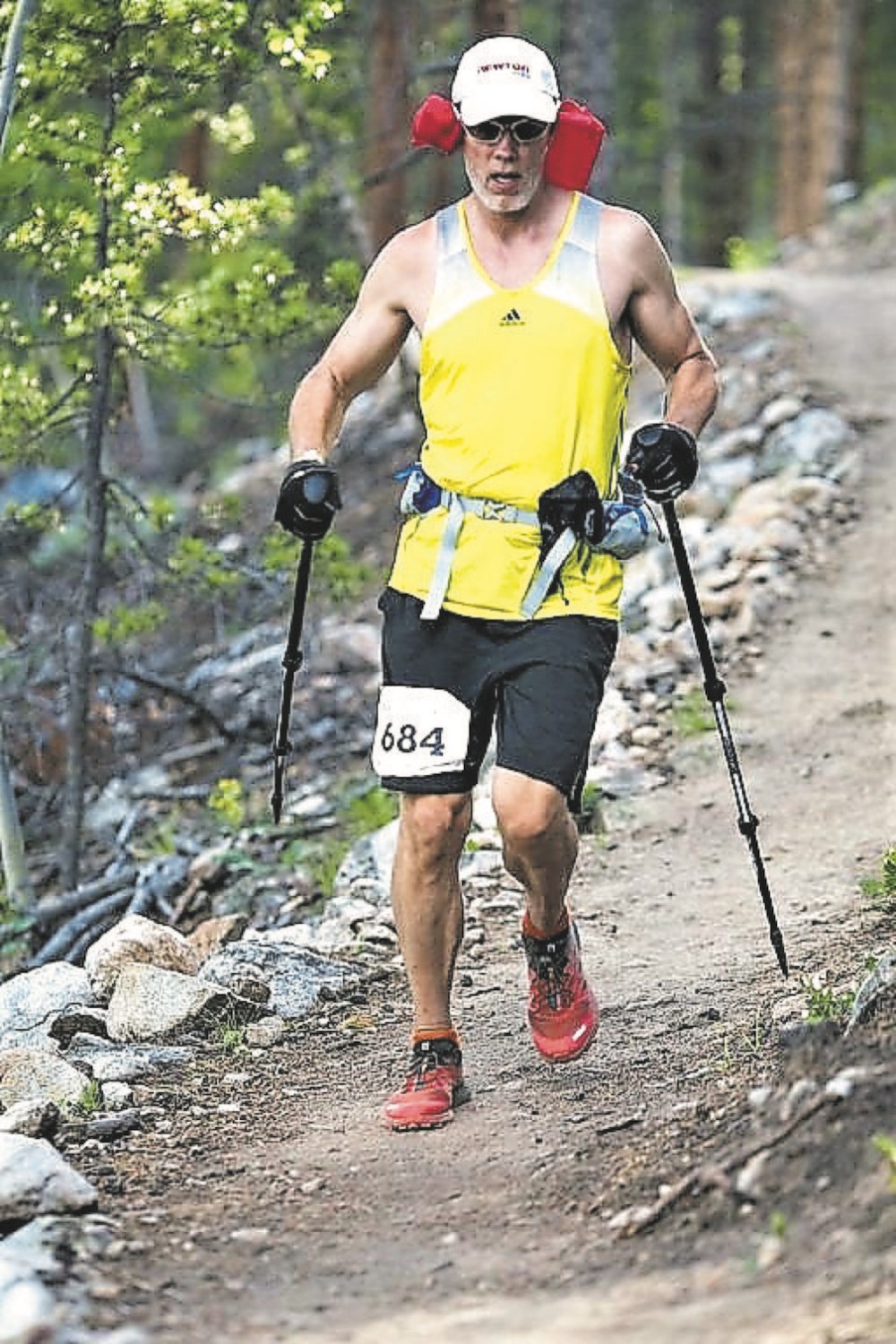
His goal became to complete a 100-mile race, setting a goal of competing in the Leadville Trail 100, one of the biggest and best known ultra marathons since it started in 1983. He got there within a couple of years but discovered the 24 to 30-hour events weren’t what he hoped.
“I realized that 100-mile races really aren’t meant for me,” Timmons said. “I didn’t really like them. I did a few and wasn’t successful in most of them. One hundred miles is truly an endurance sport but not so much a running sport.”
Instead, around eight years ago, he found 10 to 15-hour races of around 50 miles were better suited to him.
“It was the perfect combination of pain and pleasure,” Timmons joked.
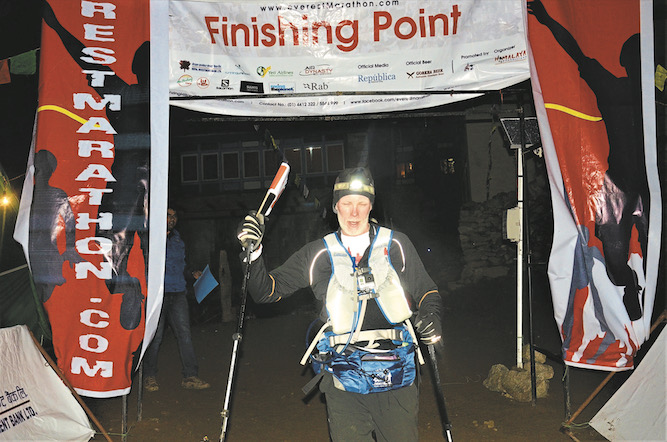
The centrepiece of the book is his experience at Mount Everest in 2014.
Timmons got hooked on the alpine stories, which are often tragic, about the mountaineers who have climbed the world’s tallest peak. When he learned about the ultra race at the iconic mountain, he signed up.
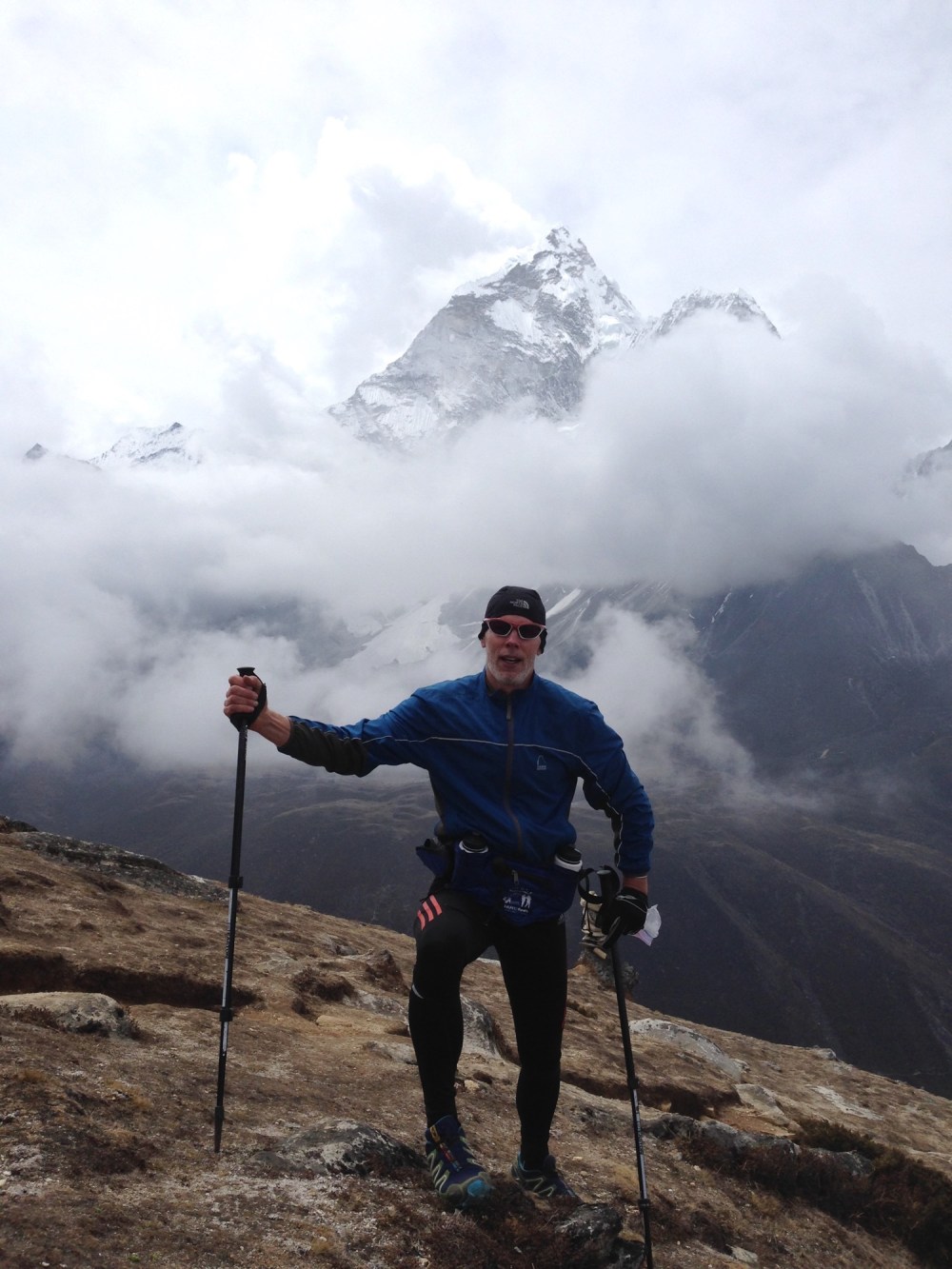
He spent two weeks on the mountain trekking 60 kilometres up to Everest base camp, which is at 5,364 metres (17,598 feet). The athletes stayed at base camp for a couple of nights, and then ran 60 kms down to their starting point.
Not surprisingly, it turned into a gruelling ordeal, and he was successful in part due to the intervention of a young Nepalese guide who spoke very little English. Since he couldn’t learn his name, Timmons called him Ujesh, which translates in the Nepali language to one who gives light.
Timmons writes movingly above the young stranger’s impact on his race and his life as repeatedly saved the Brandonite from making what could have been critical errors.
“There’s no exaggeration of what this guy did for me and meant for me and the memories I have about that,” Timmons said. “I was in a really bad spot and by all standards, this what not an overly challenging race. What was challenging was that we were at 17,000 feet for two weeks without eating or drinking or sleeping and then trying to shovel ourselves out of a snowstorm at base camp on Mount Everest and trying to escape avalanches and then run a 60-km race at 17,000 feet.”
An additional problem was snow blindness, which can happen quickly at altitude and was a problem for the teacher. Without Ujesh, Timmons would have had to navigate his way through 30 kilometres of Himalayan mountains — they were using a less-travelled route without any trails — while simultaneously feeling the effects of a lack of sleep and a very different diet.
“By the time I was at the back end of the race I was in pretty bad state so without this young kid with me, who knows where I would have ended up,” Timmons said.
Another challenge for endurance athletes is moving on after an event. When someone has a singular purpose driving them physically and mentally for months, there can be emptiness on the other side of the goal.
There can also be a lot of second guessing, especially when things don’t go as well as hoped.
“There are times when I feel like this is the worst experience in the world and how could I possibly have let myself down,” Timmons said. “I was in Everest and I was at that point and it was crushing. I couldn’t believe I committed myself to coming here and I wasn’t going to finish a race. Thankfully I did finish, but there are times when failure is a reality and it’s a mental challenge that you have to fight through and not fail and continue, or fight through the despair of accepting failure and realize it’s part of growing.”
Timmons likes to have the next race in my mind, noting if he does fail in a race, he knows where the bar is set for the next one.
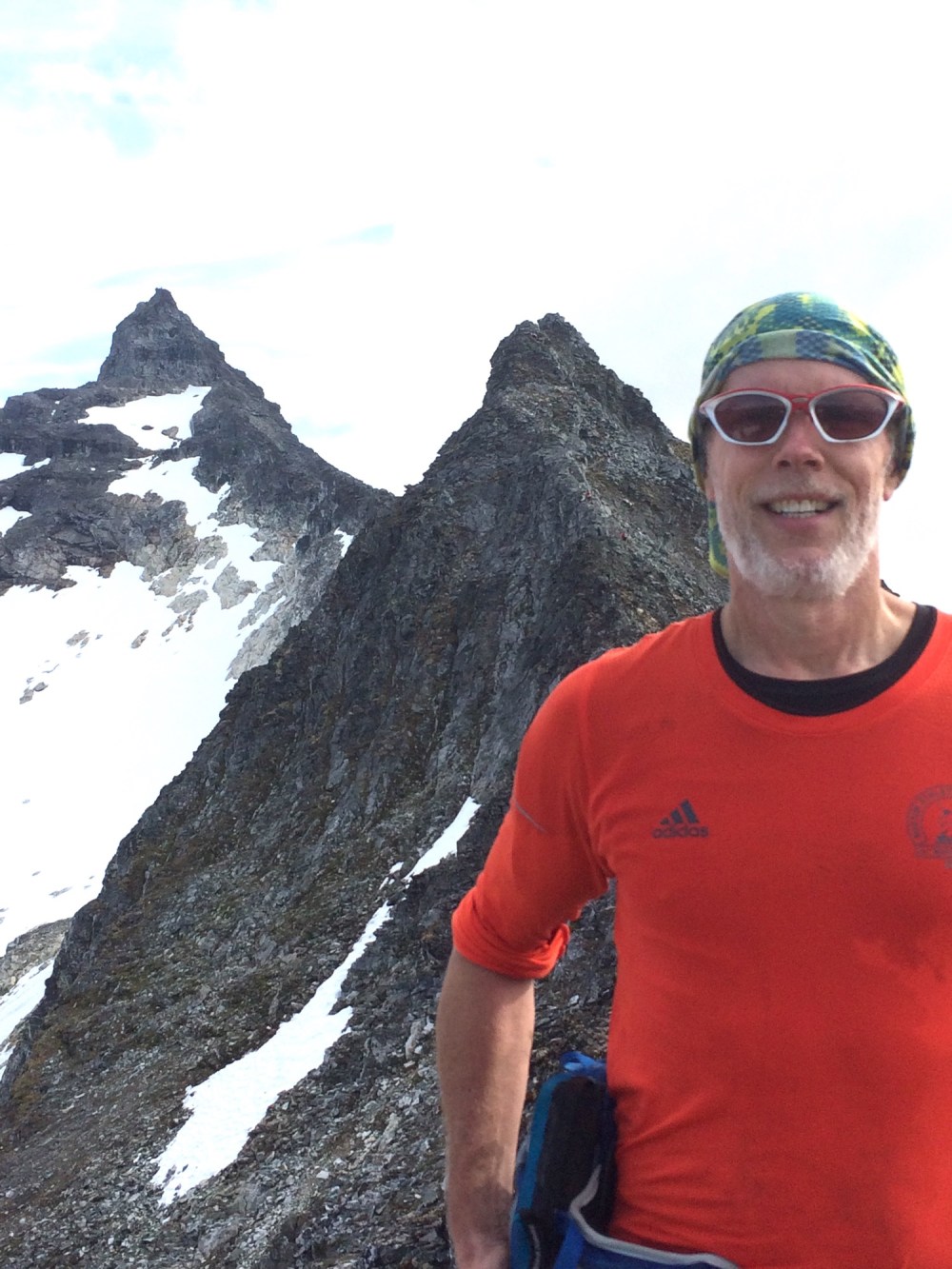
He certainly extended his limits when, as a gift to himself after he retired in 2017, he entered the Tromso Skyrace, a 55-km event in Norway that spans two mountains and actually involves some alpine skills. In a particularly heart-pounding section of the book, he and two other athletes deal with deep crevasses and a vertical ledge.
A single mistake would have instantly led to a long fall to his death.
“It was a mountain experience that was pushing me to the brink of not only physical and mental exhaustion, but all danger,” Timmons said. “I was in many situations where I had to have complete cerebral and physical control of myself to avoid falling off a mountain.
“The risk of death and thought of death were very real. To get through that and reach a point where I felt I succeeded at controlling myself and making every single breath the focus of survival, I pulled out of that race because of a time default, but I was happier than I’ve ever been.
“It shows up in the record books as a failure, a DNF (did not finish), but in my mind, that’s probably the most fulfilling experience I’ve ever had.”
He’s most proud of that fact that he never let fear take over.
While the physical toll of endurance sport is extreme — 21 ultra marathoners died in a race in China last month when the weather suddenly turned cold and wet — the less understood barrier is mental. When part of the mind is screaming to stop, the simple act of continuing to move forward can be a challenge.
Timmons said he always remembers that far better athletes than him face the same struggles, and welcomes “The Beast,” the point where mental fatigue feels overwhelming.
To help cope, he welcomes The Beast.
“It doesn’t strike you instantly,” Timmons said. “You can feel it building and building and building. It almost always connects with some kind of physical pain or little injury as well. The best thing you can do is know it’s coming.”
Another issue is trying to take in any form of nutrition. The body becomes committed to the task, and a stomach won’t process food normally, leading to appetite suppression.
But a body expending energy without taking any in is also at risk.
“Your brain doesn’t even reconcile that you can’t do it,” Timmons said. “It’s just an aversion … That’s a huge problem for me, losing hunger. It’s hard to explain to someone who hasn’t gone through it.”
That’s another reason why he struggled at the 100-mile distance.
None of those things make endurance sport seem very sensible to the uninitiated, and Timmons understands why people question his sanity.
“It’s not about excelling at something,” Timmons said. “There is always someone who is going to do something better than you. To me, the attraction of pushing myself further in endurance sports is because you can do it and still be a pretty ordinary kind of competitor. You don’t have to be the greatest.
“I’ve been around long enough and talked to enough people who are really good at it, and they don’t get anymore out of it than I do. If someone wins a 50-mile race, that’s great, they get the accolades and they get sponsorship, but they don’t have any greater sense of pride in accomplishment than I do if I come in five hours after them.
“You hear that all the time, and that’s the beauty of this sport.”
He also marvels at the fact that he can share the course with the best endurance runners in the world, while recreation golfers aren’t likely to have a Tiger Woods-quality player teeing off beside them and hockey players won’t skate with Connor McDavid.
“Every time I’m in a race, there’s greatness in front of me and I feel so blessed and honoured to be in that company and know that I’m getting the exact same experience they are, and they respect me as much as I respect them,” Timmons said. “That kind of synergy between the best and the average is really unique.”
He thinks a lot about how his racing experiences have bled into his career and family life. Timmons had moved from Vincent Massey to Neelin as he got more seriously into endurance running, and made a point of sharing his experiences with his students.
“It just showed what real living is all about, and what real people do with their real lives and what matters to them,” Timmons said. “I’ll always think back fondly on those days and the students I was able to share my life with and they shared their lives with me. It really was as inspirational for me as anything I’ve done in my life. When I think of those five years when I was getting all of this positive feedback from running, I was getting positive feedback from my students every day, and these two things together made me a much happier, better person.”
At home, he shared his experiences with his wife,
“It’s a very personal deep emotional extension beyond the physical of running, and that’s the kind of thing that is really almost impossible to explain to someone who doesn’t experience it themselves,” he said.
There has been some physical impact.
He was scheduled for knee surgery a year ago, but chose instead to try rehabbing the leg and it worked.
His next 50-mile race is scheduled for August in the Rockies, and he has also registered for a race in Bulgaria in September, if COVID allows them to happen. He would also love to run across Iceland one day.
“It’s planning for more grand adventures,” Timmons said. “I’m not prepared to let the epic stuff go.”
And that’s perhaps the most inspiring part of Timmons’ journey. He’s always looking ahead for the next obstacle to overcome, and whether he finishes a race or not, finding joy in the process.
He said that translates away from running.
“Being average is not so bad,” Timmons said. “Being normal, being ordinary is not so bad. You just have to pick something that inspires you. For me, it was long distance running. I recognized from the first day I did it that I would probably never win races but I could sure compete …
“For anyone who is having moments in their life, whether its boredom or feeling like they opportunity and it’s passed them by, I don’t say look at me and what I did, but I can kind of say kind of look at me and what I did. I had every reason just to go through life — I enjoyed my life, I didn’t have any problems, I had good relationships, I wasn’t missing anything — but there is so much you can do just beyond subsistence living.
“Everyone has something … It’s too easy to let life pass you by.”
» pbergson@brandonsun.com
» Twitter: @PerryBergson