
Volunteers to restore flat warehouse
Advertisement
Read this article for free:
or
Already have an account? Log in here »
We need your support!
Local journalism needs your support!
As we navigate through unprecedented times, our journalists are working harder than ever to bring you the latest local updates to keep you safe and informed.
Now, more than ever, we need your support.
Starting at $15.99 plus taxes every four weeks you can access your Brandon Sun online and full access to all content as it appears on our website.
Subscribe Nowor call circulation directly at (204) 727-0527.
Your pledge helps to ensure we provide the news that matters most to your community!
To continue reading, please subscribe:
Add Brandon Sun access to your Free Press subscription for only an additional
$1 for the first 4 weeks*
- Enjoy unlimited reading on brandonsun.com
- Read the Brandon Sun E-Edition, our digital replica newspaper
*Your next Free Press subscription payment will increase by $1.00 and you will be charged $20.95 plus GST for four weeks. After four weeks, your payment will increase to $24.95 plus GST every four weeks.
Read unlimited articles for free today:
or
Already have an account? Log in here »
Hey there, time traveller!
This article was published 01/07/2021 (1920 days ago), so information in it may no longer be current.
Although a small red building in Brookdale appears inconspicuous, it represents a largely forgotten chapter of Manitoba’s agricultural history.
Located approximately 50 kilometres northeast of Brandon, the building is believed to be the last-surviving flat warehouse in Western Canada.
These buildings, which stored grain, were found sprinkled throughout the Prairies until they were made redundant by the advent of grain elevators.
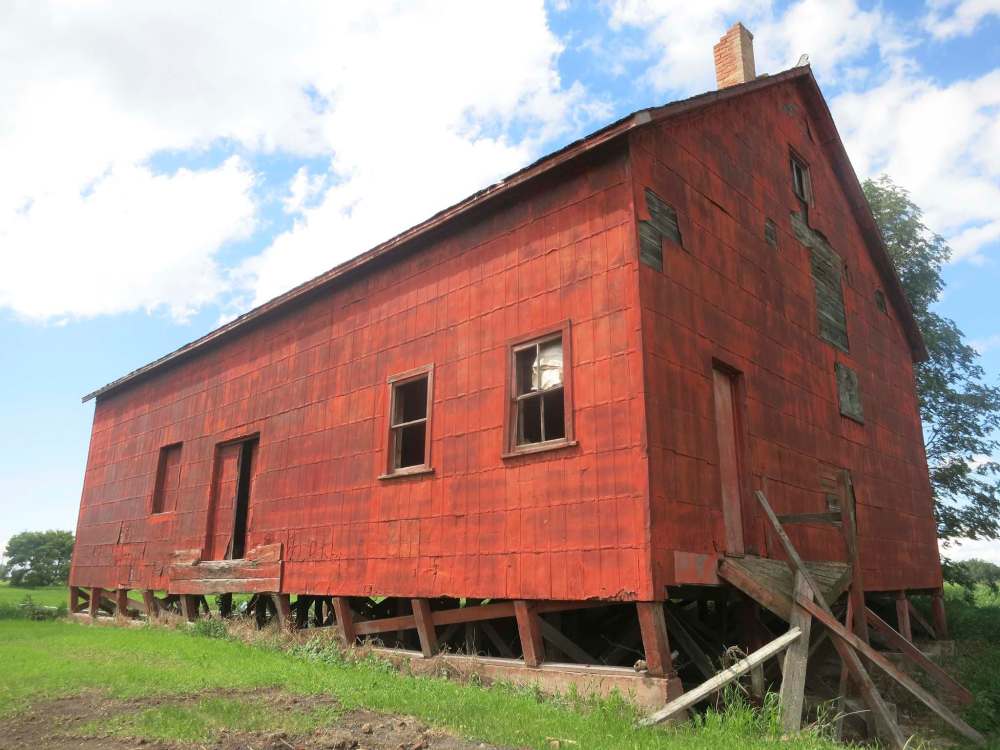
So described historian and Manitoba Agricultural Museum secretary Gordon Goldsborough, who said their short lifespan is why most people haven’t heard of them.
“They were gone before anyone alive was born,” he said. “So nobody alive has any memory of the flat warehouse.”
The flat warehouse operation was “highly labour intensive,” he said, and consisted of farmers shovelling loose grain, or stacking sacks of grain, from their cart and into the building. When enough grain had been collected in the warehouse, a boxcar would roll up at the other side of the building.
“Therefore, when they brought in grain elevators, which were much more mechanized and could handle much greater volumes of grain, it completely revolutionized grain handling, and so the flat warehouses in a matter of years all disappeared.”
The Brookdale flat warehouse is an anomaly, as it was built in 1902 — almost two full decades after grain elevators began being erected.
“I suspect … the guy who built the flat warehouse maybe didn’t have the means to put up a more substantial structure, or maybe this was better suited for what he needed,” Goldsborough said.
While some flat warehouses were later torn down, this one remained standing and used to store hardware.
It’s currently vacant, and while Goldsborough said a carpenter has clarified there are “strong bones” throughout much of the building, there’s a glaring exception in its foundation, which is on the verge of collapse.
Volunteers at the Manitoba Agricultural Museum in Austin have set their sights on relocating the building to the museum grounds approximately 66 kilometres east, placing it on a more solid footing and restoring it.
Fundraising is already well underway, with more information about sponsorships and a fireworks sale available online at mbagmuseum.ca. Goldsborough said a recent surge in support has likely raised enough to pay for its relocation to the property.
They hope to get it relocated within the next month, and it’ll be situated between a train station and grain elevator they already have on site.
The total restoration cost, including the move, cleaning, installation of cedar shakes and other associated efforts, hovers around the $100,000 mark.
It remains unclear what, exactly, the volunteer-run restoration will consist of — a process Goldsborough said will require additional research.
The siding, for example, is covered in metal cladding, which, like grain elevators, was likely added later on as a cost-effective means of protecting the building. It has also been painted a bright red, which is not period appropriate.
That said, it’s unclear what colour it was originally painted.
“We have a few historic photographs, but they’re in black and white so don’t show you much,” he said, adding it would have been a more “modest” colour.
When all’s said and done, the building will serve as another accessible exhibit at the museum, and will be decked out with historic artifacts to have it made up as though it were still in operation.
It’ll be a valuable addition to the museum, Goldsborough said, and will highlight another page in the province’s eclectic agricultural past.
» tclarke@brandonsun.com
» Twitter: @TylerClarkeMB