
Woman’s survival tale focus of documentary
Advertisement
Read this article for free:
or
Already have an account? Log in here »
We need your support!
Local journalism needs your support!
As we navigate through unprecedented times, our journalists are working harder than ever to bring you the latest local updates to keep you safe and informed.
Now, more than ever, we need your support.
Starting at $15.99 plus taxes every four weeks you can access your Brandon Sun online and full access to all content as it appears on our website.
Subscribe Nowor call circulation directly at (204) 727-0527.
Your pledge helps to ensure we provide the news that matters most to your community!
To continue reading, please subscribe:
Add Brandon Sun access to your Free Press subscription for only an additional
$1 for the first 4 weeks*
- Enjoy unlimited reading on brandonsun.com
- Read the Brandon Sun E-Edition, our digital replica newspaper
*Your next Free Press subscription payment will increase by $1.00 and you will be charged $20.95 plus GST for four weeks. After four weeks, your payment will increase to $24.95 plus GST every four weeks.
Read unlimited articles for free today:
or
Already have an account? Log in here »
Hey there, time traveller!
This article was published 03/07/2021 (1932 days ago), so information in it may no longer be current.
RitaBev Bone should never have made it to 65.
Her life’s path has taken her over some pretty precarious roads.
Homelessness. Sexual abuse. Addiction. Life as a foster child.
By rights, she should be dead.
But she isn’t.
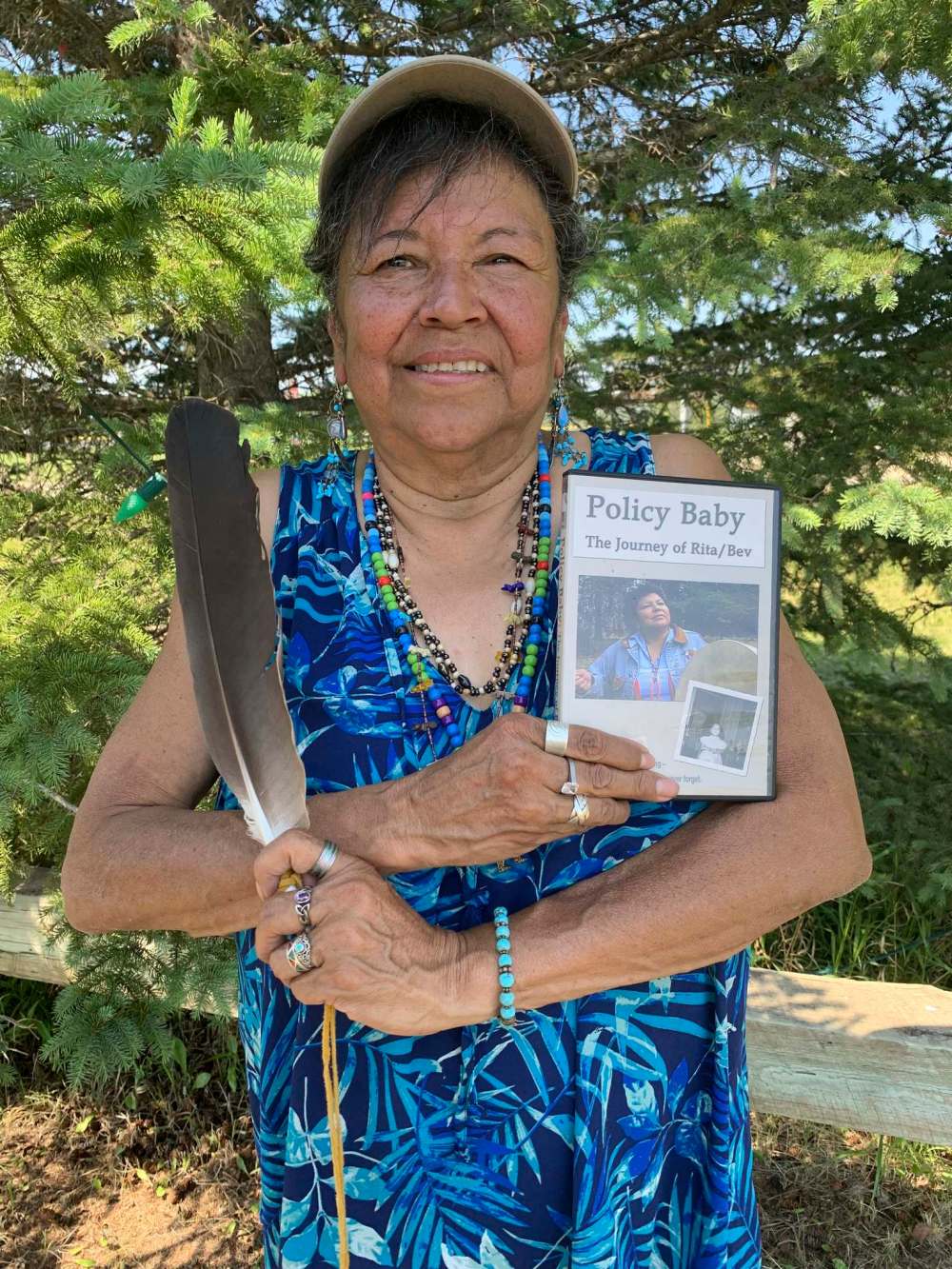
Instead, her story is one of survival documented in a film by Susan Stewart and Michael Glassbourg with Jones (Bone) as the co-producer titled, “Policy Baby, The Journey of Rita/Bev.”
Originally from Keeseekoowenin First Nation, Bone was “apprehended” at two months of age from her parents, Rachel and Gordon Bone, in 1956. She was placed with a foster family who renamed her Beverly Jones. Her story is chronicled in the documentary.
Bone said that she identifies as a “policy baby” because it was the policies of the Indian Act that took her from her home community and stripped her of her culture and identity. It wasn’t a coincidence she began to reconnect with her culture at the age of 24, she said, as it was at this point in her life that everything in her life began to click.
“I’ve had dreams all my life as a little girl and I never told anybody, because they would have committed me or something,” she said, adding this “blood memory” had been passed down to her, which prevented her new culture from making too much sense to her.
She said that her father was a medicine man and it was “because of his image that I was given strength to put the bottle down, put the needle down, to come off the streets.”
That period was marred by a series of policies enacted in Canada that enabled child welfare authorities to take Indigenous children from their families and communities and place them in white foster homes in Canada, the U.S. and New Zealand.
It is estimated that approximately 20,000 Indigenous children were taken from their families.
The term Sixties Scoop was used by social workers in the British Columbia Department of Social Welfare to describe their department’s practice of child apprehension. Foster programs and adoption policies were different in every province. Children such as Bone were apprehended during this time because in many cases, their Indigenous mothers weren’t married.
By the mid-1980s, the practice was discontinued. Sixties Scoop children have launched multiple class-action lawsuits.
Bone’s mother was a non-status woman living on the reserve. She was declared ineligible for any privileges that included medical care and education.
At two months old, Bone was “apprehended” by Indian Affairs in Keeseekoowenin First Nation. She was placed in a non-Indigenous foster home. At the time of her apprehension, Indian Affairs was being aggressive in their removal of those from the reserve who were not “status Indians,” Bone said.
At five years of age, Bone was returned to the reserve, where she lived with her family, whom she didn’t know. She couldn’t speak the language and suffered sexual abuse.
She yo-yoed back and forth for a number of years under the guidance of the child welfare system.
Bone lived on the street and had her first child at 18 and another child at the age of 19. By the age of 24, she sobered up. At 28, she entered university and graduated four years later with a bachelor of social work degree.
For the next 31 years, Bone worked in the field as a social worker, witnessing some of the harsh environments her mostly Indigenous clients lived in.
The documentary is almost an hour long and weaves Bone’s life together in a tapestry of two cultures and the unstable ground she originated from to a pathway of healing.
Bone hopes to offer the documentary as a segue between foster parents, foster children and adoptees as a pathway to their healing.
“My goal is to work with other adoptees,” she said. “What I want to do is an oral documentary with other adoptees. The core is having a spiritual foundation. What is our spiritual foundation? For me, it’s how I live. Everybody has to have a spiritual foundation. We all feed our spirit one way or the other. We stand on our spiritual foundation in our sharing.”
» kkielley@brandonsun.com,
with files from Tyler Clarke