
1978-79 BWK Series — Day 15 — Wheat Kings rally to make final
Advertisement
Read this article for free:
or
Already have an account? Log in here »
We need your support!
Local journalism needs your support!
As we navigate through unprecedented times, our journalists are working harder than ever to bring you the latest local updates to keep you safe and informed.
Now, more than ever, we need your support.
Starting at $15.99 plus taxes every four weeks you can access your Brandon Sun online and full access to all content as it appears on our website.
Subscribe Nowor call circulation directly at (204) 727-0527.
Your pledge helps to ensure we provide the news that matters most to your community!
To continue reading, please subscribe:
Add Brandon Sun access to your Free Press subscription for only an additional
$1 for the first 4 weeks*
- Enjoy unlimited reading on brandonsun.com
- Read the Brandon Sun E-Edition, our digital replica newspaper
*Your next Free Press subscription payment will increase by $1.00 and you will be charged $20.95 plus GST for four weeks. After four weeks, your payment will increase to $24.95 plus GST every four weeks.
Read unlimited articles for free today:
or
Already have an account? Log in here »
Hey there, time traveller!
This article was published 12/08/2021 (1758 days ago), so information in it may no longer be current.
Just four days after the 1978-79 Brandon Wheat Kings beat the Portland Winter Hawks in Game 6 to win the Western Hockey League championship, they were preparing to face off against the host Trois-Rivières Draveurs in the Memorial Cup.
From 1972 until 1983, and again for one year in 1987, the Western Hockey League, Ontario Hockey League and the Quebec Major Junior Hockey League each sent their champion to a three-team event. Each champ played the others twice, with the top two clubs advancing to the final.
GREGG DRINNAN (Brandon Sun): “You don’t realize it at the time because you’re travelling with them and one game bleeds into the next. When you look at it afterwards and think what you’re putting 20-year-olds through without a whole lot of time for their bodies to rejuvenate and regenerate, a lot of hotel food and a lot of times in those days it was stop at A&W and bring the box of burgers on the bus on the way home.”
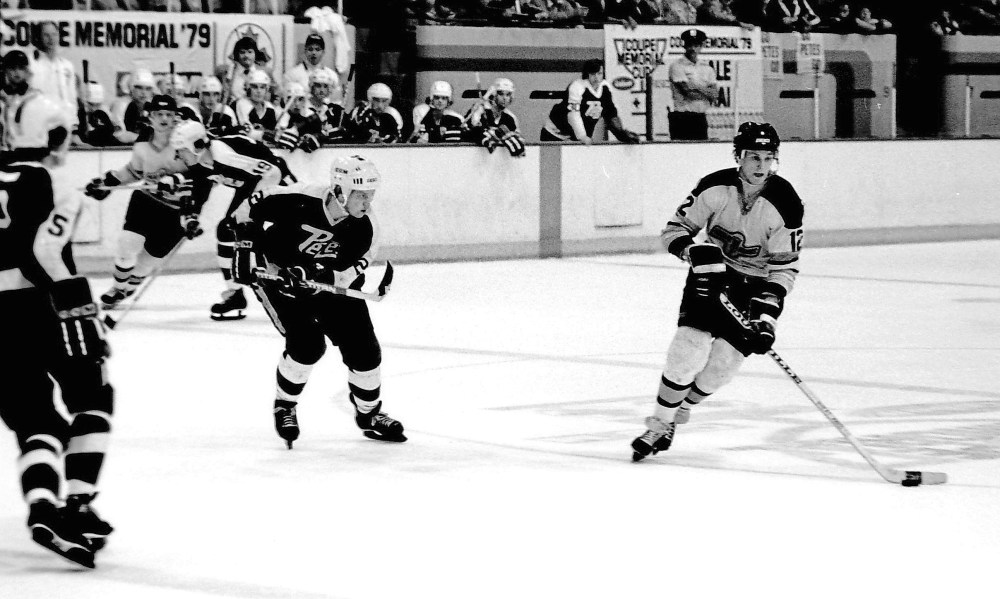
RICK KNICKLE: “You don’t really think about it while you’re doing it. It’s after the fact. You’re young and you’re playing and what does it mean, but when I see the guys who were there, and being on the team with Brad and all those guys, and what I had gone through with them that year and the year before, it was pretty amazing. At the time, you’re so mentally drained … It was a tough grind, and we had one more grind to get through at the Memorial Cup.”
KELLY McCRIMMON: “Our travel and our playoffs and the amount Brad played … we did the round-robin with Lethbridge and Portland and then a league final with Portland. You don’t think of it at the time when you’re playing, you’re a young guy, but when you look at it in hindsight it’s hard to fathom that we could travel that much in the WHL playoffs.”
GREGG DRINNAN: “When the season starts, the teams know who has a chance to win the championship and who doesn’t. At the start of the season, the teams that have a chance put so much into getting to that championship that when they win it, they have nothing left. It’s so hard for them to make a turn-around to get from that high to get back up again and play in a Memorial Cup. I really think that’s a big part of why the WHL has had limited success of late in the Memorial Cup, because it’s so hard to win a WHL championship primarily because of the travel. Assuming that the two teams who get to the championship are relatively equal, by the time they get there, they are so tired that they have nothing left. You win and you’re sky high, and you wake up the next day and you’re drained, and at some point reality sets in, it’s ‘Holy man, I have to get pumped again and go to the Memorial Cup.’ I think a lot of times — they are teenagers — and they just can’t get back up there again.”
RICK KNICKLE: “It’s crazy that you have to go through what we went through in our league and then have to go down to the Memorial Cup.”
LAURIE BOSCHMAN: “I do recall being quite fatigued but it was just something you never talked about.”
BRANT KIESSIG: “When we got to the Memorial Cup, even our senior guys like Propp, Allison, Brad and Lockridge, this is new for them too.”
GREGG DRINNAN: “I think they were starting to run out of gas. There’s a lot of travel, not just in the playoffs but in the regular season on, but when you get into the playoffs, almost every game is a high-stress situation, certainly at the start of the game. Some of them are 60 minutes of high stress, and some aren’t, but most of them are. When you get into a six-game series against a team like Portland, it’s high stress, it’s travel, it’s hard on your body. In those days, you didn’t have nutritionists and all that kind of stuff, the electronic resources to help your muscles and for the most part you’re riding the bus. By the time they got to Quebec, they were really running on fumes.”
GAME 1
The signs are there that it was diminished Wheat Kings squad by the time they arrived in Quebec.
They lost two games in a row for the first time all season, and were outshot in four of the five games at the Memorial Cup. To put the latter stat into context, in 94 regular season and playoff games, they were outshot just 12 times.
In the first game, a 4-1 loss to Trois-Rivières on May 6, the teams brawled during the pre-game skate. While the Wheat Kings may have thought they had the hosts exactly where they wanted them, it didn’t work out that way.
STEPHEN PATRICK: “We don’t know a player on the other team, we don’t know their stats, we don’t know their records, we don’t know who their scorers are, who the penalty killers or the tough guys are, nothing. You’re going into a French town with French fans and you don’t know anything. It was tough, and it was tough for the 2016 team. You win a tough series and then you have to reset. It’s really important to get out quick, and we didn’t get out quick.”
DAVE STEWART: “Trois-Rivières was a small rink.”
DON GILLEN: “The (Memorial Cup) crowd was very loud, even in warmup. That game was up in Trois-Rivières. I don’t know why they got a home game, in hindsight, but there was much more atmosphere there than the host in Verdun.”
DAVE McDONALD: “I remember that first game against Trois-Rivières. That was wild. It was a good experience. We were in Montreal and you had to take the subway to the Verdun rink. As a team, you have to bond together … Everyone wanted to do good. We practised hard and got up for every game.”
DAVE CHARTIER: “Ray Allison and somebody got tangled up with each other and that’s when the brawl started I think. I was fighting this one guy and I was hitting him and he was talking and I said to him in French to shut his mouth because I knew how to speak French. We were tough kids so we did what we did and beat the crap out of them.”
BRANT KIESSIG: “We got into that big frickin’ brawl with Trois-Rivières in the first game … We were like the Russian in the Rocky movie. We were having trouble adjusting to this new wrinkle.”
LAURIE BOSCHMAN: “The first game in Trois-Rivières, Michel Bergeron, Le Tigre, who eventually coached the Quebec Nordiques, was the coach. I remember when we got there, in the pre-game warmup, we had a pre-game brawl and I remember looking up and seeing all the dark jerseys on top of the white ones, so we just pounded these guys. Unbeknownst to some of us, our parents had made the trip out and they got just doused with beer from the home fans in Trois-Rivières.”
KELLY McCRIMMON: “It was unprecedented, even in that era, what happened.”
RICK KNICKLE: “A guy stuck me as we were coming out for warmups and everybody saw it. We went ‘Oh, they think they’re tough at home, do they? OK, good.’ So we met them at centre ice and nothing happened — there were no referees — and all of a sudden they lined up to do their line rushes and Ray skated to centre ice and bowling balled about three guys. It was messed up within seconds and we were beating every guy so bad. I played with four of those guys in Rochester three years later and I asked them ‘What was it like in the dressing room for you guys after the brawl?’ ‘Ah, it was like a MASH unit.’”
KELLY McCRIMMON: “They introduced us first, so we all stood on our blue-line, and then they introduced them next. I remember this guy named Danny St. Laurent, he wore No. 27 I believe, he came out and skated right down the blue-line and challenged our guys (laughs).”
RICK KNICKLE: “We thought we had them, and that’s why we lost the game. They played so fast, we couldn’t hit anybody, they started about three fights and we got frustrated and we just lost our heads and we didn’t play the way we should have played. But that’s what happens. We had a brawl and we thought we had them scared and they weren’t. They were at home.”
TIM LOCKRIDGE: “I think we all kind of let our guard down a little bit now that we were there. Maybe we were thinking we were better than we really were because I know we went into the game with Trois-Rivières thinking there was no way these guys were going to beat us. They came out and tried to intimidate us.”
RICK KNICKLE: “I had a puck thrown at me during the game. A guy came down the aisle and threw a puck at me when the play was in the other end. I saw him and he missed me, but now there’s two pucks on the ice. My mom and dad are at the game and they’re getting abused and surrounded by people in the stands during the brawl. It was pretty scary at times.”
GAME 2
The Wheat Kings picked a spectacularly bad time to embark on their first losing streak of the season when they fell in overtime 7-6 to the Petes on May 8. Suddenly the team that had lost five times during a 72-game regular season found themselves one defeat away from elimination.
RICK KNICKLE: “When we lost our first two games, Brad (McCrimmon) said ‘Listen, we have come so far, we can’t lose another game.’ He put it as another one of those roadblocks. That whole year, nothing was going to stop us. If you want to try to beat us up, that’s not going to happen. We had so many weapons and so many things. For my part, I just tried to not be the weak link.”
DAVE McDONALD: “Everybody looks at it a different way. We lost the first game 4-1 to Trois-Rivières and then the next one to Peterborough, 7-6. We could have been a little out of sorts. You’re not used to losing is one thing. It’s the same for each team, except maybe the host team.”
RICK KNICKLE: “For me it was bittersweet because I was drained. I had nothing left, and nothing left when I got down to the Memorial Cup. I played OK the first game, the second game I was awful and I didn’t play the rest.”
DAVE STEWART: “Knick had a couple of bad games but I don’t know why we didn’t stick with him. He probably played well.”
KELLY McCRIMMON: “I didn’t think we played poorly but suddenly we were down 0-2, and Peterborough and Trois-Riviéres really appeared to be in the driver’s seat. We had the banquet during the week and we were 0-2. I remember (Trois-Riviéres coach) Michel Bergeron waving bye-bye to us when he was leaving. We were done, we weren’t going to make it to the final and everything else, and then we eliminated them.”
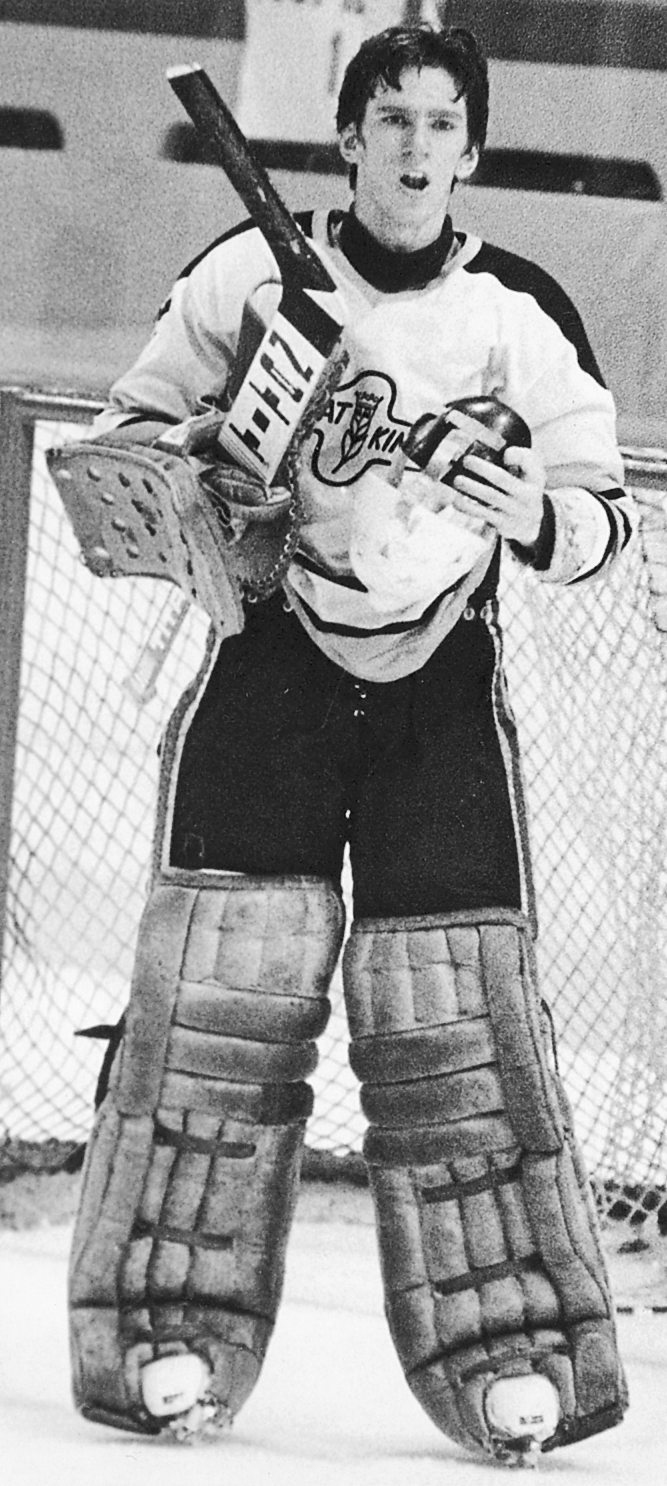
BART HUNTER
In the third game, Bart Hunter was named starter, supplanting the two goalies who had carried the mail for the first 101 games.
The fiery son of the legendary Wild Bill Hunter, who founded the WHL and co-owned and coached the Edmonton Oilers, Hunter quickly made his impact felt.
DAVE McDONALD: “They ended up putting Hunter in and he played really well.”
DAVE CHARTIER: “We said ‘We’re in a big hole here, all we have to do is what we do best. We have to start something here now.’ In the third game we beat (Trois-Rivières) pretty good.”
BRIAN PROPP: “We wanted to be there and to be in the final. I remember we lost the first game to Trois-Rivières and then we got back in. It was a little different because we used (Bart Hunter) a lot instead of Knickle. We tried to play as well as could.”
GREGG DRINNAN: “I always felt badly for Rick and Scotty Olson too with the way things turned out at the Memorial Cup. I felt badly for Dunc too because of the decision he had to make to go to Bart Hunter after you ride those guys for 101 games.”
WES COULSON: “Dunc didn’t come in and yell and scream. Yes, he would once in a while, but that caught me off guard when Hunter did that. Literally, I think’s that what we needed. Were we feeling a bit sorry for ourselves because we lost the first two games? I don’t think so but maybe we had it our own way for quite a while and now all of a sudden we have some adversity and we have to show that we can overcome that.”
BRANT KIESSIG: “Scotty Olson never got to play because all of a sudden Dunc didn’t have confidence in him, and the team sees that and is going ‘OK, there is something wrong here.’ The machinery is wonky. And even though Bart Hunter came in and played unbelievable, we still had things going on in front of him that weren’t normal for us. I don’t know if Brad McCrimmon even came off the ice in the third period of that final game.”
GREGG DRINNAN: “They had gone through over 100 games with the laid-back Rick Knickle and the smiling Scotty Olson, neither one of whom would say s— if their mouths were full of it, and neither of whom was close to being a vocal leader on that team. All of a sudden you’ve got Bart Hunter in the mix who has a sharp tongue, is quick to speak, he’s fiery and emotionally he’s all that stuff. He came in and really, really played well. Without him, and with the other two and especially with Rick in a slump, Bart really came in and saved their butts. It’s pretty hard to be critical of his selection as MVP, because without his performance, especially in his first two games, they aren’t in the final. It had to be a shock in the dressing room.”
TIM LOCKRIDGE: “Everybody accepted him. He came in (and was vocal) and I think everybody respected that. It was a little different because we didn’t get that out of Rick or Scott. They were just there as the goalie, where all of a sudden Bart came in and he was vocal and chirping a little bit about this and that. I think it helped us in some sense but it was definitely a different personality from the other two guys.”
DON GILLEN: “(Bart) was the kind of guy who would come into a dressing room he had never been in before and within five minutes call a meeting. He’s that kind of guy. With the way he was and the dad he had, he could parachute into a situation and it would not be foreign to him. He could just pick it up. He was really the perfect callup.”
WES COULSON: “We lost the first two games and were not playing very well. We came to our third game in Verdun and we were playing Trois-Rivières and he was the goaltender that Dunc chose to go with. I can remember him standing up in the room and literally coming unglued on us, telling us ‘What the hell are we doing here? This isn’t the team that I played against in the final, you guys are a hundred times better than what you’re playing.’ He just went off and that was kind of a turning point for us. It was kind of ‘Holy s—, this guy is right, we aren’t playing very well. I feel sorry for Trois-Rivières because after that we went out and just beat the s— out of them. We literally ran them out of the building.”
GAME 3
The shakeup was exactly what the Wheat Kings needed as they responded with a dominant 6-1 win over Trois-Rivières that would prove very, very important later.
WES COULSON: “They wouldn’t even come into our zone after while. Dunc just turned the big boys loose, Gillen and Kempthorne and Patrick, and said ‘OK boys, run them over’ and we did.”
LAURIE BOSCHMAN: “Trois-Rivières was a different team when we played them back in Laval. We beat them handily. They were strong in front of their home crowd.”
DAVE STEWART: “It took us a couple of games. We lost the first two. I don’t think we were prepared. To be honest, I think that Portland series took a lot out of us, and then to fly down there to Montreal … Everybody was spent by then. I know I was. You try to get up but you’re going into different territory and Trois-Rivières, you’re not expecting these guys to come out and have a brawl. It was just not a good start.”
BRANT KIESSIG: “We physically dominated them when we figured it out.”
GAME 4
After Brandon’s 3-2 victory over Peterborough in the final game of the round-robin, all three teams stood with identical 2-2 records. Happily for the Wheat Kings — the team that was famously knocked out of the Western Hockey League playoffs a year earlier in the divisional round-robin when the Regina Pats and Flin Flon Bombers also finished 4-4 — this time the countback was their friend. Courtesy of their dominant 6-1 victory on May 10, Brandon ended up +2 in the tournament on 16 goals for and 14 goals against and finished first.
Peterborough was even with 15 goals for and 15 against, and also earned a berth. The hosts were finished because they were -2 on 11 goals for and 13 against.
After a day of rest on May 12, two of the top teams in Canada were set to vie for the Memorial Cup.
» Tomorrow’s Sun: Overtime agony.
» pbergson@brandonsun.com
» Twitter: @PerryBergson