
SCO launches awareness campaign
Advertisement
Read this article for free:
or
Already have an account? Log in here »
We need your support!
Local journalism needs your support!
As we navigate through unprecedented times, our journalists are working harder than ever to bring you the latest local updates to keep you safe and informed.
Now, more than ever, we need your support.
Starting at $15.99 plus taxes every four weeks you can access your Brandon Sun online and full access to all content as it appears on our website.
Subscribe Nowor call circulation directly at (204) 727-0527.
Your pledge helps to ensure we provide the news that matters most to your community!
To continue reading, please subscribe:
Add Brandon Sun access to your Free Press subscription for only an additional
$1 for the first 4 weeks*
- Enjoy unlimited reading on brandonsun.com
- Read the Brandon Sun E-Edition, our digital replica newspaper
*Your next Free Press subscription payment will increase by $1.00 and you will be charged $20.95 plus GST for four weeks. After four weeks, your payment will increase to $24.95 plus GST every four weeks.
Read unlimited articles for free today:
or
Already have an account? Log in here »
Hey there, time traveller!
This article was published 03/09/2021 (1839 days ago), so information in it may no longer be current.
Calling on Manitobans to honour the survivors and those who died in residential schools, the Southern Chiefs Organization have designated the month of September as a time of reflection, commemoration and solidarity.
The Southern Chiefs Organization are asking all Canadians take time this September to honour survivors, their families and communities and to recognize the tragic legacy and lingering trauma of Residential Schools.
“September has been a traumatic month for First Nation people because it was the month the children were stolen from our communities,” said Grand Chief Jerry Daniels.
“This September, and for the next 30 days and every day after, I call on all those who now share this land to learn everything you can about this dark period in Canada’s history, so that we can properly honour survivors and remember the innocent lives lost because of it.”
There is a need to ensure conversations between family, friends, leaders and politicians focus on remembering the importance of reconciliation, including economic reconciliation, and changing the narrative as it relates to First Nations today.
“I think we’ve stalled, even though we’ve seen a great deal of investment, I think that reconciliation has stalled in this country. I think a lot of it has to do with the inability of the government to really recognize, especially in Manitoba, it’s been such a slow-moving process,” Daniels said.
“But we’re happy we’re seeing a change in leadership and we’re hoping that the new premier may take on a different tone.”
Sept. 30 has been designated as a National Day for Truth and Reconciliation by the federal government, honouring Call to Action #80 of the Truth and Reconciliation Commission of Canada.
The announcement came in the wake of the discovery of thousands of unmarked graves at former residential school sites across the country — including what is believed to be 104 graves at the former Brandon Indian Residential School.
“It’s a reminder really to all Manitobans given that we’re moving towards establishing sort of a Reconciliation and remembering the children,” Daniels said.
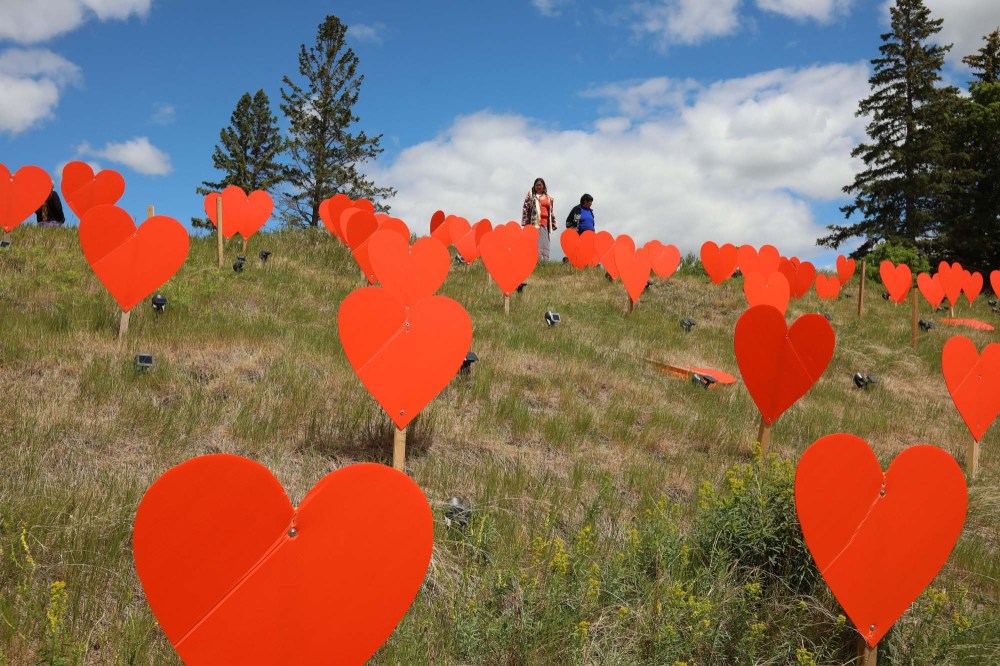
The Southern Chiefs Organization has launched the Orange Heart Awareness campaign as part of September’s acts of remembrance.
The campaign will include billboards, bus boards and transit shelters in Winnipeg and Brandon, and billboards in Portage la Prairie, Dauphin, Minnedosa and Winkler.
All Manitobans are invited to join the initiative by picking up free lawn signs from the organization’s Dublin Avenue office in Winnipeg, making personal lawn signs or hanging orange shirts in their window.
Daniels added he encourages people to prioritize Indigenous issues and push for First Nations autonomy regarding their well-being and the future of communities when it comes to the federal election.
People are slowly coming to understand thousands of children never made it home from residential school or returned to their community traumatized from their experience. These traumatic events have had a lasting impact on families lasting multiple generations.
Daniels explained these issues have been compounded by the poverty many communities continue to face and the economic blockades limiting First Nations’ ability to spur investments to support members and infrastructure.
“It has all led to the social and economic status that Indigenous peoples are currently occupying,” Daniels said.
“We have to be able to work with the right partners and you have to be able to let go of that control over Indigenous people’s lives because it hasn’t created better outcomes — in fact, it’s getting worse.”
Residential school trauma lingers in communities and is a major part of the everyday experience of many Indigenous people. This is why change to Canadian institutions is essential, Daniels said.
He hopes the Orange Heart Awareness campaign will build off the growing momentum of Every Child Matters and remind Manitobans certain language and treatment in regards to Indigenous people is unacceptable.
“I’m not sure how people can continue to support the status quo when we’re not seeing a change in the quality of life, we’re not seeing an opportunity to that extent of which we need to see it. Poverty is growing — how are we changing that narrative?” Daniels said.
“First Nations need to be in control in having a say and having direction and oversight, overall the institutions that impact the lives of First Nations, Anishinaabe and Dakota people that we advocate for here in southern Manitoba.”
For those affected by the discovery of unmarked graves, the National Indian Residential School Crisis Line is available 24/7 at 1-866-925-4419.
» ckemp@brandonsun.com
» Twitter: @The_ChelseaKemp