
POTS patients say condition lacks support in Manitoba
Advertisement
Read this article for free:
or
Already have an account? Log in here »
We need your support!
Local journalism needs your support!
As we navigate through unprecedented times, our journalists are working harder than ever to bring you the latest local updates to keep you safe and informed.
Now, more than ever, we need your support.
Starting at $15.99 plus taxes every four weeks you can access your Brandon Sun online and full access to all content as it appears on our website.
Subscribe Nowor call circulation directly at (204) 727-0527.
Your pledge helps to ensure we provide the news that matters most to your community!
To continue reading, please subscribe:
Add Brandon Sun access to your Free Press subscription for only an additional
$1 for the first 4 weeks*
- Enjoy unlimited reading on brandonsun.com
- Read the Brandon Sun E-Edition, our digital replica newspaper
*Your next Free Press subscription payment will increase by $1.00 and you will be charged $20.95 plus GST for four weeks. After four weeks, your payment will increase to $24.95 plus GST every four weeks.
Read unlimited articles for free today:
or
Already have an account? Log in here »
Hey there, time traveller!
This article was published 02/10/2021 (1828 days ago), so information in it may no longer be current.
Carol-Lynn Nother’s lips turn blue when she sits up. Her purple cane sits beside her on a soft couch. She’s pale. Her blue hair is a sharp contrast to her white skin.
At 32, Nother was diagnosed with Postural Orthostatic Tachycardia Syndrome, or POTS, four years ago. She used to walk almost 13 kilometres to work every day. Today she uses a chair lift to help her up the stairs at home.
Rylee Galiz is a black belt master in Taekwondo. Today, she has a hard time getting around her yard. Thirteen years ago, Galiz was diagnosed with POTS.
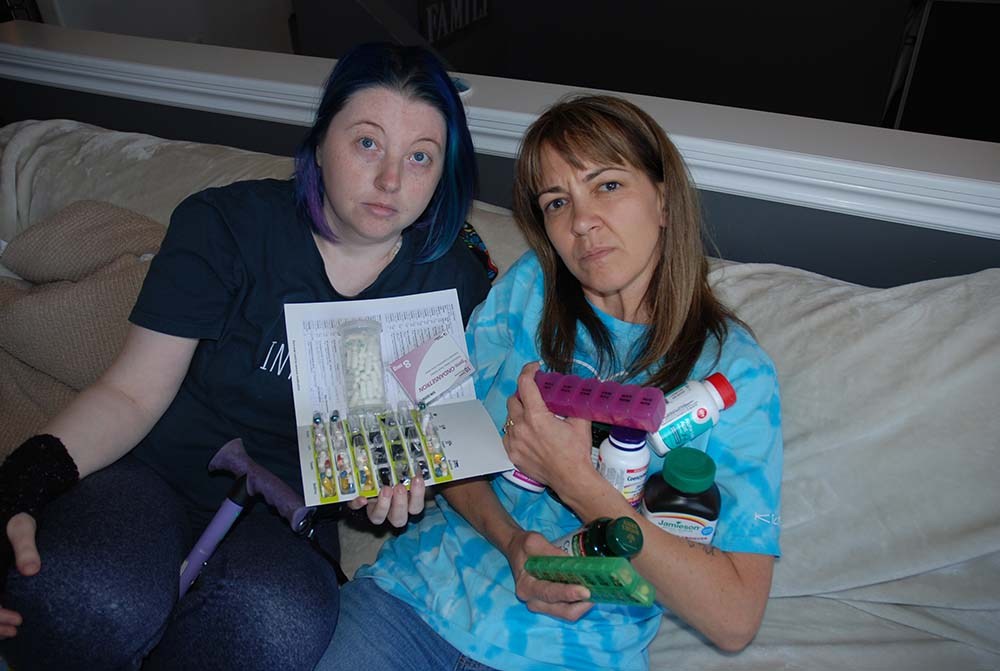
On any given day, the women have chest pain when they stand up. Medication Galiz was able to secure from a specialist at the South Health Campus – Cardiac Autonomic Disorders Clinic in Calgary has given her some quality of life.
She found the clinic on her own and signed up for a research project to determine what was wrong with her. Waiting to see local specialists was taking too long. The autonomic testing that was conducted on her was invaluable but not available in Manitoba.
Nother is still waiting for that day as she waits to be allowed into Alberta to see the same specialist Galiz did 13 years ago.
But, the COVID-19 pandemic has put the brakes on that.
When Nother attempted to book the same specialist in Calgary that Galiz did, she was told to find support for the debilitating disease in Manitoba. Alberta isn’t allowing inter-provincial testing until their rising COVID-19 numbers start to decline, Nother was told.
The testing in Calgary would provide Nother with a baseline to which Galiz’s specialist could then prescribe her the medication which could potentially give her back a semblance of her former self.
Complex testing for POTS is not available in Manitoba, the women said.
They lean on each other as Galiz helps Nother navigate the disease that has effectively stolen their lives and turned them into cane-, walker-, wheelchair- and chairlift-dependent.
POTS is a form of dysautonomia.
Dysautonomia is an umbrella term used to describe various medical conditions that cause a malfunction of the autonomic nervous system.
The autonomic nervous system controls the automatic functions of the body that we don’t consciously think about such as heart rate, blood pressure, digestion, and more.
People living with different forms of dysautonomia have trouble regulating these systems, which can result in lightheadedness, fainting, unstable blood pressure, abnormal heart rates, chest pain, shortness of breath, malnutrition, and other symptoms.
“I take eight pills to lower my blood pressure and eight pills to increase it,” Galiz said.
Some patients develop a reddish-purple colour in their legs when they stand, believed to be caused by blood pooling or poor circulation.
Doctors with expertise in POTS have compared the function of POTS patients to chronic obstructive pulmonary disease (COPD) sufferers or congestive heart failure patients, according to the website. Twenty-five per cent of POTS patients are unable to work, with their quality of life comparable to someone with kidney failure on dialysis.
POTS is estimated to impact between one to three million Americans, and millions more around the world, according to the Dysautonomia International website.
The condition is a form of orthostatic intolerance that is associated with the presence of excessive tachycardia, or a heart rate that’s too fast, and many other symptoms, upon standing.
It isn’t new and was known under other names including DaCosta’s Syndrome and Soldier’s Heart. It’s caused by a malfunction of the autonomic nervous system.
Approximately 80 per cent of POTS sufferers are women from the ages of 15 to 50. Quite often the symptoms are misdiagnosed for anxiety or a panic attack.
There are many causes of POTS. It is not a disease; it is a cluster of symptoms that are frequently seen together, which is why it’s called a syndrome.
And that is where the difficulty lies. In a lot of cases, doctors can’t pinpoint the cause with 16 potential underlying diseases and conditions.
One in 100 teenagers develop POTS before they’re adults.
Galiz’s 18-year-old daughter has the condition. In the beginning, before she was diagnosed, she fainted a lot. Today, it’s controlled.
But, Galiz is worried it’s going to get worse over time. That’s why she is bound and determined to learn as much about the syndrome as she can.
In the meantime, Galiz and Nother are on handfuls of medication. Nother lays on Galiz’s couch during the interview with the Sun. She wears cooling packs to regulate her temperature while staying horizontal ensures blood flow. Once she sits or stands, she runs the risk of fainting as blood pools in her legs and feet. “When I stand up, I have no detectable blood pressure,” Nother said.
Her 63-year-old mother is her primary caregiver but she still works, and Nother runs the risk of passing out at home alone. Personal Care had limitations and Nother’s boyfriend helps fill the gaps.
Galiz used to run 10 kilometres in 51 minutes five years ago. She had a full-time job. Now, it’s gone. Her husband, who works underground at Snow Lake, says it’s hard being away from home, knowing he can’t be there for his wife all the time.
She has an incredible support network though and has been there for Nother during the low points.
“This is not a rare condition,” Galiz said. “It’s easily diagnosed. But there’s nowhere for proper treatment or testing in Manitoba and that needs to change. I want [Nother] to get to Calgary.”
After seeing five cardiologists in the province, Nother has run out of options. “I have no options. I am stuck until the borders open.”
Nother and Galiz’s message is: if you think you have POTS, there is help. “You can have a better quality of life. Just don’t give up.”
October is Dysautonomia Awareness Month. Go to dysautonomiainternational.org for more information.
» kkielley@brandonsun.com