
Books walk families through loss and grief
Advertisement
Read this article for free:
or
Already have an account? Log in here »
We need your support!
Local journalism needs your support!
As we navigate through unprecedented times, our journalists are working harder than ever to bring you the latest local updates to keep you safe and informed.
Now, more than ever, we need your support.
Starting at $15.99 plus taxes every four weeks you can access your Brandon Sun online and full access to all content as it appears on our website.
Subscribe Nowor call circulation directly at (204) 727-0527.
Your pledge helps to ensure we provide the news that matters most to your community!
To continue reading, please subscribe:
Add Brandon Sun access to your Free Press subscription for only an additional
$1 for the first 4 weeks*
*Your next subscription payment will increase by $1.00 and you will be charged $20.00 plus GST for four weeks. After four weeks, your payment will increase to $24.00 plus GST every four weeks.
Read unlimited articles for free today:
or
Already have an account? Log in here »
Hey there, time traveller!
This article was published 06/11/2021 (1628 days ago), so information in it may no longer be current.
Through her work as an end-of-life doula and social worker, Carla Mitchell is used to dealing with death, loss and grief.
But when a dear family member suddenly died last year, she struggled to find the right words to explain death to her children.
“Even though I have all of this training, and I know what to look for, and I know what I should say — when I was the person that had to explain, what is death and … the permanency of death and answer all of the questions from my own little kids, even I struggled to find the words,” Mitchell said. “And struggled to really know what to say, and how to say it, in ways that make sense.”
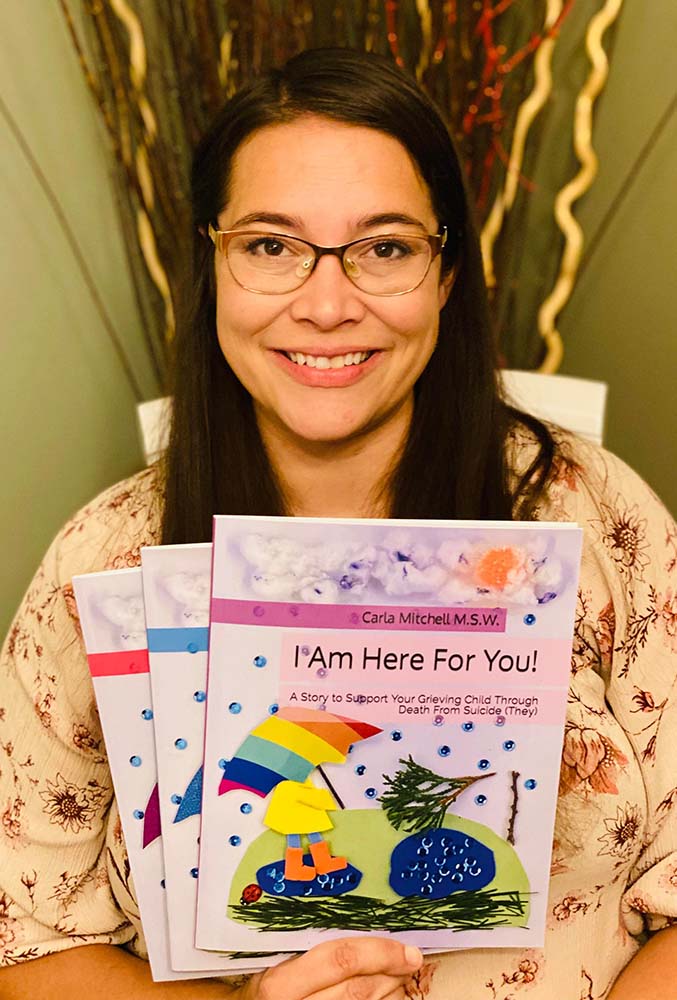
With twin five-year-olds and a two-year-old, Mitchell looked for a storybook to help explain the concept of death to her three daughters. While she found stories about ladybugs and teddy bears, she said she didn’t find any that were about people. She was looking for something with concrete terminology and direct language for children to understand.
“We’re not very good at talking about death as adults,” she said, adding we often use terms like “passed away” or “lost.”
“But to a child, what does that mean? … Or we might just jump right ahead and say they’ve gone to a spiritual world, heaven. If they don’t know about those things already, they might not understand.”
Mitchell said offering clear explanations and being direct with a child helps them to process it. Her family is grieving the loss of her father-in-law, Garry Mitchell, who died in December 2020, due to a medical condition after a chronic illness.
After she couldn’t find what she was looking for, Mitchell decided to write her own series of children’s books that discussed the concept of death. Puddle Jumper Publishing was born; the name inspired by a quote from Julie Stokes of Winston’s Wish: “For adults, grief is like wading through this enormous river, whereas for children it’s puddle jumping, but when they’re in that puddle it’s no different to the river.”
Mitchell said the goal is to find a way to normalize talking to kids about death, in a non-scary way. It ties into her work as an end-of-life doula, where she provides non-medical support to people as they navigate the death process. She helps people connect to the idea that death and dying is a normal part of life.
“It wasn’t that long ago really in society, we were comfortable with death, we understood it,” she said. “We lost touch with a lot of that, and death became hidden and something we didn’t like to talk about … and now where does that leave us, where we don’t have the language to talk, we don’t have necessarily the skill-set to really engage with death and be comfortable with it.”
She noted that the way children grieve is unique from adults. For adults, it is overwhelming, while children tend to grieve in “little chunks or puddles.”
“They may have a lot of questions and then they might go back to playing,” she said. “It may show up in behaviours: tummy aches, tantrums, sleep difficulties, changes at school … the way that they play, you might see death games or drawing pictures.”
Throughout the story, there are various prompts that educate parents about what to watch for, common things they may see, and talking points to help the discussion.
“It’s really meant to be a conversation opener between a grieving child and their caring adult,” Mitchell said. “Just open the floor and let the kid know it’s OK to talk with whoever their caring adult is — if it’s a parent or school teacher, social worker, grandparents … to know that there are resources and it’s OK to talk about death and it’s also OK to talk about the various feelings of grief.”
The first book was launched in September, titled “I Am Here For You: A Story to Support Your Grieving Child Through Death From Suicide.” It is geared toward children ages four to 12 and is available in three different pronouns: he, she and they.
“I felt it was an important thing to start [considering that] rates of suicide among non-binary and trans people are significantly higher than other groups,” she said.
She decided on the first topic after hearing many stories about suicide throughout the pandemic. She has plans to add to the series, focusing on death from natural causes, substance use and cancer. Mitchell also has plans for a more general story about death.
The books are based on the five C’s of children’s grief, Mitchell said. Children may think they caused the illness or death; they worry about catching it, or if they can cure it; they wonder who — if the death was a close family member — will take care of them; they worry about staying connected to the deceased person.
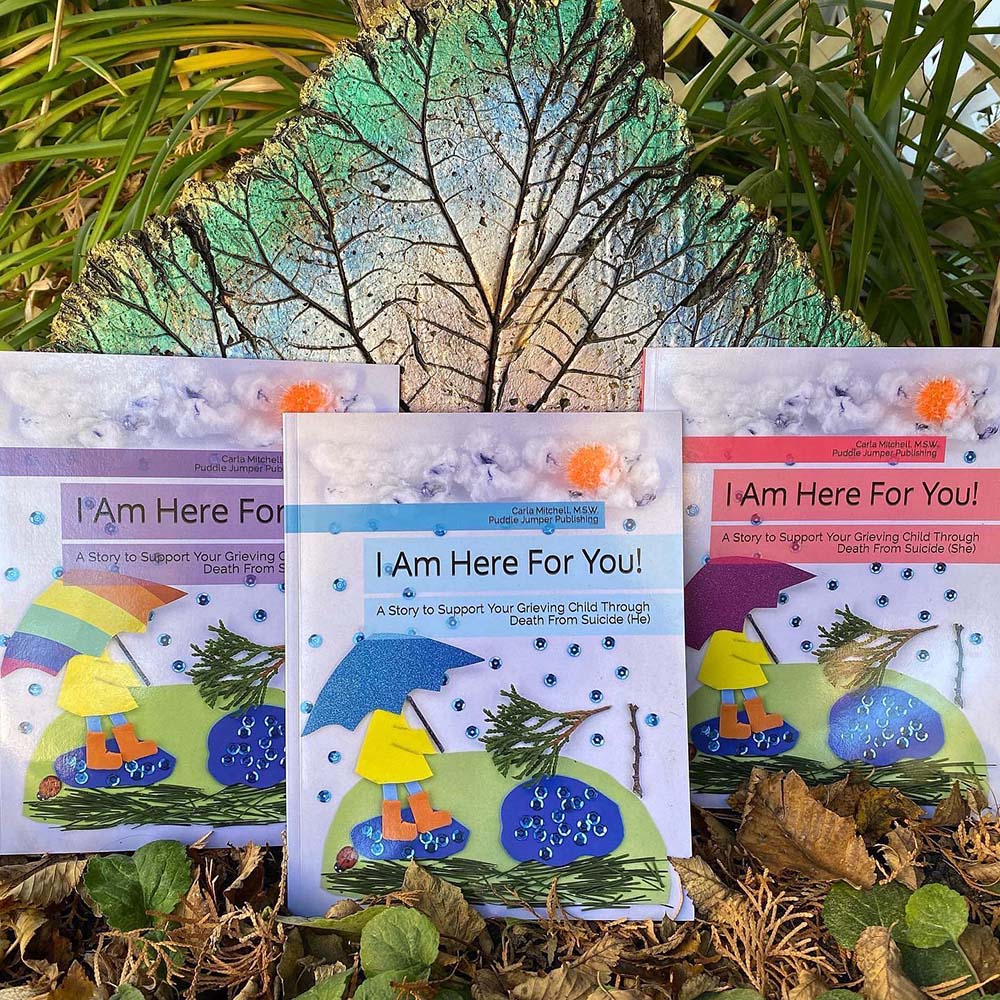
“It gives parents just a basic framework to be able to cover those five questions in a really child-friendly way with rhymes and nice, gentle words and pictures.”
Puddle Jumper Publishing books are available on Amazon. Mitchell said she is working on getting them into a wider distribution network so schools and libraries can easily access the literature.
Nov. 20 marks the International Survivors of Suicide Loss Day. Last month, the Canadian Association for Suicide Prevention announced it has decided to further recognize those impacted by suicide loss by declaring November as the Month for People Impacted by Suicide Loss.
“By CASP recognizing that a monthlong awareness event for people impacted by suicide loss is needed, it allows those individuals, often suffering in silence or alone, to have their stories heard,” stated Sean Krausert, CASP executive director, in a recent press release.
“Eliminating stigma and talking about suicide by the people left behind allows not only for healing but for further education and advocacy in the name of suicide prevention and life promotion.”
Throughout November, CASP will host awareness activities for those who have been impacted by suicide loss. For a full list of planned virtual activities and events, visit www.suicideprevention.ca.
Children’s Grief Awareness Day is Nov. 18. According to childrensgriefawarenessday.org, the day “seeks to bring attention to the fact that often support can make all the difference in the life of a grieving child. It provides an opportunity for all of us to raise awareness of the painful impact that the death of a loved one has in the life of a child, an opportunity to make sure that these children receive the support they need.”
Additional resources include kidsgrief.ca, childrenandyouthgriefnetwork.com, grievingchildrencanada.org and childrensgrieffoundation.org.
» Jillian Austin is a Local Journalism Initiative freelance writer, and a real estate agent with Century 21 Westman Realty.
» jillianaustin.news@gmail.com
» Twitter: @jillianaustin