
Will photo radar, red-light cameras be election issue?
Advertisement
Read this article for free:
or
Already have an account? Log in here »
We need your support!
Local journalism needs your support!
As we navigate through unprecedented times, our journalists are working harder than ever to bring you the latest local updates to keep you safe and informed.
Now, more than ever, we need your support.
Starting at $15.99 plus taxes every four weeks you can access your Brandon Sun online and full access to all content as it appears on our website.
Subscribe Nowor call circulation directly at (204) 727-0527.
Your pledge helps to ensure we provide the news that matters most to your community!
To continue reading, please subscribe:
Add Brandon Sun access to your Free Press subscription for only an additional
$1 for the first 4 weeks*
- Enjoy unlimited reading on brandonsun.com
- Read the Brandon Sun E-Edition, our digital replica newspaper
*Your next Free Press subscription payment will increase by $1.00 and you will be charged $20.95 plus GST for four weeks. After four weeks, your payment will increase to $24.95 plus GST every four weeks.
Read unlimited articles for free today:
or
Already have an account? Log in here »
Hey there, time traveller!
This article was published 30/12/2021 (1594 days ago), so information in it may no longer be current.
If we were looking for a controversial, hot-button issue to increase voter interest in Brandon’s 2022 elections for mayor and city councillors, we may have found it.
On Wednesday, a report by Drew May in the Sun revealed that Brandon City Council is considering the possibility of bringing red-light cameras and photo radar to the Wheat City.
At the Dec. 20 city council meeting, Coun. Bruce Luebke (South Centre) presented a motion to ask the provincial government to give the City of Brandon and Brandon Police Service permission to use “image capturing enforcement systems” in the city. The systems are currently only allowed in Winnipeg.
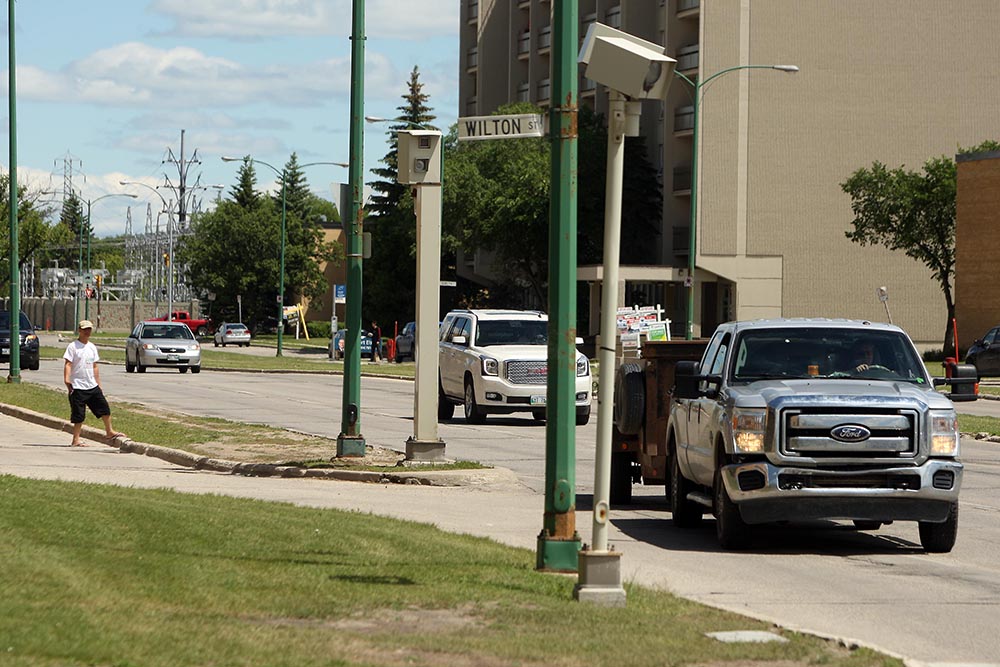
City council agreed to seek more information before approaching the province, but there appears to already be a level of support for using photo radar and red-light cameras.
“I think it’s good to have this in our toolbox if it’s something we want to use at this point in the future,” Luebke says.
Coun. Kris Desjarlais (Rosser) says it would increase safety for everybody on the road, and pedestrians too.
Coun. Shawn Berry (Linden Lanes) told the Sun he doesn’t believe photo radar is the solution to traffic issues in residential areas, but also said: “You can’t just stay stagnant … we have a problem in Brandon with traffic.
“We’re getting to be a busier city, people are always in a hurry, always in a rush,” he added. “Speeds are sometimes ridiculous depending on which street you’re on — and I’m talking even residential.”
To say the use of photo radar and red-light cameras is a polarizing issue is an understatement. I Googled “pros and cons of photo radar,” and found there are 48.2 million results. In other words, a lot of people have a lot to say about it.
There are those who, like Desjarlais, believe the measures make traffic safer by forcing drivers to slow down and pay better attention to traffic lights. That was the conclusion of a Toronto Star editorial this past August, which was re-published in the Winnipeg Free Press.
The editorial, entitled “Speed Cameras Slow Drivers Down. Let’s Add More of Them,” discussed the results of a Ryerson University study in Toronto, which found that “during a warning period in early 2020, more than half the vehicles travelling past the cameras in all zones were speeding.
“Once the cameras started triggering tickets, the percentage of speeders dropped to 36 per cent. Before the cameras, vehicles averaged 18 km/h over the limit in 40 km/h zones. After the cameras, that dropped to just six km/h over.”
Among the many complaints about photo radar and red-light cameras are that photo radar can cause accidents because many drivers slam on their brakes when they realize they are approaching a camera.
Others argue it causes drivers to speed up at intersections in order to get through before the light turns red. Some say the presence of cameras is a form of surveillance and violates their right to privacy.
There are those who complain the ticketing process is unfair because it denies an offender the opportunity to face his accuser in court, but the biggest complaint is that the use of photo radar and red-light cameras is a money grab by local governments. They result in way more tickets, and way more revenue, than under the current enforcement system.
The numbers don’t lie. In 2020, the City of Winnipeg reported more than $9.6 million in revenues from its photo enforcement program. That’s a big number, but more than half of that amount was paid out in expenses, including “salaries and benefits of the Winnipeg Police Service members assigned to work on the Photo Enforcement program on a full-time basis (12.60 per cent) and “the cost of working with outside contractors on enforcement (Conduent and operators) (87.38 per cent).”
Conduent Incorporated is a company based in New Jersey.
In other words, the City of Winnipeg has turned photo radar and red-light cameras into a cash cow, but it is taking millions of dollars out of the local economy annually, and sending a lot of that money to New Jersey.
Is that what we want in Brandon? Or, before renting the cameras, should we try other “traffic calming” measures like redesigning high-speed streets, narrower vehicle lanes, curb alterations, improved signage and increased enforcement?
Those are great questions for your city councillor, and for any candidate who wants to be your next councillor.
» deverynrossletters@gmail.com
» Twitter: @deverynross