
New ag minister wants sector to thrive and survive
Advertisement
Read this article for free:
or
Already have an account? Log in here »
We need your support!
Local journalism needs your support!
As we navigate through unprecedented times, our journalists are working harder than ever to bring you the latest local updates to keep you safe and informed.
Now, more than ever, we need your support.
Starting at $15.99 plus taxes every four weeks you can access your Brandon Sun online and full access to all content as it appears on our website.
Subscribe Nowor call circulation directly at (204) 727-0527.
Your pledge helps to ensure we provide the news that matters most to your community!
To continue reading, please subscribe:
Add Brandon Sun access to your Free Press subscription for only an additional
$1 for the first 4 weeks*
*Your next subscription payment will increase by $1.00 and you will be charged $20.00 plus GST for four weeks. After four weeks, your payment will increase to $24.00 plus GST every four weeks.
Read unlimited articles for free today:
or
Already have an account? Log in here »
Hey there, time traveller!
This article was published 20/01/2022 (1521 days ago), so information in it may no longer be current.
The new agriculture minister is returning to his farming roots as he looks to foster business growth in the province, the recovery of feed and herds to farmers, and preparing for drought ahead of the growing season.
Following the provincial government’s cabinet shuffle on Tuesday, Derek Johnson shared his outlook for Manitoba farmers this year.
“First of all, I want to thank the premier for entrusting me with a very important position like agriculture, and I’m proud to serve under the first female premier of Manitoba,” Johnson told the Sun.
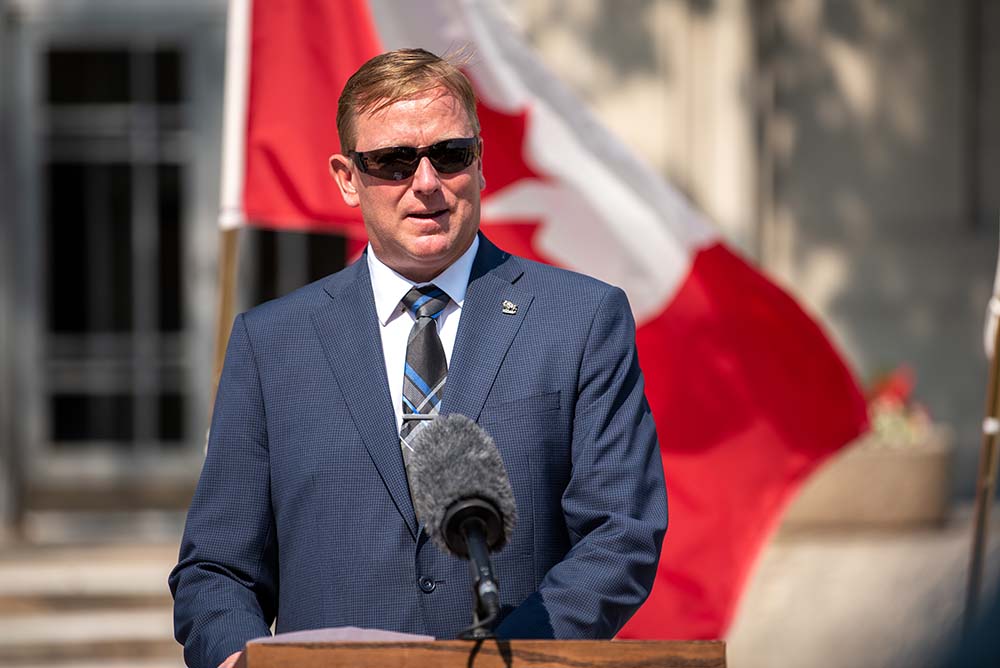
“I would be remiss if I didn’t mention how hard [former] minister [Ralph] Eichler and his department have been a champion for agriculture in Manitoba and quite frankly his ripple effect felt across the country.”
Johnson, the MLA for Interlake-Gimli, previously served as the minister of municipal relations. Now, he is excited to take on a new portfolio and recognized this is a critical time for the agriculture sector.
“I have very large connections with the beef producers in my area, and bringing their voice forward has always been something that I was proud of,” Johnson said.
“It’s one of the main parts of the GDP flowing out of the Interlake. This last year, I believe, agriculture represented 11.5 per cent of our GDP, and that’s a huge portion of our provincial jobs at 7.5 per cent and almost 50,000 jobs that are directly in farming. It’s a huge part of Manitoba’s economy, and we need to make sure that it not only survives but thrives.”
Johnson wants to begin his new position by helping the province attract more ag businesses to Manitoba.
“These businesses, of course, include farmers, but also attracting businesses like Roquette and Merit or dozens more that create the value added right here in Manitoba,” Johnson said.
“When you can use our products locally and put [out] a final product in Manitoba, you’re not paying the shipping to haul that out of the province to have that value added there. Small things like having those [production] plants here prevent the farmers from having to haul their final product so far.”
Johnson said the increase in demand for local processing plants has helped with farm cash receipts across the province and has found both animal and plant protein are key to a sustainable industry going forward. He said recognizing how climate change will affect where businesses want to set up in Canada can bode well for the province based on its energy rates.
“If we make the environment for businesses to come to Manitoba, we have the cheapest power probably across Canada with low hydro costs and access to all the trucking industries. All those added up, to keep the product in Manitoba and have a final product that we sell is very important. When the farmers have a good year, the provincial government has a good year.”
Going into 2022, the minister addressed the readiness to help producers in need, should the province face drought conditions similar to last year. The challenges of both overland flooding in 2011 and droughts struck a chord with Johnson, as he explained how it got him interested in serving the public.
“I grew up on the farm in the Interlake, on the shores of Lake Manitoba, and in 2010 and 2014, I served as a municipal councillor,” Johnson said.
“For all the farmers there that went underwater, it took years for that land to recover, so we do have issues with excess water but also drought. In the last couple of years, I personally toured many farms and I was pleased to attend with the Honourable [federal agriculture] Minister Marie-Claude Bibeau to make her aware of the dire situation. My commitment to my constituents is to bring their voice forward and continue to work on programming that helps them get through this.”
One such program that will be a key focus for this year is the rebuilding the herd program under the AgriRecovery framework. Johnson explained how the program is adding to feed and trade assistance with more than $150 million committed thus far and is in place to help livestock farmers who struggled to maintain and purchase enough feed for their entire herds.
“The final piece of the puzzle is we’re offering a unique herd management program to support producers who had to make those tough decisions on breeding stock and we’re going to help them rebuild their herd after they have the capabilities to feed them at home.
“If there was a farmer that had to sell half of their herd because they only had enough feed for the other half of that herd — say they had 400 and they had to sell 200 of them — this will help them rebuild their herd, whether it’s cattle, bison, elk, sheep, goats, it’s not just straight beef.”
The program will continue through Dec. 31 as of now, and Johnson is encouraging farmers to use the program that many might not be aware of after they seek assistance in feeding their herds.
“You also have to understand that it’s very emotional for a farmer to sell their herd because that is their breeding stock and they have selected genetics over the years to build what they feel is the nicest animal available for sale. Selling their calves is one thing cause that’s income, but selling a herd is hard because it’s a part of them and their family.”
Across Manitoba, the government has started the process of eliminating education tax on farmland over 10 years. After removing 25 per cent in the most recent property tax year in the plan, Johnson said the province will consider options when discussing how much will be removed in 2022.
“We removed 25 per cent in the first year, but with COVID and a lot of the spending we have now, we will have to revisit whether we will do another 25 or 10 per cent this year. I understand how important that is to farmers where their profits are eroded by local taxation.”
Additionally, Johnson said he will meet with Bibeau in the coming weeks to discuss making changes to the federal restrictions in regards to truck drivers crossing the American border and the current vaccine requirement. He said he is aware of the potential supply chain issues should policies stay in place.
“Our province supports mandatory testing, and mandatory vaccines are putting some restrictions on drivers crossing. It’s not something that we can change provincially, but I am attempting to have a call this coming week with Minister Bibeau, and this will be a part of our conversation.”
In a study published by the provincial government, entitled “Manitoba Agricultural Labour Forecast to 2025,” the province has found since 2011, nearly 61 per cent of the Manitoba agricultural workforce has remained in the age bracket of 45 and older. The same study finds by the year 2025, 30 per cent of those people will have retired. Going into the next few years, the minister would like to see the younger generation recognize the importance of contributing to this sector of the economy.
“To encourage younger farmers to get into agriculture, we do have some incentives for them; we have a special loans program for them through Manitoba Agriculture Services Corporation which allows them to purchase land even from family members that are looking to retire,” Johnson said.
“I do feel that a lot of my constituents are definitely in the majority of being older than myself. I just turned 51 the other day. It is a concern as we still have a planet to feed. We need to make sure our ag sector is profitable enough to justify somebody borrowing those large sums of money to get into farming.”
Johnson said it is his goal to keep the province in consultation with both grain and beef producers in the new year and will tour the province in the coming months to help keep agriculture sustainable for everyone in Manitoba.
» jbernacki@brandonsun.com
» Twitter: @JosephBernacki