
Cattle producers struggle with feed shortages
Advertisement
Read this article for free:
or
Already have an account? Log in here »
We need your support!
Local journalism needs your support!
As we navigate through unprecedented times, our journalists are working harder than ever to bring you the latest local updates to keep you safe and informed.
Now, more than ever, we need your support.
Starting at $15.99 plus taxes every four weeks you can access your Brandon Sun online and full access to all content as it appears on our website.
Subscribe Nowor call circulation directly at (204) 727-0527.
Your pledge helps to ensure we provide the news that matters most to your community!
To continue reading, please subscribe:
Add Brandon Sun access to your Free Press subscription for only an additional
$1 for the first 4 weeks*
- Enjoy unlimited reading on brandonsun.com
- Read the Brandon Sun E-Edition, our digital replica newspaper
*Your next Free Press subscription payment will increase by $1.00 and you will be charged $20.95 plus GST for four weeks. After four weeks, your payment will increase to $24.95 plus GST every four weeks.
Read unlimited articles for free today:
or
Already have an account? Log in here »
Hey there, time traveller!
This article was published 25/01/2022 (1694 days ago), so information in it may no longer be current.
It’s no secret just how difficult being a cattle farmer has been in Manitoba over the last year — and this has caused worry for some producers as a new season approaches.
Many beef producers are concerned about whether they will have enough feed to manage the rest of the winter months ahead of an unknown growing season.
“In a lot of ways, it’s been a sh—-y year for everybody, not just farmers, with everything that has been going on,” said Darcy Stewart, owner of GDD Stewart Farms in Clearwater.
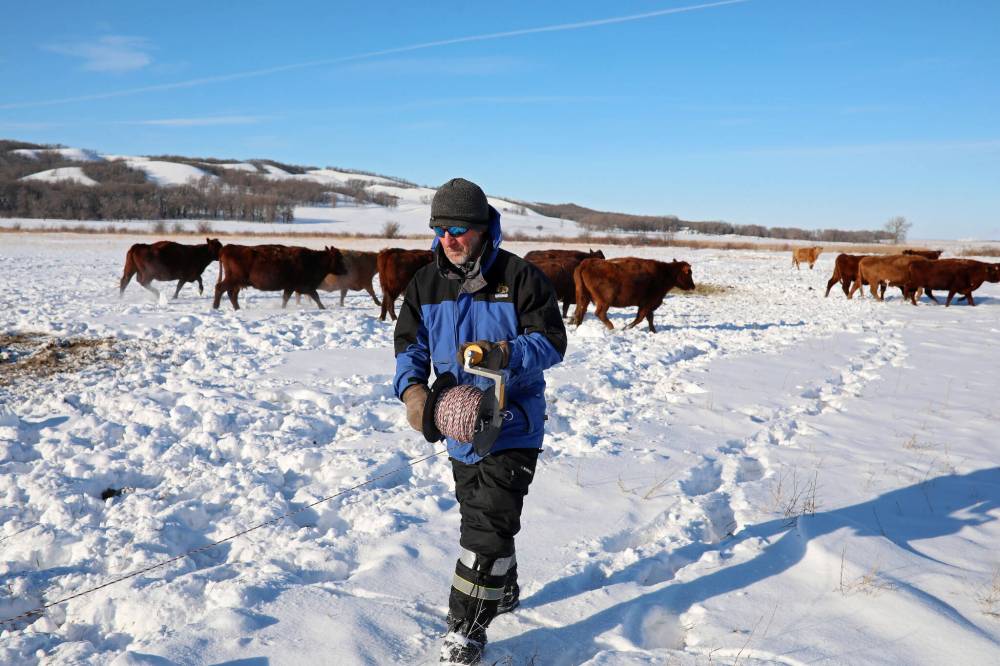
“For us, I think it’s the fact that we’re being forced to change and adjust on the fly and not know what’s going to happen next.”
Stewart began cattle farming in 2007. His family is counting on a good start to the spring with some early rainfall to help recover from last year’s crippling drought in order to ensure enough feed for his farm.
“Right now, we think we’re in pretty good shape. The caveat is that we have less animals that we’re feeding in probably 20 years.
“We’re going to start selling animals sooner than what we usually would. We’re trying to ration our feed as best as possible and the best way for us to do that is to market the animals earlier than normal.”
Stewart feeds his cattle primarily silage, dry hay and straw, but had to improvise last summer and turn to cultivating his corn crops for the herd based on the extremely dry conditions.
“We decided to chop our corn for silage, just to make sure we had a little extra forage on hand, assuming that would be hard to source.”
Over the winter, the family farm was tasked with the difficult decision of selling off a significant portion of its herd and is currently in the process of doing that leading up to the spring.
“We did a heavier than normal cull on our cow herd just so we didn’t have that extra mouth to feed through the winter,” Stewart said.
“Normally speaking, we would keep our calves through and put them on grass and sell them in the springtime. This year it’s just not going to be an option for us.”
Most of his calves will be shipped before March and he expects them to be sold to feedlots in Ontario, where they have had a better previous growing season compared to Alberta, where they would typically go to in the past.
The farmer expects to sell between 300 animals now, which they’d normally keep until spring. Two hundred of those are calves and the other 100 are heifers used to replenish breeding stock.
The Clearwater family isn’t the only farm across the Westman region looking to stay afloat against the pressure of the drought.
“Everybody is concerned. If you could tell us when we’re going to start feeding or be able to go to grass in the spring, they’d be able to tell you if they had enough feed or not,” said Blair McRae, owner of Mar Mac Farms, near Brandon.
“It depends how long we have to be able to feed into the spring.”
McRae said the region has not been affected as much compared to farmers in the Interlake and southeastern half of the province but could see farmers stretched thin in feed supply.
“It was severe enough because we had passes that ran out of water, we had passes that ran out of grass, so we had to do a lot of shuffling of animals that we normally wouldn’t do,” McRae said.
“The hay crops were probably a third of what they normally are, so we were short there.”
McRae was able to source straw from neighbours to extend their silage use and out of need looked for alternative feed sources.
“That’s the saddest thing about the drought, there’s a lot of good cows that probably went to town that guys weren’t really wanting to have to sell, but the feed shortage dictated that they had to.”
Much like Mar Mac, Ian Grossart, owner of Howpark Farms just south of the city, said he has lined up a semi of hay to cover through the rest of winter in order to prevent herd loss.
“We had way less hay than we did the year before. If we don’t get spring rains, we’ll have to make some serious decisions into the summer with the pasture we’re going to have.”
Howpark relies on grown organic hay to give its organically raised herd an excellent source of nutrition. The owner has found if they can’t grow enough organically, relying on buying and sourcing conventional hay is less than encouraging for them.
“The prices now are probably two to three times what they would have been a couple of years ago for cost per pound of hay; that’s a challenge,” Grossart said.

“If we can’t find enough organic hay, then we’d have to feed one portion of those cows conventional hay and then they’d be tagged out of the organic system, which would be a double-whammy.”
Manitoba is in a better situation than feeding lots currently in Alberta, Grossart said, but knows his contemporaries are facing a crunch here, too. It’s a problem that farm couple Jason McLean and his wife, Mylia Richards, sought to get ahead of in spring 2021.
“We implemented a drought strategy last February to prepare ourselves for the oncoming year and hoping it wouldn’t be as bad as it was,” McLean said.
“Being producers for 30-plus years, we started stockpiling feed early before it became a crisis. We acquired a lot of our forage prior to it getting really bad.”
As cattle farmers operating out of Pilot Mound, the couple began purchasing feed in May, and dug a well on their farm on April 1, to mitigate the lack of precipitation.
“We’re very fortunate we implemented that when we did, we saw the signs coming to think ahead.”
The couple has found feed mills and screening pellets to be in short supply resulting in steep costs for feed, similar to what Grossart noticed.
“The feed price coming out of the mills must be triple what they were, which makes it hard for a lot of producers to afford to buy that prepared feed to help them balance their rations with the lower-quality feed they have,” McLean said.
“Prices started to go up last summer; right now they are at a high that we’ve never had to deal with,” Richards said.
Richards, who works as a farm veterinarian, is concerned for producers who aren’t able to supply enough hay and concentrates to their cattle rather than straw, which she has found has less nutritional value.
“They need to up their protein and their energy through grain to help support that use of the straw and the little bit of hay they do have.”
In addition to stockpiling and digging a well, the couple, much like Stewart, bit the bullet and decided to part ways with some of their herd.
“In the spring when we knew our pastures we’re going to be in short supply, we sold cow calf pairs. We’re down 25 per cent of our herd numbers where we were in 2020,” Richards said.
“We only have so much feed and we did the math, and this is how many cows we can keep,” McLean said.
On the positive side, the couple found they could keep more replacement heifers based on a lower feed intake, allowing to regenerate a younger herd moving forward.
At GDD Stewart Farms, the family is hopeful their decision of selling a portion of the herd for income now, will help going forward.
“With every change, you hope that you’re making a positive impact on the future and what’s going to happen in the next year or six years,” Stewart said.
“Everybody is doing things right now that they didn’t think they’d have to do a few years ago. For us, we’re still going to have animals at the end of the day and use them the way we want to. Others haven’t been so fortunate and have had to do what they can do to survive.”
» jbernacki@brandonsun.com