
Art exhibit melds biology, Indigenous perspectives
Advertisement
Read this article for free:
or
Already have an account? Log in here »
We need your support!
Local journalism needs your support!
As we navigate through unprecedented times, our journalists are working harder than ever to bring you the latest local updates to keep you safe and informed.
Now, more than ever, we need your support.
Starting at $15.99 plus taxes every four weeks you can access your Brandon Sun online and full access to all content as it appears on our website.
Subscribe Nowor call circulation directly at (204) 727-0527.
Your pledge helps to ensure we provide the news that matters most to your community!
To continue reading, please subscribe:
Add Brandon Sun access to your Free Press subscription for only an additional
$1 for the first 4 weeks*
*Your next subscription payment will increase by $1.00 and you will be charged $20.00 plus GST for four weeks. After four weeks, your payment will increase to $24.00 plus GST every four weeks.
Read unlimited articles for free today:
or
Already have an account? Log in here »
Hey there, time traveller!
This article was published 26/01/2022 (1515 days ago), so information in it may no longer be current.
Artist Mary Anne Barkhouse’s exhibit “opimihaw” at the Art Gallery of Southwestern Manitoba is the culmination of a lifelong love affair with art and biology.
“Ever since I [was] a kid, I’ve been fascinated with biology and art,” Barkhouse said. “That separation between art and science — I don’t see it as having ever existed.”
Barkhouse is Namgis, Kwakwa̱ka̱ʼwakw, and originally hails from British Columbia. Her experiences as an Indigenous person made her intimately familiar with issues like food sovereignty and ensuring the integrity of the landscape.

In her nation, the major issue is deforestation, Barkhouse said.
She comes from an Indigenous and European background and this is reflected in her art. Her mother is from a famous carving Indigenous family in British Columbia, while her father hails from Nova Scotia.
“From both sides of my family, I’ve had very direct experiences with [land] stewardship,” Barkhouse said. “I’m familiar with both coasts from Nova Scotia to British Columbia, and here I am in the Prairies.”
In her art, she looks to create juxtapositions between Indigenous knowledge and histories with European perspectives to play with audiences.
Her goal is to tease out conversations about the species impacted by changes to the ecosystem and the role people can play in the revitalization of the landscape.
“There’s these two threads that are going through the exhibition and through my artwork.
“I bring my own perspective and background to it, but I also hope that when people are looking at [it], they bring their own experience to it, and that the pieces themselves are open for interpretation, and that people can draw not only an aesthetic appreciation but a personal community thread from the different artworks.”
Barkhouse cited the return of bison to Wanuskewin in Saskatchewan as the major impetus behind the project. The bison are a critical image on the plains and are featured throughout her work in “opimihaw.”
Opimihaw is the name of the creek running through Wanuskewin.
A herd of bison was recently released onto the landscape at Wanuskewin and this event set Barkhouse’s artist mind aflame.
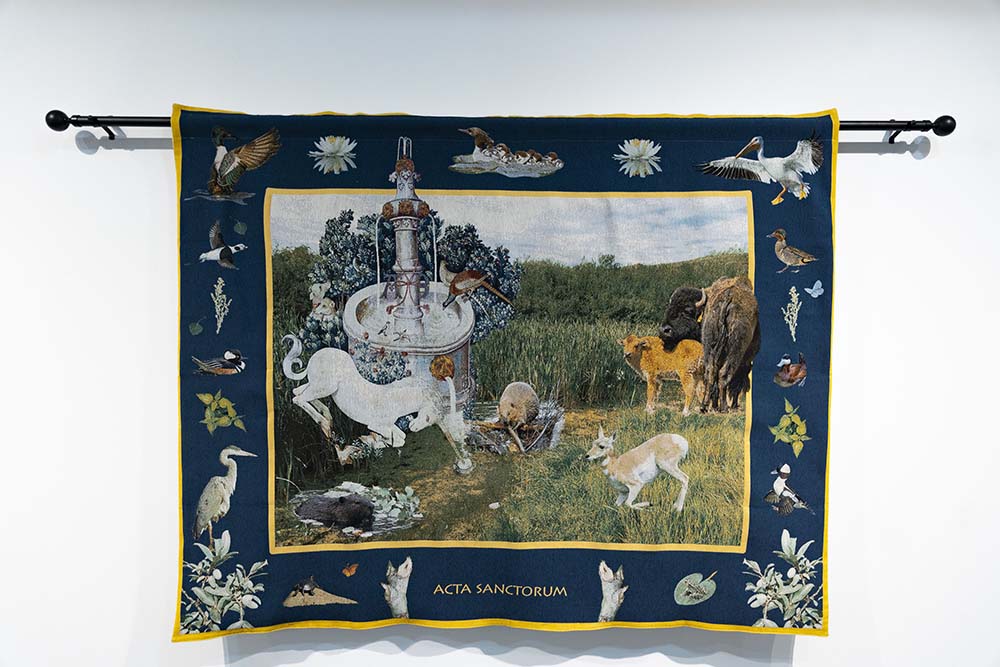
“I was looking into the return of bison from both the ecological perspective and what that meant to the land, and I was also looking at it from the Indigenous perspective and looking for common threads from where I’m from originally,” Barkhouse said. “A lot of the time, things these species do are in direct competition to human interests, which [is] exactly why they’ve been killed over the past hundred years — but they have a job … it’s exciting for me to be showing.”
Barkhouse is known for her work with bronze sculptures, but the “opimihaw” art installation draws on several different materials, including textiles and ceramics.
As visitors make their way through the installation, she hopes they are considering why different animals and materials are featured and what makes them important.
“It goes back to their own personal relationship to land. Their own personal relationship to whatever community they belong to,” Barkhouse said. “They think about those relationships and how there is that cause and effect between the smallest thing you can do and the daily choices that we make.”
Her pieces do not attempt to anthropomorphize the animals. Instead, she focuses on how the animals have been perfectly crafted by evolution to fit their ecological niche.
Barkhouse works to push the idea of the Prairies being the animals’ home so viewers think about what types of guests they are; to help promote this analogy, they are placed in domestic settings.
“Are we terrible house guests?” Barkhouse said with a laugh. “That’s part of what I’m trying to get at by placing these animals.”
Art Gallery of Southwestern Manitoba curator Lucie Lederhendler said it was challenging bringing the exhibit together due to the size of some of the pieces, but she has tried to arrange the displays in a way that gets the audience thinking.
The exhibit speaks to concerns regarding the changing landscape of the Prairies, Lederhendler said, which is a message Westman residents can relate to.
The show is a special exhibit to Brandon, she added, because of Barkhouse’s ability to incorporate biology into her work, inspiring conversations and meaningful dialogue about humanity’s place on the natural landscape.
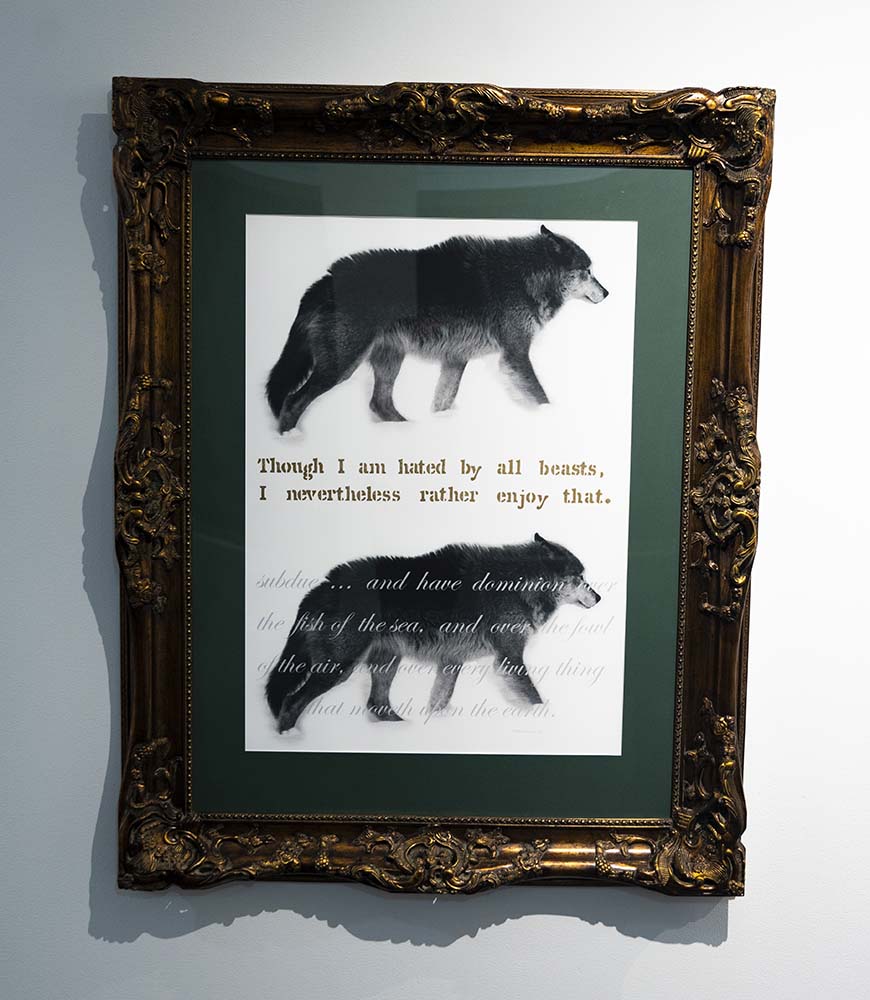
She added “opimihaw” creates a unique worldview that can teach people to see the landscape in new ways.
Lederhendler cited the large Wanuskewin tapestry with bison as an example.
“It’s about creating an interior space and showing how things reference each other,” Lederhendler said.
“opimihaw” has its opening reception, featuring the Sweet Medicine Singers, today at the Art Gallery of Southwestern Manitoba at 7 p.m. A guided tour of the exhibit with Barkhouse will be available Friday at 1 p.m. The art installation will be on display at the AGSM until April 9.
» ckemp@brandonsun.com
» Twitter: @The_ChelseaKemp