
Italy’s president, 80, is recruited to stay on for 2nd term
Advertisement
Read this article for free:
or
Already have an account? Log in here »
We need your support!
Local journalism needs your support!
As we navigate through unprecedented times, our journalists are working harder than ever to bring you the latest local updates to keep you safe and informed.
Now, more than ever, we need your support.
Starting at $15.99 plus taxes every four weeks you can access your Brandon Sun online and full access to all content as it appears on our website.
Subscribe Nowor call circulation directly at (204) 727-0527.
Your pledge helps to ensure we provide the news that matters most to your community!
To continue reading, please subscribe:
Add Brandon Sun access to your Free Press subscription for only an additional
$1 for the first 4 weeks*
*Your next subscription payment will increase by $1.00 and you will be charged $20.00 plus GST for four weeks. After four weeks, your payment will increase to $24.00 plus GST every four weeks.
Read unlimited articles for free today:
or
Already have an account? Log in here »
Hey there, time traveller!
This article was published 29/01/2022 (1515 days ago), so information in it may no longer be current.
ROME (AP) — Italian President Sergio Mattarella was elected on Saturday night to a second seven-year term as the country’s head of state, ending days of political impasse by party leaders that risked eroding the nation’s credibility.
Earlier on Saturday, lawmakers entreated Mattarella, 80, who had said he didn’t want a second mandate, to change his mind and agree to reelection by lawmakers in Parliament and regional delegates. That move followed days of fruitless efforts by political leaders to reach a consensus on another candidate.
Mattarella won in the eighth round of voting when he clinched the minimum of 505 votes needed from the eligible 1,009 Grand Electors. Applause broke out in Parliament, prompting the Chamber of Deputies president to interrupt his reading aloud of the ballots. The count then resumed, with Mattarella continuing on to win 759 votes.
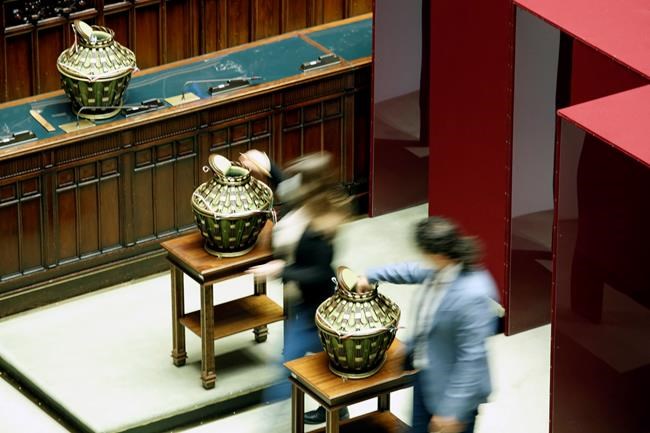
Mattarella’s term ends Feb. 3. Ahead of the presidential election this week, Mattarella repeatedly said he doesn’t want another stint. He even rented an apartment in Rome to prepare for his move from the presidential palace atop Quirinal Hill.
But after a seventh round of balloting in six days in Parliament failed to yield any consensus on a presidential candidate, party whips and regional governors visited Mattarella at the presidential palace to solicit his willingness Saturday.
Rai state TV said Premier Mario Draghi, a non-partisan former chief of the European Central Bank who is leading a pandemic unity government, telephoned party leaders to encourage the lobbying. Draghi had previously indicted he would be willing to move into the president’s role, but some party leaders featured that would prompt an early election.
Mattarella’s willingness to serve again “is a choice of generosity toward the country,” Democratic Party leader Enrico Letta told a news conference minutes before Saturday’s second, conclusive round of voting began.
“You don’t change a winning team,” former Premier Matteo Renzi told reporters.
Former Prime Minister Silvio Berlusconi, who heads the center-right Forza Italia party he founded, said that unity “today can only be found around the figure of President Sergio Mattarella, of whom we know we’re asking a great sacrifice.”
Health Minister Roberto Speranza, who heads a small left-wing party, told reporters that Mattarella’s re-election would be crucial for “stability for Italy.”
The head of the populist 5-Star Movement, Parliament’s largest force, former Premier Giuseppe Conte, told reporters “Mattarella is the guarantor of everybody, impartial, authoritative.”
Conte’s praise for Mattarella was all the more remarkable considering how, when Conte was trying to form Italy’s first populist-led government in 2018, Mattarella intervened and vetoed his pick of a euro-skeptic economist for the post of finance minister, an appointment likely to have shaken financial markets’ faith in Italy to stay in the euro zone.
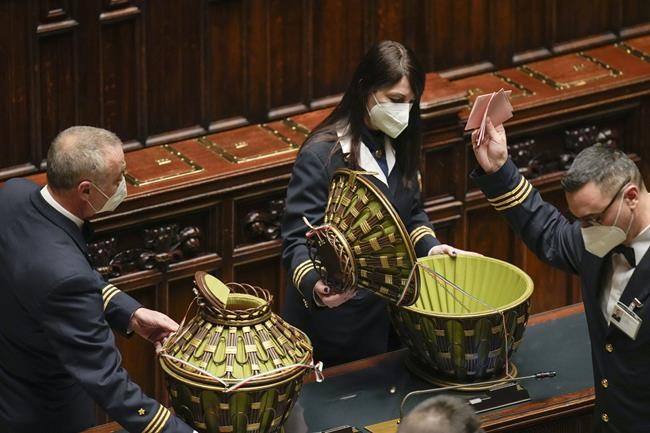
Also lobbying for Mattarella was right-wing League party leader Matteo Salvini, whose candidates failed to take off in the early rounds. In 2019, Salvini suffered the humiliation of seeing Mattarella turn to Conte to form a government, this time without the League, after Salvini yanked his support in a failed bid to grab the premiership for himself.
Italy’s presidency is a generally largely ceremonial role, that sees the head of state make official trips abroad or receives visiting foreign leaders to strengthen Italy’s international relations. On occasion, the president can send legislation back to Parliament to modify aspects deemed not in keeping with the post-war Constitution.
During the pandemic, Mattarella also staunchly backed the nation’s vaccination campaign — one of the more successful ones in Europe — as critical to Italy’s economic recovery.
Mattarella’s brother, Piersanti Mattarella, was assassinated by the Sicilian Mafia in 1980 while serving as that island’s governor.
A Palermo native, Sergio Mattarella began his career in Parliament in 1983. He was active in the Catholic social movement faction of the Christian Democrats, then the dominant post-war party in Italy. Mattarella had been serving as a judge on the nation’s constitutional court from 2011 until his election as head of state on Jan. 31, 2015.