Workshop resurrects pysanky artform
Advertisement
Read this article for free:
or
Already have an account? Log in here »
We need your support!
Local journalism needs your support!
As we navigate through unprecedented times, our journalists are working harder than ever to bring you the latest local updates to keep you safe and informed.
Now, more than ever, we need your support.
Starting at $15.99 plus taxes every four weeks you can access your Brandon Sun online and full access to all content as it appears on our website.
Subscribe Nowor call circulation directly at (204) 727-0527.
Your pledge helps to ensure we provide the news that matters most to your community!
To continue reading, please subscribe:
Add Brandon Sun access to your Free Press subscription for only an additional
$1 for the first 4 weeks*
*Your next subscription payment will increase by $1.00 and you will be charged $20.00 plus GST for four weeks. After four weeks, your payment will increase to $24.00 plus GST every four weeks.
Read unlimited articles for free today:
or
Already have an account? Log in here »
Hey there, time traveller!
This article was published 28/03/2022 (1410 days ago), so information in it may no longer be current.
In the back hall of Eastside Eatery, magical transformations were occurring as simple eggs became cultural icons.
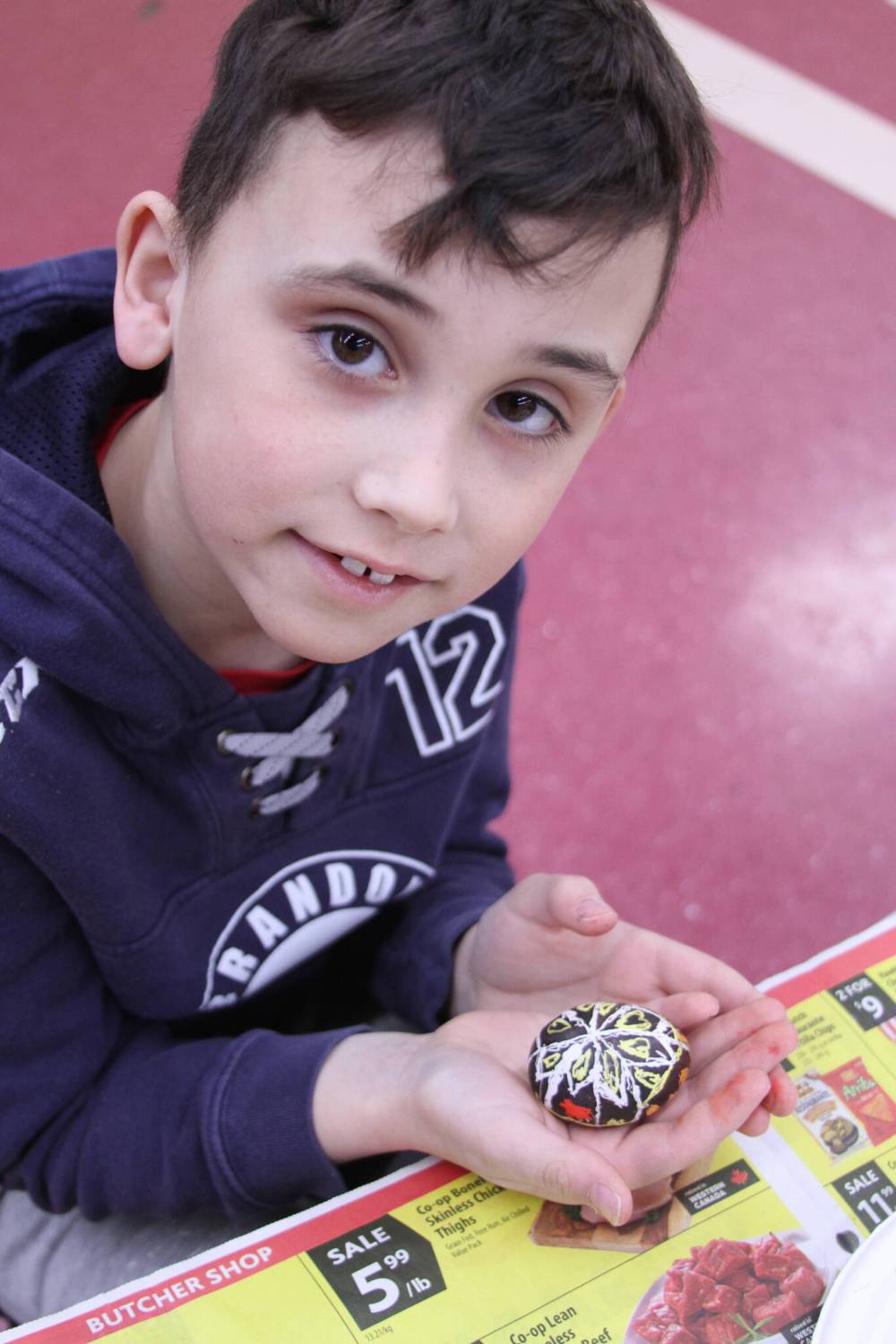
The ancient tradition of pysanky, or Ukrainian Easter eggs, came to life as 14 people gathered to learn, or relearn, how to etch intricate designs on eggs at a workshop held by “The Prairie Babette,” Jen Piwniuk.
“This is a dying art in North America, and because of teachers like me, we still know how to do it,” she said.
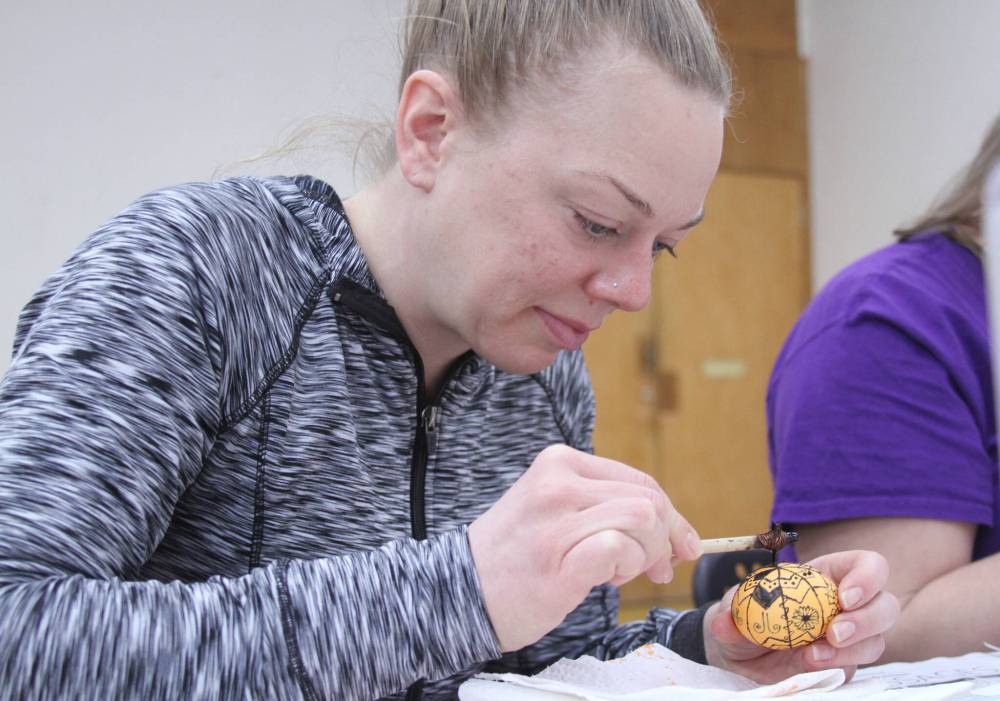
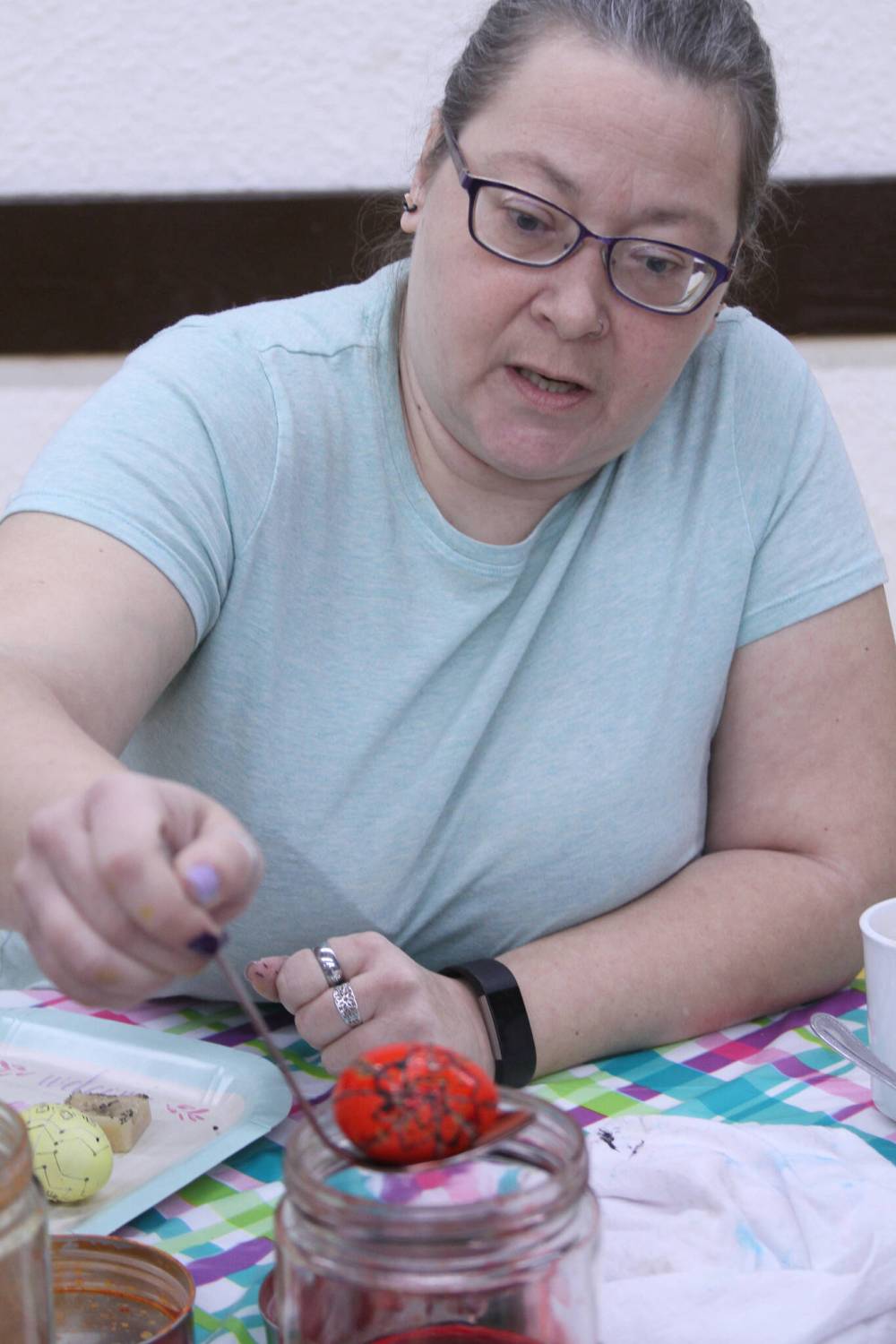
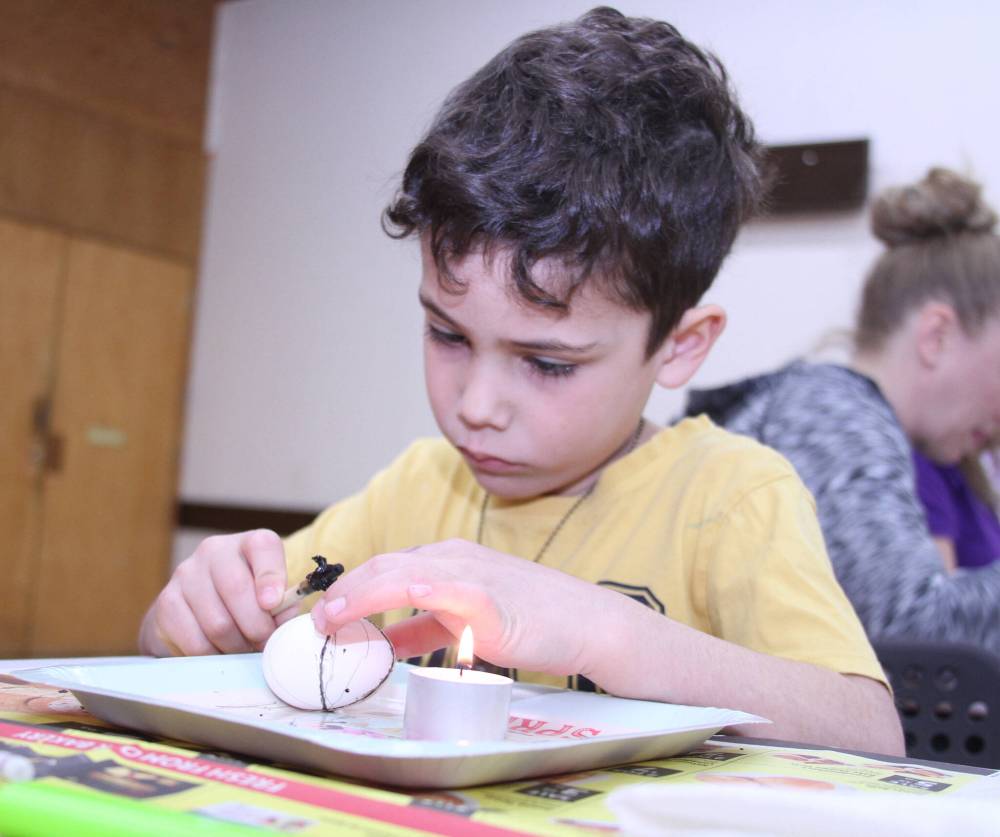
Pysanky is derived from the Ukrainian word for “to write,” which is what the artist is doing — writing a pattern on an egg’s surface. The artform involves drawing geometric designs on eggs using beeswax, water, candles, paper towels and a special stylus called a kitska. Then, using a wax-and-dye process, patterns are laid down on the eggs, ranging from simple to very intricate.
The technique is known as wax-resist, where parts of the egg are covered with wax to prevent it from being dyed. Through multiple layers of waxing, dyeing, rewaxing and redyeing, the pattern is set on the egg surface. The wax is then carefully melted off using a candle and gentle rubbing to reveal the final pattern.
The eggs can be a broad spectrum of colours, Piwniuk said, but she brought four common colours for this workshop: orange, scarlet, black and yellow.
No matter what the pattern, all eggs are finished with either royal blue, purple or black.
It’s an ancient folk art form, dating back to at least the first century AD. Piwinuk said it was originally done on wooden eggs, then chicken, goose, quail eggs and even ostrich eggs.
It’s meditative and a form of blessing, with patterns and symbols having special meanings, from purity, to prosperity, to the cycle of life.
“It’s all about making blessed gifts for people,” Piwniuk said. “When you are writing pysanky, you are infusing those positive intentions into the egg. The colours and motifs all represent something. When you give an egg to someone as a gift, you are giving blessings to that person.”
For most of the participants, this was a return to their heritage.
Darcy Collister said she impressed herself with her own egg after decades away from the craft.
“I haven’t done this since I was a child, and I wanted to take it up again,” she said. “I can see it coming back, if I did a few more. I came here so I could start again with other people rather than try alone and have to buy all the equipment for myself over again.”
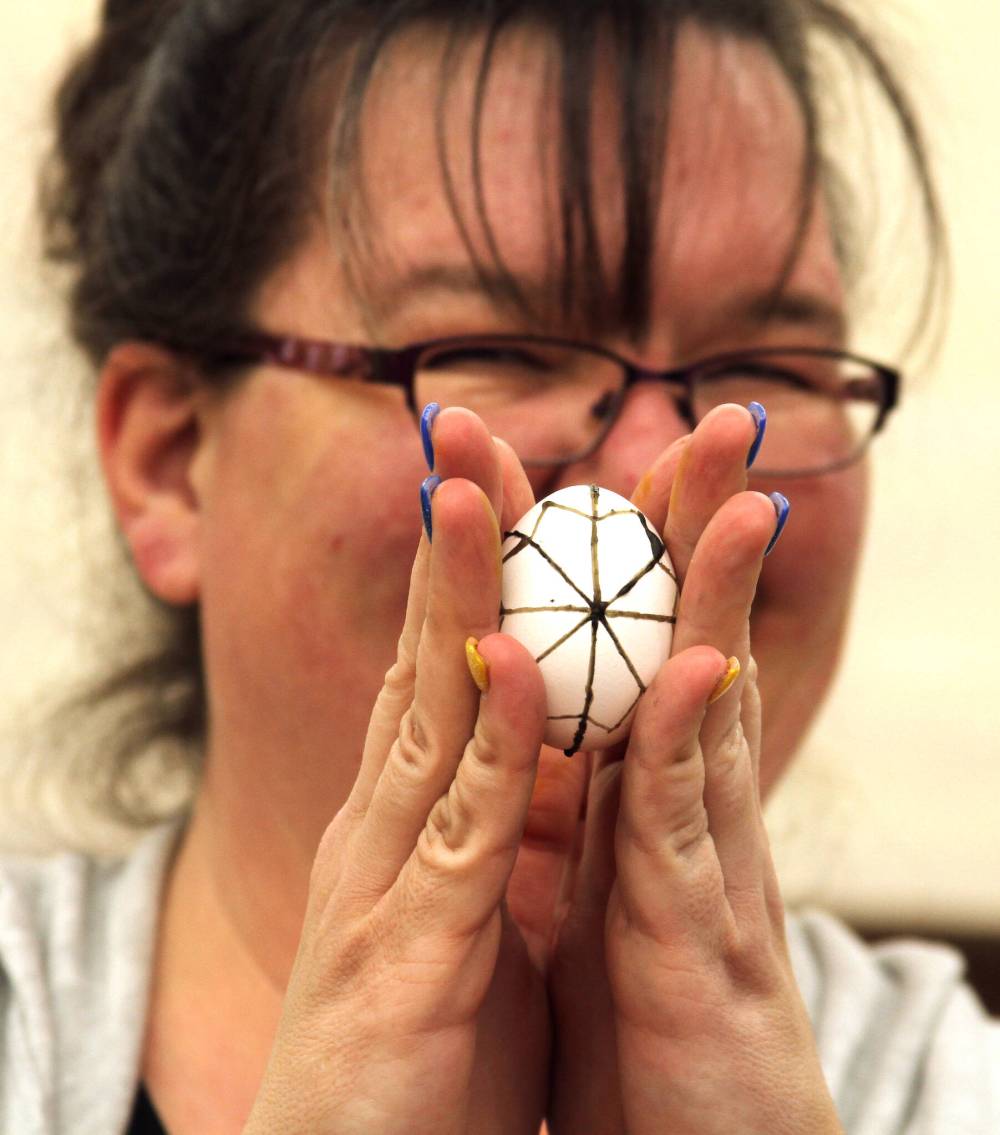
She definitely plans on making more, now that she has taken it up again.
Collister’s daughter, Amber Barkley, said she wanted to try pysanky her whole life, but never did it as a family tradition.
“I’m not sure about how my egg turned out. It’s pretty, but I want to make a million more now that I know how,” she said.
» kmckinley@brandonsun.com
» Twitter: @karenleighmcki1