
Federal budget tackles affordability
Advertisement
Read this article for free:
or
Already have an account? Log in here »
We need your support!
Local journalism needs your support!
As we navigate through unprecedented times, our journalists are working harder than ever to bring you the latest local updates to keep you safe and informed.
Now, more than ever, we need your support.
Starting at $15.99 plus taxes every four weeks you can access your Brandon Sun online and full access to all content as it appears on our website.
Subscribe Nowor call circulation directly at (204) 727-0527.
Your pledge helps to ensure we provide the news that matters most to your community!
To continue reading, please subscribe:
Add Brandon Sun access to your Free Press subscription for only an additional
$1 for the first 4 weeks*
- Enjoy unlimited reading on brandonsun.com
- Read the Brandon Sun E-Edition, our digital replica newspaper
*Your next Free Press subscription payment will increase by $1.00 and you will be charged $20.95 plus GST for four weeks. After four weeks, your payment will increase to $24.95 plus GST every four weeks.
Read unlimited articles for free today:
or
Already have an account? Log in here »
Hey there, time traveller!
This article was published 07/04/2022 (1627 days ago), so information in it may no longer be current.
The 2022 federal budget includes elements aimed at making life more affordable for Canadians, an issue Brandonites are reckoning with as inflation creeps higher.
Canadians looking to save for a down payment to buy their first home will have a new tax-free savings account to use starting next year.
The federal government announced the tax-free first home savings account (FHSA) in the budget Thursday as well as a doubling of the first-time homebuyers’ tax credit up to $1,500 to ease the home-buying process.
Housing prices across the country have soared over the past year as Canadians have flooded into the housing market over the course of the pandemic, making it difficult for many to find a foothold.
The accounts will have a $40,000 lifetime limit on contributions and an annual contribution limit of $8,000. Unused annual contribution room will not be carried forward.
In addition to the sharp rise in home prices, Canadians are feeling pinched by inflation as rising prices for virtually everything else take a larger bite out of their already stretched household budgets.
If a saver does not use the money in their FHSA for a first home purchase within 15 years of opening the account, the account must be closed. Any unused savings may be transferred into an RRSP or RRIF, or withdrawn on a taxable basis.
The budget also includes $475 million in 2022-23 for a one-time $500 payment to those facing housing affordability challenges, but did not include specifics.
Another place where Canadians are hit hard by inflation is at the gas pumps.
On Thursday, most gas stations in Brandon had regular gas priced around 173.9 cents a litre.
Buying electric and hybrid vehicles is one way people can try to get around those costs.
However, electric vehicles typically carry a bigger price tag than their fossil fuel-powered counterparts. For example, a Kia Niro electric SUV starts at $44,995, while the hybrid model of the same vehicle starts at $26,995.
This year’s federal budget includes $1.7 billion over the next five years to make zero-emission vehicles less expensive for Canadians as well as $540 million for businesses to switch their fleets over to zero-emission vehicles.
Additionally, the Canadian Infrastructure Bank will spend $500 million over that same time frame to build infrastructure to support the 1,500 charging stations the federal government has already committed to build.
At Kelleher Ford, general manager Chuck Burton said while fuel prices have shot up this year, increased interest in electric and hybrid vehicles actually kicked off in 2020 and only increased in 2021.
“Last year, we sold more electric and hybrid-electric vehicles than we ever have.”
For vehicles like the all-electric Mustang Mach-E, Kelleher Ford has never had a model linger on the lot for more than a week before selling.
Ford is preparing to release an all-electric pickup truck called the F-150 Lightning later this year, and Kelleher already has 14 reservations from customers.
On balance, Burton said he has seen more interest in all-electric cars than hybrids, which use gasoline engines in concert with electric motors.
He believes the price of fuel is one of the main reasons people are electrifying their transportation, but the lessened environmental impact is also a big draw.
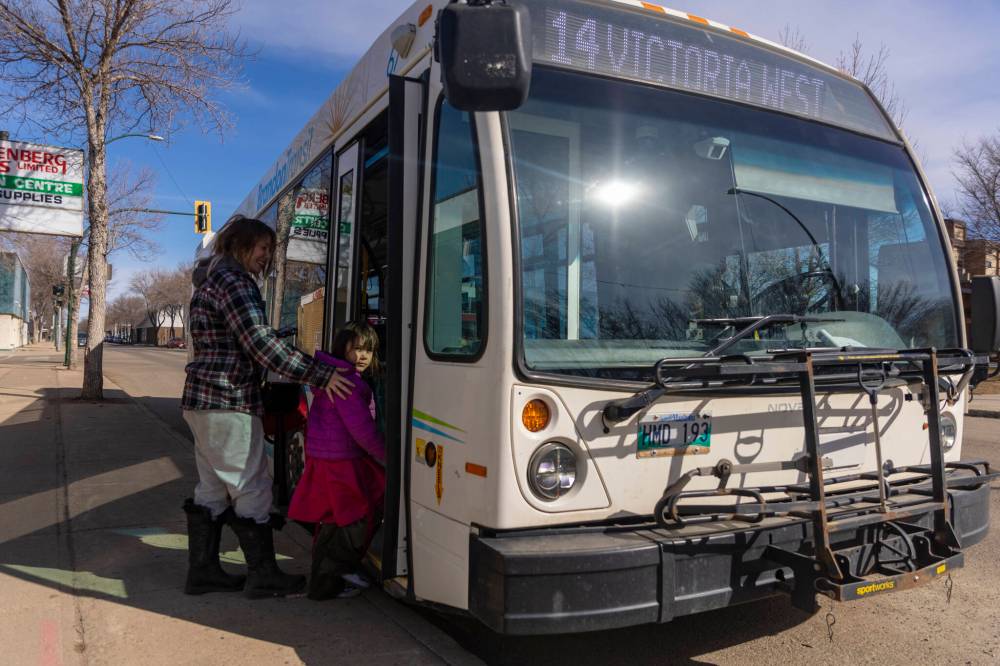
It may also be why people are leaning on alternative transportation options. For instance, Brandon Transit has seen an increase of 10,000 riders from March 2021 to March 2022, according to a City of Brandon spokesperson.
In March 2021, 58,557 rides were taken on Brandon Transit buses, which rose to 69,230 rides in March this year.
However, the spokesperson noted this year’s figures haven’t been audited and ridership is still far below what it was in 2019, before the COVID-19 pandemic started.
The city isn’t sure what exactly has led to an increase in ridership, whether it’s the rising price of fuel, relaxed public health restrictions or something else.
Some people are relying on bikes to help slash their gas bill this spring and summer as the price at the pumps remains at record highs in Manitoba, said Colleen Wirch, co-owner of A&L Cycle.
“When we have shoppers in [the store] they are mentioning, some of them, because of gas prices, they’re going to choose to use their bike a lot more,” she said.
“We do hear that get brought up all the time.”
The stock of bicycles is much better this year than in 2020 and 2021, when many people were rushing to buy bikes as a form of exercise and pandemic restrictions shut other options down, she said. There are still some gaps in inventory, but it is “far better” than before.
“We feel really a lot better about the stock issue this year than last year. Our store is full of bikes. People can come in and most of them are leaving with a bike that day.”
Many people are also buying racks to load groceries or other bags onto their bikes to avoid driving.
Brandon cyclists are also doing more bike tuneups to make sure their two-wheeled transportation is ready for the season, Wirch said. Even when not buying a new bike for commuting or riding, they’re getting maintenance done to prepare.
In 2020, the City of Brandon opened a temporary bike lane on Pacific Avenue as an active transportation method, but traffic and transportation planner Sam van Huizen said the city has “no immediate plans” to bring back the temporary bike lane this year.
“We are always willing to accept feedback from the community and take suggestions and requests under consideration,” he said.
Meanwhile, the price of food rose approximately five per cent in 2021, according to research at Dalhousie University. But Marc Bellon, owner of Prairie Rose Meats and Tendercuts Meat and Deli, said he hasn’t yet had to change prices at his store this year.
“We own an abattoir, so that helps us with the cost. I slaughter my own animals, basically.”
As a result, Bellon said he hasn’t seen a great deal of change in people’s meat consumption. They are still buying beef, pork, chicken and bison.
Any increase in price depends on the market, he said. As the price of grain rises, it costs more to feed the animals, so the price to buy them may increase, too.
Grocery stores struggling to maintain their meat stock during the pandemic drove customers to butchers who had plenty to spare, he said.
“They probably will continue to support us.”
» dmay@brandonsun.com and cslark@brandonsun.com, with files from The Canadian Press
» Twitter: @DrewMay_ and @ColinSlark