
Health care given top billing in provincial budget
Advertisement
Read this article for free:
or
Already have an account? Log in here »
We need your support!
Local journalism needs your support!
As we navigate through unprecedented times, our journalists are working harder than ever to bring you the latest local updates to keep you safe and informed.
Now, more than ever, we need your support.
Starting at $15.99 plus taxes every four weeks you can access your Brandon Sun online and full access to all content as it appears on our website.
Subscribe Nowor call circulation directly at (204) 727-0527.
Your pledge helps to ensure we provide the news that matters most to your community!
To continue reading, please subscribe:
Add Brandon Sun access to your Free Press subscription for only an additional
$1 for the first 4 weeks*
- Enjoy unlimited reading on brandonsun.com
- Read the Brandon Sun E-Edition, our digital replica newspaper
*Your next Free Press subscription payment will increase by $1.00 and you will be charged $20.95 plus GST for four weeks. After four weeks, your payment will increase to $24.95 plus GST every four weeks.
Read unlimited articles for free today:
or
Already have an account? Log in here »
Hey there, time traveller!
This article was published 12/04/2022 (1626 days ago), so information in it may no longer be current.
While the province has touted the importance of health-care spending and pandemic recovery, government officials delivered a budget with plenty of tax cuts on Tuesday.
Budget 2022 features a projected deficit of $548 million, down from a $1.597-billion deficit run last year when the COVID-19 pandemic was in full swing.
Health-care spending was emphasized through billions of dollars in funding for new and old programs.
This includes $110 million for the province’s surgical and diagnostic backlog, $17 million toward the first year of a five-year plan to tackle mental health, $52 million in combined funding to improve health-care and care home conditions for seniors, $11 million to boost enrolment at Manitoba’s post-secondary nursing programs and $630 million for the continuing response to COVID-19.
No target date was set for clearing the surgical and diagnostic backlog.
It also includes $812 million in capital projects for rural and northern Manitoba under the province’s clinical and preventative services plan, though many elements of that plan, such as hospital expansions in communities like Brandon and Dauphin and new hospitals in places like Portage la Prairie and Neepawa, had been previously announced.
Two elements of the budget relating to health care in Brandon appear to be new.
The first will expand capacity for dialysis treatments in Brandon by 12 patients as part of a $1.8-million investment in renal care.
Additionally, funding has been set aside to create a behavioural care unit at Fairview Personal Care Home.
The Progressive Conservative government says it plans to boost the education tax rebate for residential and farm properties to 37.5 per cent from 25 per cent, which would save the average homeowner $196 a year. A similar tax credit for renters is to be expanded to more recipients, including people in social housing.
The Tories have already promised to phase out the education tax over several years, although they are moving to do so more slowly than former premier Brian Pallister had discussed before he retired last fall and was succeeded by Heather Stefanson.
The government is planning to cut annual registration fees for most non-commercial vehicles by another $10, following two similar cuts in recent years.
Some companies are to get a break as the province increases the threshold at which employers pay a tax on their payroll to $2 million from $1.75 million in total remuneration.
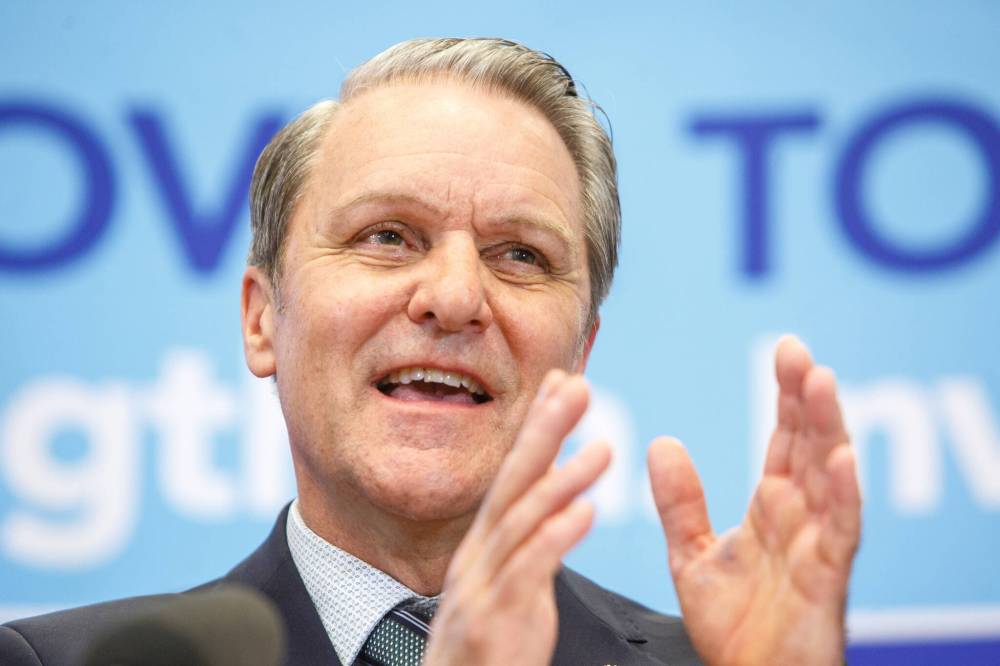
Finance Minister Cameron Friesen said the government can cut taxes at a time when health care is stressed and deficits are ongoing.
“We simply think it’s not correct to make Manitobans wait. We think that they need relief now. They need affordability now,” Friesen said Tuesday.
With expected economic growth and a rise in federal transfer payments, the province is forecasting a deficit of $548 million, down from $1.4 billion in the last fiscal year. With the exception of a small surplus in 2020, Manitoba has not seen a balanced budget since 2008 and is not expecting to see another until 2028.
The number of times Brandon is mentioned in the full text of the 182-page budget document is 13 times.
However, 10 times are for previously-announced programming, one mention is made of Brandon University and the final two occurrences are for the health-care programs previously mentioned by the Sun.
The previously-announced programming mentioned in relation to Brandon includes the continuation of a virtual COVID-19 outpatient program, $70 million for upgrades at Brandon Regional Health Centre and the Western Manitoba Cancer Centre announced last summer, a continuation of the forensic nurse examiner program announced earlier this month, previously announced funding for upgrades at Brandon’s water treatment plant, three respite home beds announced last August, supportive recovery-housing units being made in partnership with Westman Youth for Christ announced last December, and the continuation of a home nutrition and learning program started in June 2020.
In a media call with rural media outlets Tuesday afternoon, Friesen was asked about the long-term funding plan for education after the education property tax is completely phased out.
“We have undertaken to form that new committee that is going to study education funding,” he said. “We want to make sure that it looks equitable across the province of Manitoba — urban, rural, north, south, east, west. It’s very important that we have a new formula. Our formula is broken.”
Last December, Brandon Mayor Rick Chrest told previous finance minister Scott Fielding he was hopeful for a funding increase for municipalities in the upcoming budget after years of no increases and belt tightening.
On Tuesday, Friesen talked up maintaining current funding, COVID supports for municipalities and new infrastructure spending, but didn’t say anything about a boost to yearly grants.
In an interview with Manitoba NDP Leader Wab Kinew, the opposition leader criticized the lack of extra resources for municipalities and more from the budget. He said he believes that what was announced on Tuesday won’t put anyone in a better economic position and will only lead to more health-care cuts down the road.
“What we saw today is just a continuation of Brian Pallister’s plan,” Kinew said. “It’s a lot of the same initiatives, a lot of the same announcements, and I expect more of what we saw under his time, which is basically they make a lot of announcements but then they always underspend and underdeliver and fail to follow through in the way that Manitobans need them to.”
Kinew said it’s hard to believe the government’s plans to fix health care when a lot of the problems are due to their own cuts to the system.
“It didn’t meet the hype,” Manitoba Liberal Leader Dougald Lamont said about the budget. “We were told to stay tuned, we were promised all sorts of excitement, but it turned out to be more of a rerun, a retread than anything really bold. What really needed to happen was a big investment in people, whether that’s in education or in health care. We really need to do much more to keep nurses working in the system and make the system a better place to work in.”
In a statement issued Tuesday afternoon, CUPE Manitoba slammed the budget, saying it’s putting public services at risk.
“Manitobans expect to see a budget that protects the public services they rely on,” says Gina McKay, president of CUPE Manitoba. “This government continues to cut taxes for ideological reasons rather than fully supporting our schools and health care facilities.”
The Manitoba Organization of Faculty Associations, which represents post-secondary staff in the province, issued its own statement saying the current government’s policies are harming universities.
“What we see through cuts, year after year is the deliberate downsizing and hollowing out of our universities,” MOFA president Scott Forbes said.
“Our students pay more to get less. Premier Stefanson continues Brian Pallister’s policy of austerity in education. In doing so, she simply ignores the role of higher education in economic development. Our graduates are fully employed, collect higher salaries, pay more taxes; enjoy more rewarding careers and lives. But it seems Premier Stefanson doesn’t want our students to have those nice things.”
The continued phasing out of education property tax on farm properties as well as infrastructure, child care and labour elements were welcomed by Keystone Agricultural Producers (KAP).
“Access to affordable and accessible childcare in rural areas has been an ongoing concern for young Manitoba farmers,” KAP president Bill Campbell stated in a release. “KAP is encouraged by the news of investments into childcare aimed at improving affordability and accessibility of a much-needed service for Manitoba farm families.”
Doctors Manitoba, which has frequently criticized the province for its handling of the health-care system — especially during COVID-19 — had some faint praise for the budget.
“From a financial perspective the Manitoba budget has appropriately prioritized investing in health care, though the results will be measured not by dollars spent but by shortening wait times, clearing the pandemic backlog, and recruiting and retaining more nurses, doctors and other health care workers to ensure patients get the care they need,” president Dr. Kristjan Thompson said in a statement.
» cslark@brandonsun.com, with files from The Canadian Press
» Twitter: @ColinSlark