
Russian troops planted mines in playgrounds and parks in Ukrainian town: Joly
Advertisement
Read this article for free:
or
Already have an account? Log in here »
We need your support!
Local journalism needs your support!
As we navigate through unprecedented times, our journalists are working harder than ever to bring you the latest local updates to keep you safe and informed.
Now, more than ever, we need your support.
Starting at $15.99 plus taxes every four weeks you can access your Brandon Sun online and full access to all content as it appears on our website.
Subscribe Nowor call circulation directly at (204) 727-0527.
Your pledge helps to ensure we provide the news that matters most to your community!
To continue reading, please subscribe:
Add Brandon Sun access to your Free Press subscription for only an additional
$1 for the first 4 weeks*
- Enjoy unlimited reading on brandonsun.com
- Read the Brandon Sun E-Edition, our digital replica newspaper
*Your next Free Press subscription payment will increase by $1.00 and you will be charged $20.95 plus GST for four weeks. After four weeks, your payment will increase to $24.95 plus GST every four weeks.
Read unlimited articles for free today:
or
Already have an account? Log in here »
Hey there, time traveller!
This article was published 10/05/2022 (1654 days ago), so information in it may no longer be current.
OTTAWA – Foreign Affairs Minister Mélanie Joly says Russian troops planted mines in playgrounds, parks and in front of family homes in Irpin, a town she recently visited with the prime minister.
Joly visited Kyiv and Irpin on Sunday with Prime Minister Justin Trudeau during a surprise visit to Ukraine to reopen Canada’s embassy.
The foreign minister said she was told not to step off the sidewalk in Irpin because the Russians planted so many mines in the town, including around people’s homes, before troops retreated.
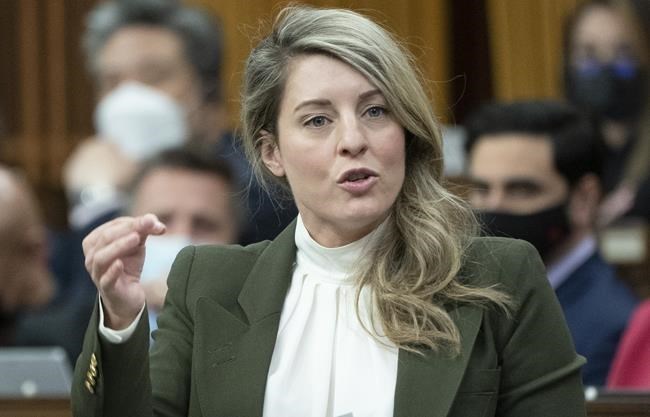
“They were putting mines everywhere, not only around condo complexes that we saw that are completely bombarded … but they were putting mines in playgrounds, in parks, in front of houses, behind houses,” she said in an interview Tuesday from Berlin.
Joly said Irpin was strategically important to the Russians in their push to capture Kyiv. It is next to Bucha, where Russian atrocities directed at civilians are being investigated as war crimes.
She said 50,000 civilians were evacuated from Irpin, which was popular with young families before Russia invaded.
“Irpin is a city that could be compared to a suburb of Toronto or Montreal,” she said. “It is a city that is very much a place where first-time homebuyers go. Young families buy their first homes there, their first condo apartment, that is where they have their children. There are lots of playgrounds, usually lots of strollers.”
Even though Russian troops have left, she said it is still too dangerous for families with children from the Kyiv suburb to return until the mines are mapped, so they can be avoided, and then cleared.
The minister said Canada is skilled in mine clearance and is providing expertise to Ukraine, as well as $2 million in funding for the Halo Trust, which clears mines and explosives.
“We are specialists in demining,” she said. “We were the ones who created the international convention on landmines. We also have Canadian technology to deal with landmines. We have a lot of expertise.”
She said Canada is also supporting education about the danger of mines for Ukrainian adults and children.
During the visit with Joly and Deputy Prime Minister Chrystia Freeland, Trudeau reopened the Canadian Embassy in Kyiv and expressed unwavering support for the embattled country.
He met Volodymyr Zelenskyy in person for the first time since Russia invaded in late February, and announced $50 million in fresh Canadian military support for Ukraine, including drone cameras, satellite imagery, small arms and ammunition, as well as funding for demining.
This report by The Canadian Press was first published May 10, 2022.
Related Articles
Ukraine to hold first war crimes trial of captured Russian
Advertisement Advertise With Us