
Grain companies push for road improvements
Advertisement
Read this article for free:
or
Already have an account? Log in here »
We need your support!
Local journalism needs your support!
As we navigate through unprecedented times, our journalists are working harder than ever to bring you the latest local updates to keep you safe and informed.
Now, more than ever, we need your support.
Starting at $15.99 plus taxes every four weeks you can access your Brandon Sun online and full access to all content as it appears on our website.
Subscribe Nowor call circulation directly at (204) 727-0527.
Your pledge helps to ensure we provide the news that matters most to your community!
To continue reading, please subscribe:
Add Brandon Sun access to your Free Press subscription for only an additional
$1 for the first 4 weeks*
*Your next subscription payment will increase by $1.00 and you will be charged $20.00 plus GST for four weeks. After four weeks, your payment will increase to $24.00 plus GST every four weeks.
Read unlimited articles for free today:
or
Already have an account? Log in here »
Hey there, time traveller!
This article was published 10/05/2022 (1425 days ago), so information in it may no longer be current.
Overland flooding in Manitoba has exposed the cracks in provincial infrastructure, say Holland-area grain companies whose shipping routes have been disrupted by floodwaters.
The companies want the province to increase road weight restrictions for transporting goods in order to avoid significant detours when their regular routes are closed.
According to Megan Kemp, sales and purchasing manager for Zeghers Seeds, an independent seed wholesaler, her company lost thousands of dollars in unexpected freight charges from May 2-9.
“It cost us [an additional] $10,000-plus in freight charges … this week because I rerouted trucks from Winnipeg to Brandon, back to Holland,” Kemp said.
What normally would be a 140-kilometre drive from Holland to Winnipeg more than doubled when a portion of Highway 2 became inaccessible for traffic due to a flooded segment of road between the communities of Rathwell and St. Claude on May 2.
Kemp said she was forced to reroute trucks over the past week back toward Brandon because of the lack of north and south highways that support the required weight restrictions for semi-truck trailers.
Manitoba uses RTAC, a weight-loading classification standard to which commercial vehicles must conform. For example, if a semi-truck trailer has the capacity to carry 1,000 pounds worth of goods, the driver must abide by provincial highway restrictions, which may limit that amount to 90 per cent, or 900 pounds.
Craig Soldier, economic development officer for the Rural Municipality of Victoria, which is 115 kilometres southeast of Brandon, said highway engineers will determine how many inches of asphalt and base they need to implement underneath a highway to support 100 per cent capacity.
Based on the lack of RTAC-certified highways allowing for 100 per cent capacity nearby, Zeghers Seeds was unable to access Highway 13, the closest route that would take its drivers from Highway 2 to Winnipeg.
Instead, the company’s drivers had to take a 325-kilometre detour. Kemp said Zeghers Seeds lost $1,000 per load, based on the higher cost of fuel and other inputs due to the increased distance. She said this affected 10 loads over the last week. The company normally uses Highway 10 when travelling from the west, and Highway 13 from the east.
“There needs to be more north and south roads that are sustainable to becoming RTAC. It really affects a lot of businesses with highway[s] 5 and 34.”
Kemp said highways 5 and 34, the closest access routes to Holland to the Trans-Canada Highway, are restricted to 90 per cent and 65 per cent capacity, respectively.
Zeghers Seeds makes use of grain shipping via ocean containers and intermodal freight transport. It requires the company’s grain to be placed on rail, which can only be offloaded in Winnipeg, not in Brandon.
She said the province is failing to invest in its roads.
“Highway 34 has a bridge that is falling apart; it’s barely safe for traffic and it’s been like that for over 10 years.”
A spokesperson for the provincial department of Transportation and Infrastructure said the government recognizes that Highway 34 and Highway 5 are important routes for agricultural producers in the area.
Manitoba Transportation and Infrastructure (MTI) recently held an online public engagement regarding the Routes: Trade and Commerce grid strategy, which included sections of Highway 34 and Highway 5. MTI has also been working with local governments to develop a prioritized list of upgrades to provide an unrestricted route between Highway 3 and the Trans-Canada Highway.
But Darrell Callewaert, grain elevator manager for Patterson Grain, is worried the province has waited too long to increase weight capacity along highways in southwestern Manitoba.
“The infrastructure in our province is deteriorating in front of our eyes and it doesn’t seem to be a concern for the provincial government,” Callewaert said. “With Highway 2 closed, we were completely cut off.”
On Monday afternoon, Manitoba Highways announced the segment of Highway 2 had reopened to traffic with reduced speeds based on surface conditions.
Years ago, the Patterson Grain terminal lost its rail service, requiring the majority of its grain to be transported via trucks heading east to its Winnipeg or Morris terminals.
Callewaert said he sympathizes with the trucking industry more than ever based on the demands it has faced with rising fuel costs and inflation.
“We’ve already bought the grain, [now] we’re asking the trucking organizations to haul it at the same price as we estimated, and now they’ve got to haul smaller loads at further distances,” he said.
Callewaert said there are instances in the case of Highway 34 where semi-trucks can’t meet the weight restriction simply with an empty trailer because their steering axles put them over the limit, thus requiring significant detours, which adds extra mileage.
“Somewhere along the line, the governments of this country want us to use less fuel, conserve energy and worry about the environment, and they are forcing us to keep supply chains going and forcing us to burn more fuel than is necessary,” he said.
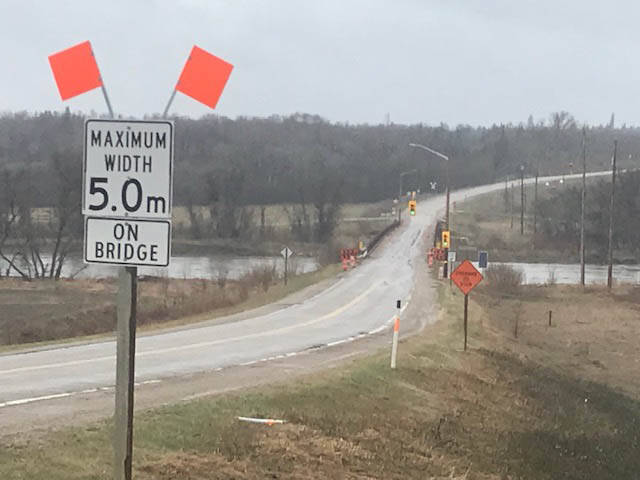
Soldier has been demanding change for improvement to the bridge that covers the Assiniboine River on Highway 34. The current single-lane bridge that Kemp referenced has been in disrepair for years.
“At one point, you could actually see through the asphalt into the water,” Soldier said.
The provincial spokesperson said the bridge on Highway 34 is currently restricted to a single lane over the structure and a preliminary design is complete that recommends a new bridge on a new alignment on the east side of the location of the existing bridge. A detailed design for the bridge is almost complete, and construction is planned to start between 2022 and 2023, with a deadline set around 2024 or 2025.
» jbernacki@brandonsun.com
» Twitter: @JosephBernacki