
Home sweet hive
City green-lights BU beekeeping project despite opposition
Advertisement
Read this article for free:
or
Already have an account? Log in here »
We need your support!
Local journalism needs your support!
As we navigate through unprecedented times, our journalists are working harder than ever to bring you the latest local updates to keep you safe and informed.
Now, more than ever, we need your support.
Starting at $15.99 plus taxes every four weeks you can access your Brandon Sun online and full access to all content as it appears on our website.
Subscribe Nowor call circulation directly at (204) 727-0527.
Your pledge helps to ensure we provide the news that matters most to your community!
To continue reading, please subscribe:
Add Brandon Sun access to your Free Press subscription for only an additional
$1 for the first 4 weeks*
- Enjoy unlimited reading on brandonsun.com
- Read the Brandon Sun E-Edition, our digital replica newspaper
*Your next Free Press subscription payment will increase by $1.00 and you will be charged $20.95 plus GST for four weeks. After four weeks, your payment will increase to $24.95 plus GST every four weeks.
Read unlimited articles for free today:
or
Already have an account? Log in here »
Hey there, time traveller!
This article was published 08/06/2022 (1569 days ago), so information in it may no longer be current.
Brandon City Council approved a beekeeping operation on the roof of Brandon University’s Harvest Hall after a public hearing Monday.
“If it sounds creative, it’s because it is,” said Ryan Nickel, the city’s director of planning. “The city has no rules for urban beekeeping.”
He said the idea is worthy of investigation to see if it works, and it could have further benefits going forward to establish beehives for research and urban agriculture projects.
Since the hives are on the roof, he said he doesn’t believe it will be a danger to local residents.
Because the city currently doesn’t have standards for beehives, he said it was hard to determine a limit though researching a similar program in Winnipeg was helpful.
The variance order is in place for five years, which Nickel said is a good amount of time to assess potential benefits or risks.
Other than the time limit, there is another condition for the variance: the project must have a licensed apiarist available to guide it. Apiarists are people who study bees or act as beekeepers.
Though the variance allows for up to four hives, there will only be two in place at the start. There will be approximately 20,000 to 80,000 bees per hive.
Coun. Barry Cullen (Victoria) said he liked that this project would be on a roof and therefore isolating people from risk, but asked Nickel about this opening the door to hives being introduced elsewhere in the city like in backyards.
“We haven’t received a lot of requests for beekeeping, so I don’t think it’s going to be a floodgates-open type of thing,” Nickel replied.
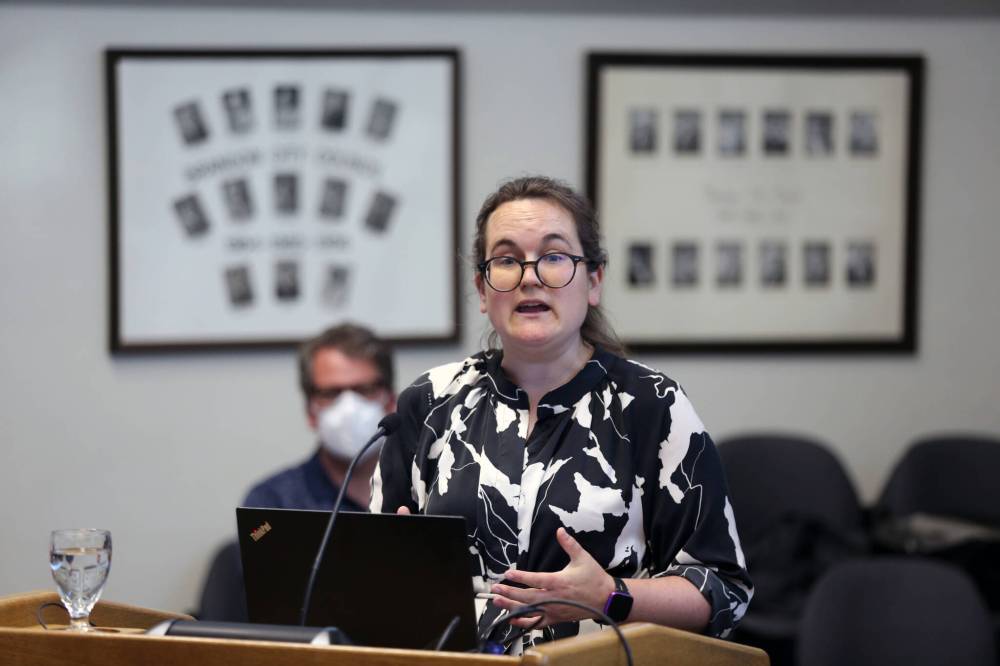
Speaking on behalf of the university, English Prof. Deanna Smid said she didn’t know how timely the idea of introducing beehives was when the proposal was made. There was a large die-off of bees over winter and the apiarist working with the university had 80 per cent of their own bees die.
Other than providing pollination for local plants, she said this could allow for testing of bees outside of Winnipeg for things like health, mite infestations and more if the program is successful. Another hope is that it could inspire similar projects in the future.
With regard to safety, the placement of the hives on the roof of Harvest Hall will serve as a deterrent to people getting too close.
“That’s where the greatest risk of bee stings occurs, right near the hive,” Smid said. Overall, the bees are expected to travel only within a five-kilometre radius of the hives.
The beekeeper working with the university is from a family with more than 100 years of experience with the insects and will work to discourage aggressiveness.
According to her, the City of Calgary has an urban beekeeping program and has seen fewer than 10 complaints a year. Most of those complaints are from neighbours annoyed that bees are looking for water sources in their yards.
In 2019, the City of Saskatoon reported three total complaints, all related to bees looking for water.
Coun. Jeff Fawcett (Assiniboine) told Smid he was glad the university was taking the lead on the project because he knows those involved will record the data from the project accurately.
He asked Smid if the bees could possibly be aggressive. She said only if the bee felt that it or the hive was threatened, like if it was stepped on or captured while trying to forage.
Swarms of bees are usually more docile than individual bees, Smid said. If the beekeeper believes the hive is becoming too aggressive, he’ll switch out the queen for one of his own, which is calmer.
Fawcett also asked if the bees could be affected by mosquito fogging, but Smid said they’ll likely be at their hive by the time fogging occurs at night.
Another councillor worried about the health and safety of the bees was Shawn Berry (Linden Lanes), who asked if smoke from residents’ fire pits could affect them. Smid wasn’t sure.
The English professor conceded that there could be some conflict with native pollinators and the BU honeybees and that they could carry disease to the native insects. If the university’s bees turn out to be harmful to native pollinators, Smid said they would have to end the experiment.
After voicing opposition to the project at a previous planning commission meeting, Barb Strutt returned to council chambers to once again speak against the installation of the hives.
“I don’t think the university is the right place for bees,” Strutt said. “I’d feel a lot better if it was at the college, on the North Hill.”
She said that her grandson lives near the university and has an extreme allergy to bees. This project, she said, puts him and people like him at risk.
“Do you not care about people with allergies?” Strutt asked. “Schools will ban peanuts for people with allergies, why can’t we do the same for people allergic to bee stings?”
After Strutt expressed concern that urban beekeeping would be generally allowed in Brandon after this decision, Mayor Rick Chrest explained that this would be a one-off pilot project.
Strutt acknowledged that council was likely to approve the project but said she wanted to come back to council with experts next year to discuss how safe the first year would be.
After a motion put forward by Coun. Bruce Luebke (South Centre), council approved the project unanimously but requested that a report be provided every year.
» cslark@brandonsun.com
» Twitter: @ColinSlark