
Once restricted by ignorance, Brandon Pride movement now flourishing
Advertisement
Read this article for free:
or
Already have an account? Log in here »
We need your support!
Local journalism needs your support!
As we navigate through unprecedented times, our journalists are working harder than ever to bring you the latest local updates to keep you safe and informed.
Now, more than ever, we need your support.
Starting at $15.99 plus taxes every four weeks you can access your Brandon Sun online and full access to all content as it appears on our website.
Subscribe Nowor call circulation directly at (204) 727-0527.
Your pledge helps to ensure we provide the news that matters most to your community!
To continue reading, please subscribe:
Add Brandon Sun access to your Free Press subscription for only an additional
$1 for the first 4 weeks*
*Your next subscription payment will increase by $1.00 and you will be charged $20.00 plus GST for four weeks. After four weeks, your payment will increase to $24.00 plus GST every four weeks.
Read unlimited articles for free today:
or
Already have an account? Log in here »
Hey there, time traveller!
This article was published 10/06/2022 (1365 days ago), so information in it may no longer be current.
For decades, the only stories about Pride events in the pages of the Brandon Sun were about the ones that happened in other cities.
Every year around June, there would be stories about Pride parades and gay rights events in cities such as Toronto and Chicago, but it wasn’t until the late 2000s when similar events started being held in the Wheat City.
At first there were annual socials held by the Sexuality Education Resource Centre, with the first Pride march taking place in 2015.
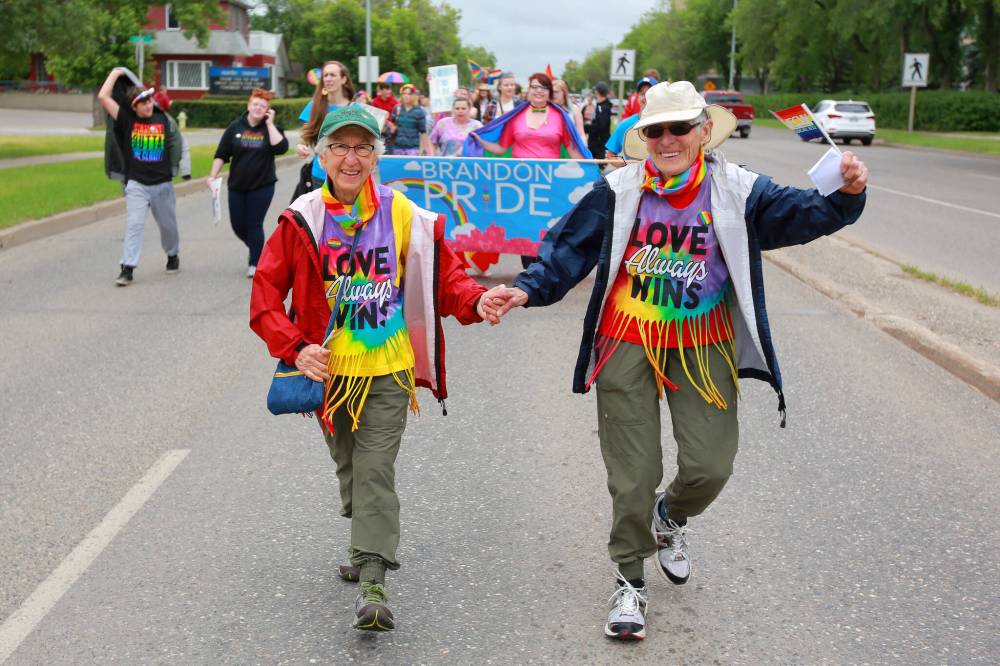
Just a handful of years into a formalized annual series of Pride events, and everything had to be placed on hold due to the COVID-19 pandemic.
With Pride Week finally returning after a two-year hiatus, there’s a lot of anticipation for the seven days of activities starting Sunday.
These events celebrate the current Pride movement in Brandon, but there are also talks aimed at informing queer and non-queer people alike about the politics of Pride, its history and its role in society.
Ahead of Pride Week, the Sun spoke with organizers and participants involved in Pride Week about what the community means to them, how they’ll be celebrating the occasion and what they know of the struggles to establish queer spaces in the Wheat City.
While doing research for a queer history talk coming up this Monday, Brandon Pride vice-chair Aly Wowchuk said she had to read between the lines.
Though queer people have always existed, their queerness wasn’t always recorded in history books or documentation.
Throughout history acts of ignorance have resulted in the erasure of people’s identities. There are “jokes” about how some historians or archeologists will see evidence of two people of the same gender writing each other affectionate letters, living together and displaying clear signs of intimacy and conclude that they must have been just close friends or roommates.
There was also a required element of secrecy — being outed could lead to unemployment, disownment by family, drawing unwanted attention or violence.
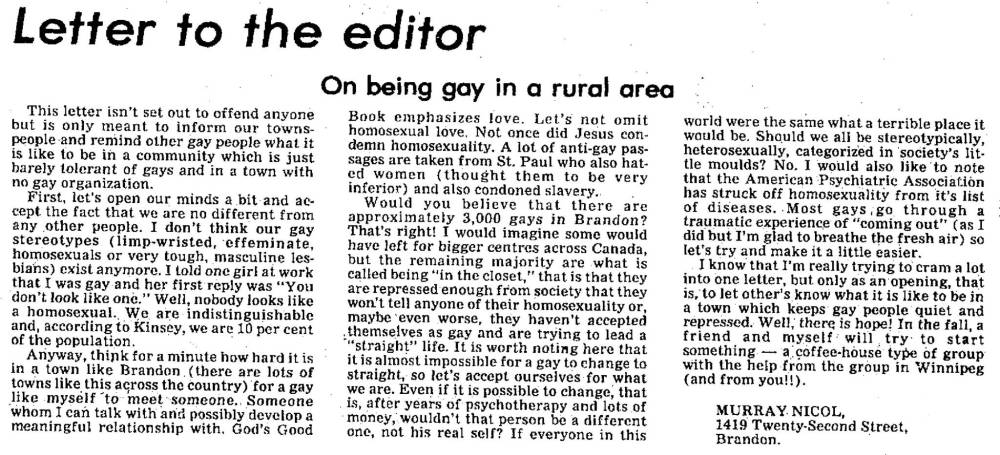
In 1975, the Sun ran a letter to the editor written by a man named Murray Nicol, who bravely identified himself as gay and called out the stereotypes of “the effeminate gay man,” “the masculine lesbian” and the assumption that queer people looked a certain way.
“This letter isn’t set out to offend anyone but is only meant to inform our townspeople and remind other gay people what it is like to be in a community which is just barely tolerant of gays and in a town with no gay organization,” Nicol wrote.
He talked about how hard it was to find a community of people like him, that Jesus never condemns homosexuality in the Bible and that methods purporting to “convert” gay people into being heterosexual don’t work.
Ten years after the letter was published, in 1985, a classified ad in the Sun reads: “Gay men and lesbians. You’re not the only one. Call Wednesday 7-10 p.m.”
There was also backlash to Nicol’s letter. Five days after his submission was initially published, a letter from Rev. L. Koeppen in Rivers complained of “the bold and defiant ways homosexuals are demanding their rights.”
This reverend parroted now-disproven studies about how gay people were the result of unhappy upbringings and advocated the conversion of gay people through religion to make them right in the eyes of God.
Three years later, in 1978, Bethel Temple in Brandon received a visiting preacher from Edmonton who advocated for the conversion of gay people.
Though Gordon Franklin acknowledged that attempts to do so were “reasonably unsuccessful,” he attributed this to the lack of religious involvement and the fact that 97 per cent of homosexuals felt no need to change.
Yet, Franklin urged churches not to traffic in too much homophobia. There could be undesirable side-effects he said he’d seen tear churches apart, like the persecution of two old ladies who lived together. No word on whether they were just roommates.
The practice of conversion therapy, which has never proved to be successful, was only officially banned across Canada on Jan. 7, 2022.
Lest it is thought this attitude was exclusively held by members of the clergy, another 1978 issue of the Sun published an essay written by a student at Wawanesa deploring the state of sexual liberation and the empowerment of gay people.
“The world is becoming addicted to sex,” the essay reads. “Is this sex revolution just another cycle of human history? Or is it the last cycle of civilization which could end tomorrow?”
According to Wowchuk, the first queer organization she found in her research popped up in the 1990s. It was called GLOBE, which stood for “Gays and Lesbians of Brandon and Elsewhere.”
Brandon Pride chair Ken Jackson said that GLOBE was mostly focused around Brandon University
“That slowly morphed into Brandon Pride,” he said. “I came on in the first few years after it became Brandon Pride. Basically, when we started, it was primarily a one-event situation. We started with a social and went from there.”
The first mention of one of these SERC Pride events in the pages of the Sun came on July 20, 2008, in an article titled “An event to break barriers.”
“Though the community has hosted regular socials over the years like the popular Fantasy and Fetish event, last night’s social was open to the general public and seen as the first official public Pride celebration in the Wheat City,” the article reads.
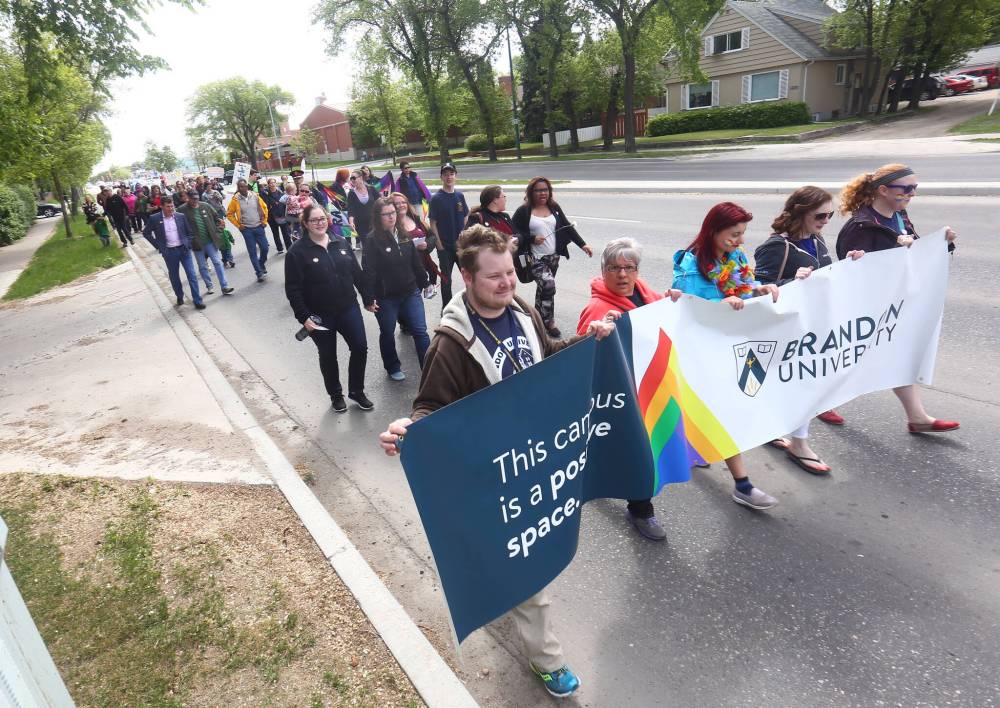
After several years of events like these, the first Pride march on the streets of Brandon only took place in 2015.
“It was a hard decision to make when we originally first started doing the march, not being 100 per cent sure of how opinions in the Wheat City and area had changed towards people who were LGBT,” Jackson said. “We weren’t sure what the response would be when we did that first march. I think we were pleasantly surprised with it and it kinda kept growing.”
This is Wowchuk’s first time working with Brandon Pride and is one of those community members excited for the march and the surrounding events to return.
“Two years with no Pride events, I think, has really taken a toll on everyone,” she said.
There was, according to Jackson, some consideration given to doing virtual Pride events during the pandemic, but the difficulty of hosting that kind of event and the fear that the quality might suffer as a result, worked against that idea.
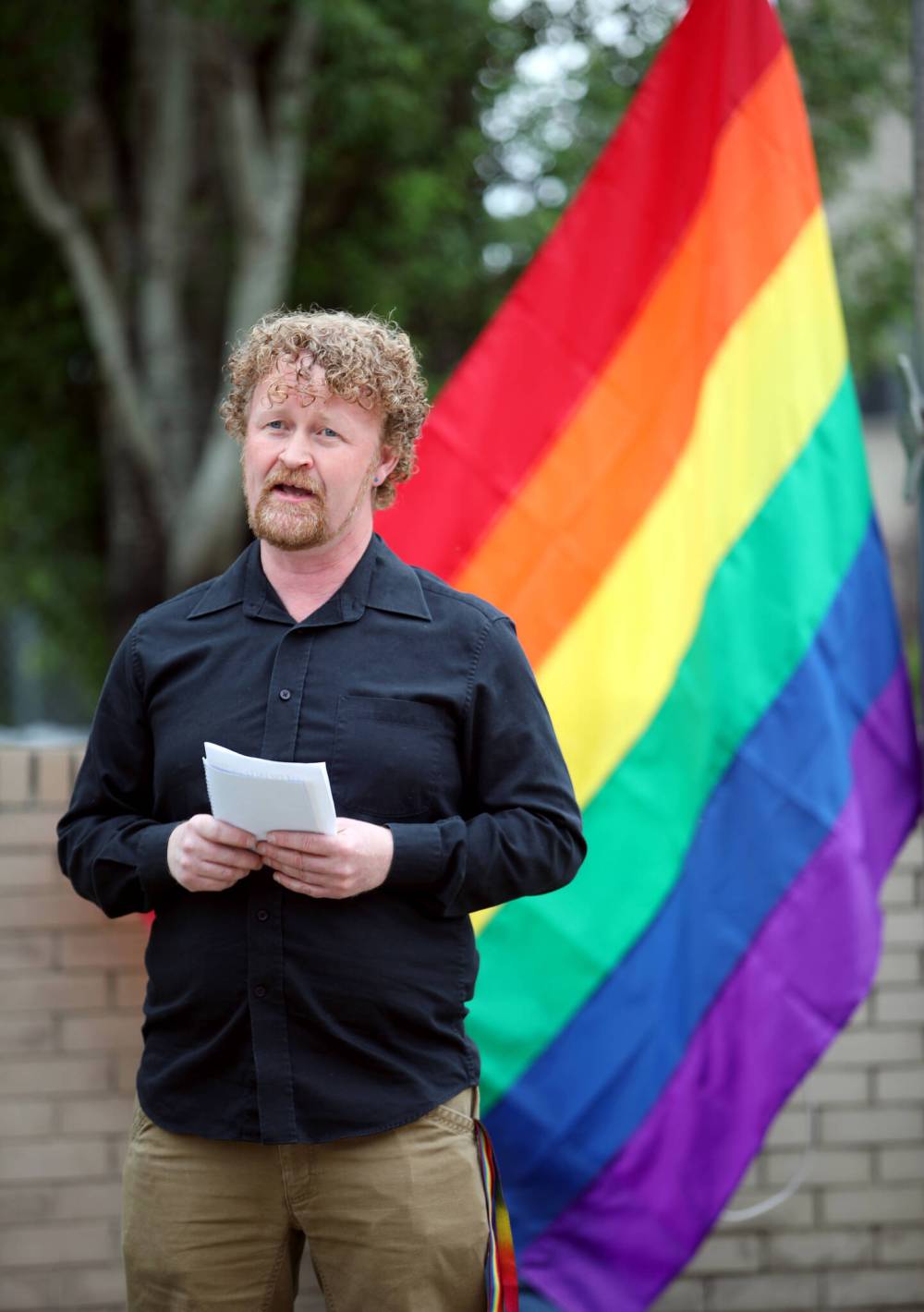
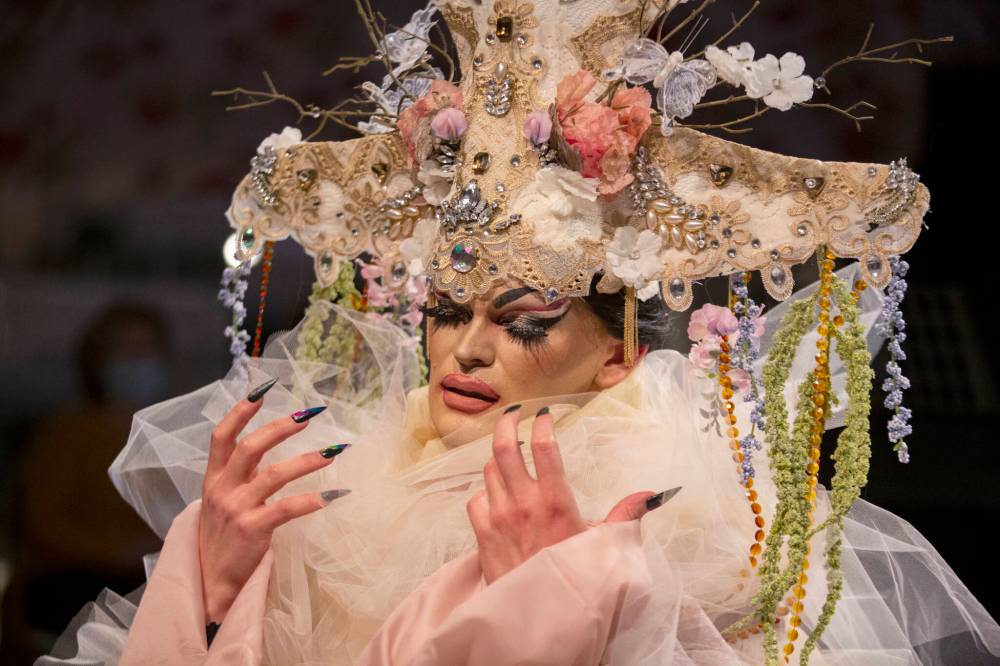
Also participating in Monday’s queer history event is local teacher Ryan Flannery, who will be giving a talk on the history of drag. Flannery’s alter ego, drag queen Flora Hex, is scheduled to appear or perform at multiple events during Pride week.
Part of the reason this Pride week is especially important for Flannery is that it will be the first one held since he got into drag during the COVID-19 pandemic.
Earlier this year, Flora Hex got a taste of performing when she held a drag workshop at the Art Gallery of Southwestern Manitoba in March. As someone who had been active with the gallery since he arrived in Brandon, Flannery said it was meaningful to come full circle and perform there.
“One of the reasons I started getting into drag in the first place was to create more events that were both queer-centred or creative-centred in Brandon,” he said. “It was a nice fruition moment.”
It was also special for Flannery because one of his former students was involved in organizing the event and is getting into drag themselves.
There had previously been a drag show or two a year in Brandon, but they usually brought in drag artists from “RuPaul’s Drag Race” or from Winnipeg. As far as he’s aware, the March event was the first performance by a queen from Brandon.
“At the event, I spoke about how this is a situation where if you work at something, it will eventually happen,” he said.
“I grew up in Elkhorn, Manitoba, where my graduating class had 13 people in it. I grew up north of there on a farm, so I don’t necessarily come from the culture of drag, but I found my way into it and there was an individual at the show who basically told me they came from a similar situation and when they moved to Brandon, they had this perception that they were going to find their community there because they’re queer.”
Flannery describes Brandon as being in limbo: there is a population to support a queer community, but there’s also a rural mentality where people want to keep things the same as they’ve always been.
Creating spaces for queer people in Brandon is one of Flannery’s biggest goals alongside trying to dispel the assumption that the city is a “super conventional, very ridged, traditional location.”
“There is a huge population hungry for creative events that are centred around queer culture,” he said.
One of the topics Flannery will cover during his talk will be the Stonewall riots, which happened in June and July 1969 in New York City. After a police raid on the Stonewall Inn, a gay bar, patrons of that establishment and other queer bars in the neighbourhood fought back when officers became violent.
Apart from the history talk, Flora Hex will make an appearance at the Pooch Pride event at the Riverbank Discovery Centre on Sunday. From 1 to 4:30 p.m., locals are welcome to come down with their dogs to socialize, listen to music and take photos with the drag queen.
Flora Hex will also present three drag performances at Pride in the Park at Rideau Park at 1 p.m. Saturday.
Another queer cultural event will take place at the AGSM at 4:30 p.m. Thursday.
Visual artist Marin Curtis will host an artist talk and a workshop titled “The Politicized Body.”
“It’s about the politicization of the queer person’s body, mine specifically,” she said. “I don’t want to have a politicized body, but I do. The lack of choice is what I want to talk about and the laws, not necessarily in Canada but in America, that have big impacts on people’s bodies.”
She’s referring to laws that allow for people to be fired, kicked out of housing or prevented from playing sports just because they are transgender.
Curtis will also talk about the hateful politicization of queer bodies in art history from paintings on the walls of caves to the AIDS crisis to current postmodern art.
The AIDS crisis, she said, was politicized through a lack of action in the United States about the disease since it was seen as something that affected just gay people.
One of the artists Curtis will discuss is Felix Gonzalez-Torres, who created a piece called “A Portrait of Ross in L.A.” He would put a pile of candy in the corner of an art gallery and encourage people to take pieces.
The pile of candy weighed the same as his partner Ross, who died of AIDS, and the action of removing pieces represented his wasting away. Gonzalez-Torres would also die of AIDS in 1996.
Curtis’ own art thesis, titled “Gazes,” was about the politicization of her own body as a transgender woman, consisting of a series of self-portraits.
Some of the difficulties in thinking about trans history, she said, come from complications like the lack of words people use to express their gender identity or that people’s transness wasn’t addressed.
She likens the situation to the societal expectation that everyone be right-handed to the point of forcing left-handed people to learn how to write like the other people. Once that stopped, there was a rise in the number of left-handed people.
“Now people are allowed to be trans or out more, so there’s been a big spike in that,” she said. “Historically they weren’t able to [express themselves] or if they were, they had to hide.”
Something many of the events scheduled for Pride Week have in common is that they’re designed to educate queer and non-queer people alike about historical and current issues facing queer people.
“I think it’s always been important,” Wowchuk said about the education aspect.
“These are not new conversations and things that have been happening to the LGBTQ community. I think that is, unfortunately, going to be a constant message and a constant fight for the queer community, to prove that we’re people, we deserve freedoms, rights and respect. It’s going to be a fight for a while, but the queer community is especially resilient.”
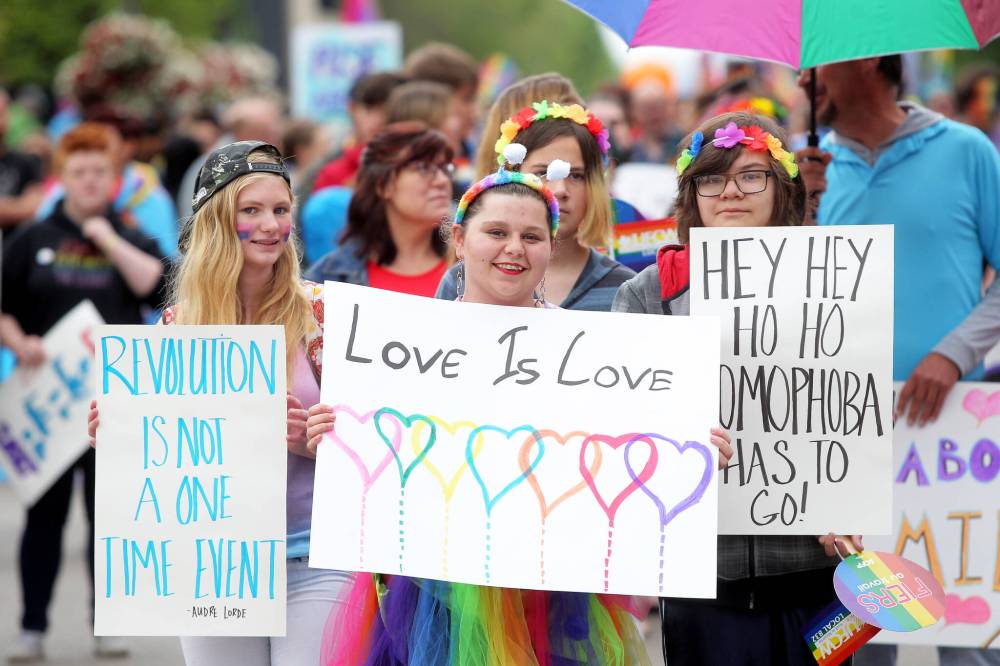
There’s hope that with the momentum of Pride Week’s return, there will be an effort to hold more events over the rest of the year.
Jackson said changemakers of the past deserve credit for the state of Pride in Brandon. Past organizers had to meet in secret or in darkly-lit halls before Pride could become what it is today.
Some recognition will come during the June 18 Pride march, where the grand marshals will be representatives from the Brandon chapter of PFLAG (Parents, Famililes and Friends of Lesbians and Gays) and members of high school gender sexuality alliances.
That event starts with a rally at city hall starting at noon, followed by the Pride march heading toward Rideau Park at 12:30 p.m.
“I really hope that people can come out and learn and celebrate with us this year at any of the events,” Jackson said. “We wanted to have a slogan to identify what this year meant to us.”
That slogan is “Just can’t hide my pride.”
» cslark@brandonsun.com
» Twitter: @ColinSlark