
Manitoba raising minimum wage to $15
Advertisement
Read this article for free:
or
Already have an account? Log in here »
We need your support!
Local journalism needs your support!
As we navigate through unprecedented times, our journalists are working harder than ever to bring you the latest local updates to keep you safe and informed.
Now, more than ever, we need your support.
Starting at $15.99 plus taxes every four weeks you can access your Brandon Sun online and full access to all content as it appears on our website.
Subscribe Nowor call circulation directly at (204) 727-0527.
Your pledge helps to ensure we provide the news that matters most to your community!
To continue reading, please subscribe:
Add Brandon Sun access to your Free Press subscription for only an additional
$1 for the first 4 weeks*
- Enjoy unlimited reading on brandonsun.com
- Read the Brandon Sun E-Edition, our digital replica newspaper
*Your next Free Press subscription payment will increase by $1.00 and you will be charged $20.95 plus GST for four weeks. After four weeks, your payment will increase to $24.95 plus GST every four weeks.
Read unlimited articles for free today:
or
Already have an account? Log in here »
Hey there, time traveller!
This article was published 18/08/2022 (1484 days ago), so information in it may no longer be current.
Manitoba’s minimum wage will increase to $15 an hour in three phases between Oct. 1 this year and Oct. 1, 2023, Premier Heather Stefanson announced Thursday.
On Oct. 1 this year, the minimum wage will rise from the current rate of $11.95 per hour to $13.50.
Then, on April 1, 2023, the minimum wage will go up a further 65 cents to bring the minimum wage to $14.15 per hour.
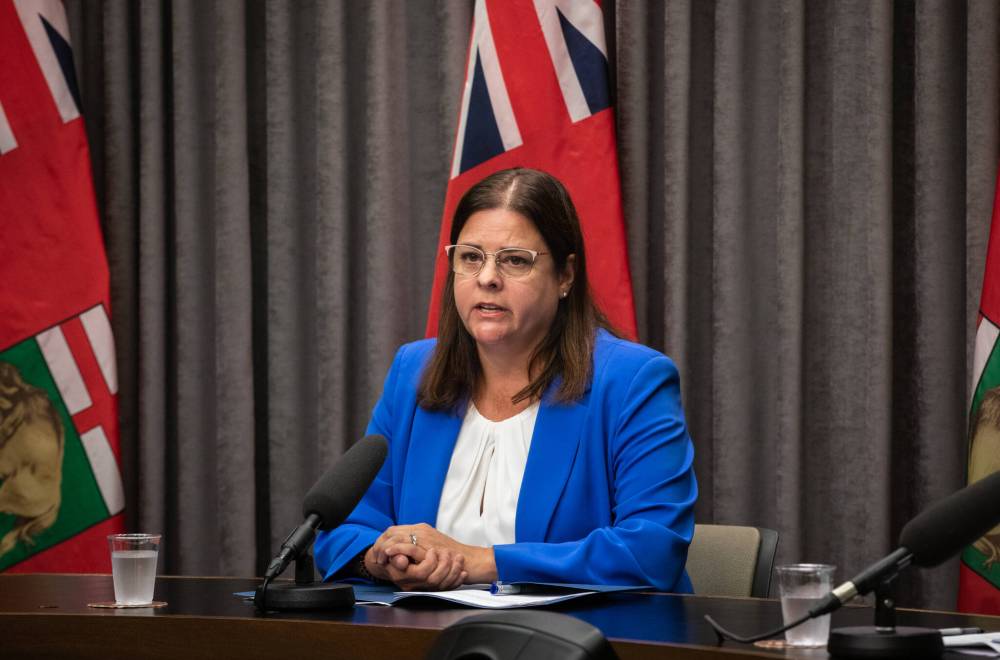
Premier Heather Stefanson
The provincial government expects the scheduled consumer price index increase set for Oct. 1, 2023, will bring the minimum wage up to an even $15 an hour.
In a media conference at the Manitoba Legislative Building in Winnipeg, Stefanson said the increases are a recognition of the financial challenges faced by Manitobans under the current period of inflation.
“Back in 2017, when we began to index the minimum wage to inflation, it was intended to help Manitoba remain competitive,” the premier said.
“However, in recent months, it’s become apparent that we have fallen behind. We know that in order to attract workers and immigrants to Manitoba, wages need to be competitive with other provinces.”
Labour Minister Reg Helwer, who accompanied the premier at the conference, said the announcement was a result of the government listening to Manitobans about the financial challenges they’re facing.
He added that the plan announced Thursday was made in consultation with both the labour and business sectors.
“In a time of uncertainty like the one we’ve been through and are in now, this will get us back to more predictable changes as we move ahead,” said Helwer, the MLA for Brandon West. “The average minimum wage worker will see an annual rise of $3,000 to help keep up with rising costs and inflation.”
Also present was Cliff Cullen, minister of economic development, who said the wage bump would help Manitoba attract and retain more workers.
However, he acknowledged that the increase would put a strain on some businesses and pledged the government would consult with them to implement programs to assist with their payroll.
“We realize that this wage increase may create challenges and we want to avoid unintended consequences that might result in higher prices,” Cullen said.
As things currently sit, Manitoba has the second-lowest minimum wage in Canada ahead of only Saskatchewan at $11.81 per hour.
Three provinces — Alberta ($15), British Columbia ($15.65) and Ontario ($15) — are already at the $15 per hour threshold as well all three territories.
Manitoba’s originally scheduled consumer price index raise to the minimum wage for Oct. 1, 2022, would have brought it to $13.35 an hour.
Even after that boost to $13.50 an hour this fall, Manitoba will still have the second-lowest minimum wage with New Brunswick, Newfoundland and Labrador and Nova Scotia planning increases that will keep them ahead of the Keystone Province. Saskatchewan is boosting its minimum wage to $13 an hour, which will keep it below Manitoba.
Tanya LaBuick, president of the Brandon Chamber of Commerce, said Thursday she understood the cost-of-living factors involved in the minimum wage increase but is worried about the potential “domino effect” it may have across the business sector.
“Ideally, we would like to see the province increase the personal tax exemption and increase or abolish the payroll tax limit for business so more money stays in the hands of our taxpayers and our businesses,” LaBuick wrote in a text message. “And by default, our local economy.”
Manitoba NDP Leader Wab Kinew told the Sun that the phased approach means Manitobans will always be behind in terms of minimum wage.
“We know that a living wage right now — meaning the level at which somebody working full time would be able to escape poverty — is $15 an hour,” Kinew said. “If the [Progressive Conservatives] aren’t going to do that now under Stefanson, what they’re in fact continuing is Brian Pallister’s policy, which was to index a poverty wage to inflation.”
The governing Tories should have had a package or program ready to help small businesses deal with the increase in payroll to coincide with the announcement, Kinew said, perhaps by looking at the small-business exemption for corporate income taxes.
Manitoba Liberal Leader Dougald Lamont said the announcement was a mixed bag and a gambit made with next year’s provincial election approaching.
He said it was a move the province had to make in order to attract workers under the current labour shortages and to compete with other Canadian jurisdictions, but it still leaves Manitobans with some of the lowest wages in the country even after the first of the planned increases.
“That’s not a living wage for a lot of people,” he said of the $15 an hour mark. “The other [issue] is that a lot of people don’t even qualify for the minimum wage.”
Manitoba Labour’s website states “all employees must receive minimum wage unless they are not covered by provincial employment standards or are excluded from the legislation.”
Groups that are excluded from minimum wage standards include domestic workers who work less than 12 hours a week, workers who are in an approved provincial or federal training program or election officials appointed under The Elections Act.
When it comes to the concerns of businesses who worry about the financial impact of the wage increases, Lamont said they should remember that minimum-wage workers are also their customers and they’ll have more money in their pocket.
Inflation is running rampant, Lamont said, because many businesses are trying to pay off debts they accrued to stay alive during the COVID-19 pandemic. To help ease that pressure on small businesses and the higher prices they’re charging consumers, he said the province should be doing something to help them deal with those debts.
On an individual level, Lamont said he believes the province would help a lot of people with insecure incomes by reforming the provincial Employment and Income Assistance program.
» cslark@brandonsun.com
» Twitter: @ColinSlark