
Recovery Day a time to share, educate, empower
Advertisement
Read this article for free:
or
Already have an account? Log in here »
We need your support!
Local journalism needs your support!
As we navigate through unprecedented times, our journalists are working harder than ever to bring you the latest local updates to keep you safe and informed.
Now, more than ever, we need your support.
Starting at $15.99 plus taxes every four weeks you can access your Brandon Sun online and full access to all content as it appears on our website.
Subscribe Nowor call circulation directly at (204) 727-0527.
Your pledge helps to ensure we provide the news that matters most to your community!
To continue reading, please subscribe:
Add Brandon Sun access to your Free Press subscription for only an additional
$1 for the first 4 weeks*
*Your next subscription payment will increase by $1.00 and you will be charged $20.00 plus GST for four weeks. After four weeks, your payment will increase to $24.00 plus GST every four weeks.
Read unlimited articles for free today:
or
Already have an account? Log in here »
Hey there, time traveller!
This article was published 05/09/2022 (1264 days ago), so information in it may no longer be current.
Recovery is a journey that is seldom linear and more than just kicking destructive habits — it’s about healing a person, their family and the community around them.
Brandon’s Recovery Day on Saturday was the time to talk openly about the process, along with what resources are available to those who want to start their journey or find more options as they progress. People wanting to share their stories, along with agencies and organizations focused on helping people in need, met at the Global Market on Rosser Avenue for a relaxed but informative day to exchange information and reach out to the public about what recovery means for everyone.
When people hear recovery, they most often think about substance use like drugs and alcohol. But there are many facets to that, and most of them fall under mental health and well-being, said Brandon Recovery Day chairperson Dee Taylor-John.

Sary Innerst, with her grandson Nolan, who's 25 months old, was the first speaker to talk about her mental health journey and challenges getting help as an Indigenous woman. It was also her 45th birthday. (Karen McKinley/The Brandon Sun)
Trauma, eating disorders, as well as addictions to drugs, alcohol, gambling, Internet, nicotine and even sex all share common traits that need to be treated with a holistic approach to break the cycles that cause them, she said.
“Substance abuse disorder is under the mental health umbrella, and a lot of people like myself have suffered in their mental health, whatever that mental health may be,” Taylor-John said. “That recovery is likely going to be very different for the individual, whether it is medication-therapy combination, group, whatever that individual does to holistically heal their mental health umbrella.”
She added this is part of an international movement, and each city that participates chooses which day in September they want to mark a Recovery Day. Brandon’s is the first Saturday in September, which is also National Recovery Month in Canada.
Any progress in the recovery process should be celebrated and talked about, not just to gain confidence, but to make others aware that it isn’t a linear process and can take years. Taylor-John said she had an opiate use problem, but hasn’t used for around five years. She said that has helped her physical and mental health improve. But that doesn’t mean she didn’t have issues.
There is more to recovery than just stopping substance use of a harmful habit, she said. Relapses happen and recovery is seldom linear. Those relapses are being exacerbated by stigma and barriers people face when seeking help.
The best way to end stigma and make societal progress is education and talking openly, Taylor-John said.
“If people are open to it, they get that this isn’t a choice and this is something people are not actively seeking,” she said. “There are other groups that use drugs and aren’t suffering, and that is also within the realm, too, and that can co-exist.”
There has been forward movement globally, Taylor-John added. It is not as acceptable to shame people for their addictions because people have learned that is not how you help someone recover.
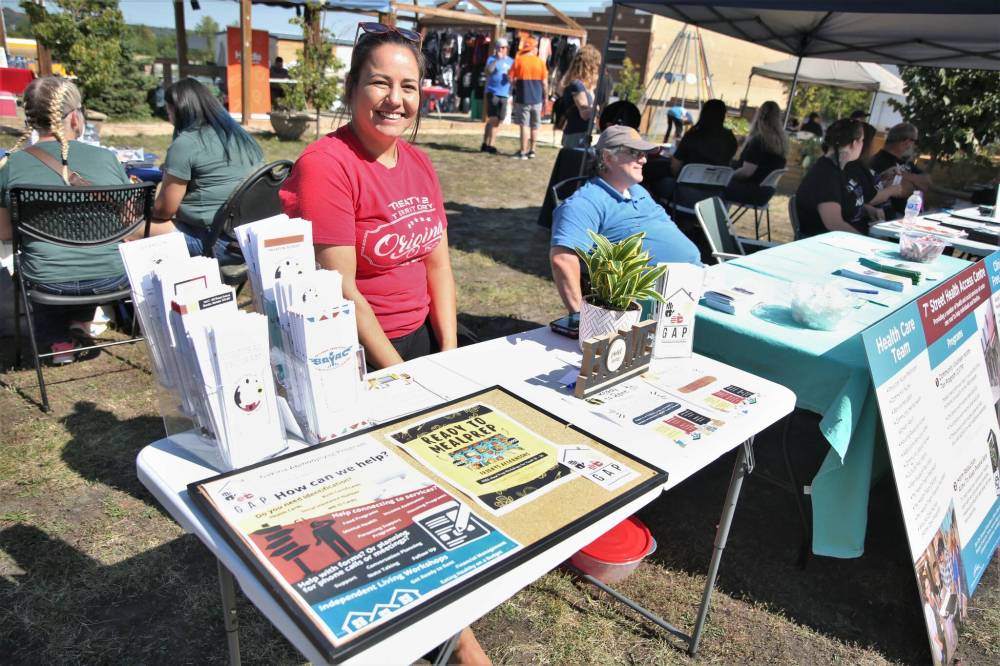
Lisa Noctor, co-ordinator for the Brandon Friendship Centre's GAP Program, was speaking to people about the program aimed at helping youth transition into adulthood by teaching life skills through one-on-one mentorship and workshops like meal prep, Ready to Work and Ready to Rent. Everyone in the program has lived experience and passes that on to youth to prepare them for living independently — a critical component to healthy living, she said.
Several people took the time to speak publicly about their experiences, as well as the problems they had personally seeking help, as well as their opinions on what needed to change.
Sary Innerst was among the first to speak about her own substance use and mental health journey. While she didn’t get into many details, she said she was diagnosed at a young age with a mental health issue, but self-medicated with alcohol for years.
Innerst said she wanted to convey how hard it is for an Indigenous person, especially a woman, to get any help in recovering from addictions.
People needing mental health help are marginalized to begin with, but it’s even more difficult to get non-Indigenous people to relate to the issues specific to Indigenous people.
“We carry a lot of trauma through the generations,” she said. “On top of all the mental health issues, we carry that trauma and racial bias.”
A major contributing factor is the mental health system isn’t designed to help Indigenous people. Innerst said she received only fragments of what was needed.
But getting up to talk was an empowering, but nerve-wracking experience, she said. Her hope is it will help change attitudes around Indigenous people and their mental health needs. Next time they see someone who’s Indigenous on the street or struggling with their mental health, they will understand it’s especially difficult because thy don’t fit into society like other people.
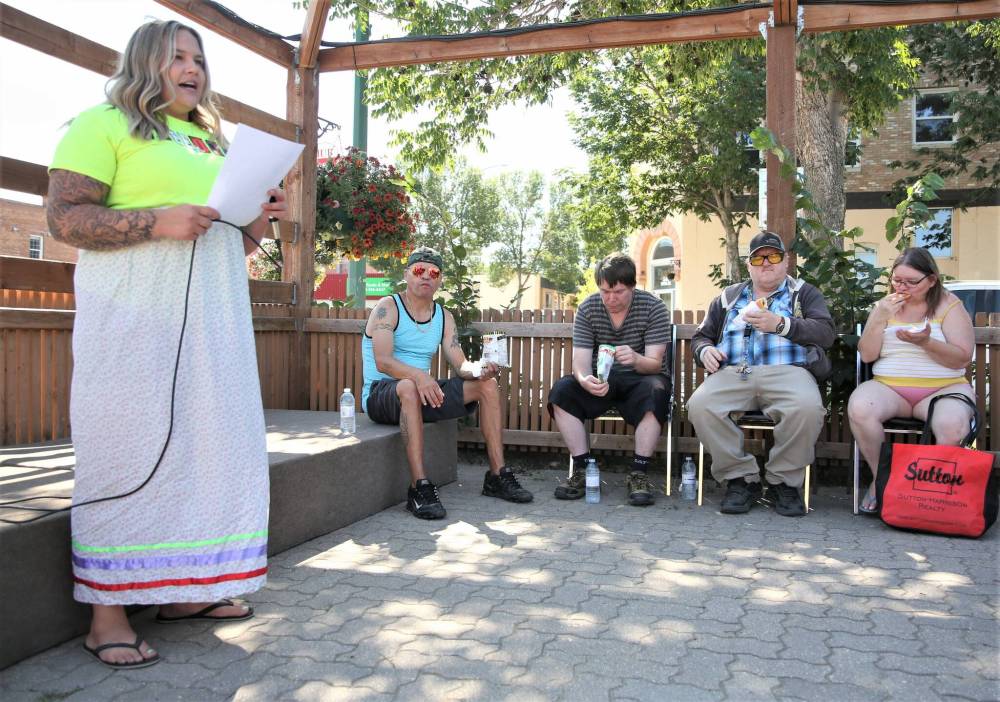
Nichelle Wilk stood up to talk about her own recovery experiences during the speaker portion of Brandon Recovery Day at the Global Market on Saturday. (Karen McKinley/The Brandon Sun)
There are several organizations in Brandon that serve the city and surrounding communities with what are known as low-barrier services. One of them is 7th Street Health Access Centre, which had an information booth at Recovery Day.
Service navigator Chris Blaikie said they try to offer everything from a community health nurse, Rapid Access to Addictions Medicine (RAAM), even help with income tax.
The variety of services is designed to recognize all the fundamentals of health, he said, from physical to mental, which includes even non-medical needs.
“It isn’t just about medical — it’s income, housing, all of that.” he said. “We provide services that wrap around all of that and help where you have deficits. If you are not getting those basics, there is no way you can progress any further.”
People still face a lot of stigma and barriers to get the help they need. He said RAAM is a good example, as it only runs from Monday to Wednesday. As well, longer-term treatment programs have long wait periods.
However, events like Recovery Day allow agencies and people to come together and talk about those gaps and how they can fill them. Programs also get together to see what else is available in case they need to send people elsewhere for additional help.
The more people talk, the more they will be calling for changes, Blaikie added.
While people are wanting to help more, government departments have to do more in terms of funding and accessibility for broad change to really take effect.

Ashlee Lockhart (left) and co-ordinator Solange Machado of Manitoba Harm Reduction Network were running the organization's booth with games and a draw for prizes to draw in the public to talk about substance use and safe practices around it. (Karen McKinley/The Brandon Sun)
Brandon mayoral candidate Jeff Fawcett was invited by organizers to speak and meet with people at the event. He agreed that not enough is being done, adding he has been talking to advocates and has a good relationship with the Brandon Police Service. There’s a lot to work on going forward, he said, including getting people into recovery, ongoing efforts to establish a sobering centre and the role police should have in the drug trade that is fuelling crime and helping users get out of that situation.
“We are working together as a whole community,” Fawcett said. “We have the Community Wellness Collaborative that is really getting going, and I see lots of potential to be a lot of help.”
» kmckinley@brandonsun.com
» Twitter: @brandonsun.com