
Donald joins Rugby Canada board
Advertisement
Read this article for free:
or
Already have an account? Log in here »
We need your support!
Local journalism needs your support!
As we navigate through unprecedented times, our journalists are working harder than ever to bring you the latest local updates to keep you safe and informed.
Now, more than ever, we need your support.
Starting at $15.99 plus taxes every four weeks you can access your Brandon Sun online and full access to all content as it appears on our website.
Subscribe Nowor call circulation directly at (204) 727-0527.
Your pledge helps to ensure we provide the news that matters most to your community!
To continue reading, please subscribe:
Add Brandon Sun access to your Free Press subscription for only an additional
$1 for the first 4 weeks*
*Your next subscription payment will increase by $1.00 and you will be charged $20.00 plus GST for four weeks. After four weeks, your payment will increase to $24.00 plus GST every four weeks.
Read unlimited articles for free today:
or
Already have an account? Log in here »
Hey there, time traveller!
This article was published 20/09/2022 (1278 days ago), so information in it may no longer be current.
No one is more surprised where Sandy Donald’s life in rugby has led him than he is.
The 56-year-old Brandon realtor joined the Rugby Canada board for a three-year term starting May 15, putting him at the pinnacle of the game he loves.
“It shocks me,” Donald said. “It absolutely shocks me. There have only been four people from Manitoba on the board. Ray Hoemsen was the last one, and that was about 10 years ago.
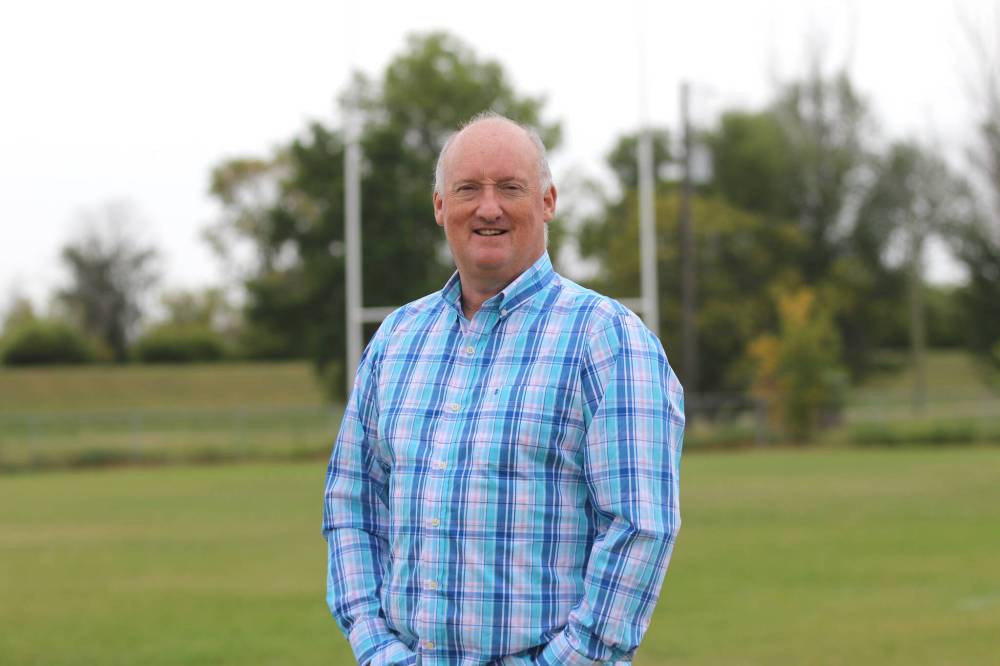
Sandy Donald, who joined the Rugby Canada board in May, poses for a picture at John Reilly Field. The Brandonite has taken an interesting path in the game, which began in Scotland when he was a youngster. (Perry Bergson/The Brandon Sun)
“For a dirt farmer from Alexander, Manitoba who played for the Brandon Barbarians and is now a member of the board of Rugby Canada, that shocks the hell out of me.”
His journey in the game began more than four decades ago in Scotland: He was born in Lanark and brought up on a dairy farm in the Clyde valley.
Donald said there is a rough geographic divide in Scotland, with one side favouring soccer and the other more devoted to rugby. That was also the case in his family, with his mother a rugby proponent and his father a soccer guy.
His phys-ed teacher was a rugby guy, making it the only sport he could play against other schools, so he gave it a try at 10.
“I enjoy the playing of it, I enjoy the athleticism of it, I enjoy the fact that when I started, the only way you came off the field was if you were injured and unable to continue,” Donald said. “You played defence, you played offence, I enjoyed all of those aspects, your reliance on other people and their reliance on you with the systems.
“It was such a great sport.”
He also enjoyed the fact that with 15 players on the field plus substitutes, it was a large team that bonded together.
The Donald family moved to Canada to a farm near Alexander in October 1983 just prior to Sandy’s 17th birthday. While it wasn’t the rugby hotbed he left behind, Donald said he was fortunate to almost immediately see the Barbarians practising on their former pitch along 18th Street.
He stopped and talked to them, and a new chapter in his rugby life began.
“I settled into Canada very quickly,” Donald said. “The two things I really associate with that was, number one, the sport of the rugby, and number two, was working at McDonald’s.”
Donald’s family had a labour-intensive dairy farm in Scotland but purchased a grain farm in Canada, where the work was more spread out. With time to fill and a well-developed work ethic, he quickly found the job with the burger giant — “The work is no screaming hell but you made lifelong friends” — and it provided him with another community.
On the rugby pitch, the 17-year-old Donald was the youngest player on a Barbarians squad that had only been started a couple of years early.
“The level of rugby was agricultural,” Donald said. “It was fantastic. The philosophy was ‘We’ll beat them into submission for 20 minutes and then we’ll see if we can score.’ You went out there and played hard.”
The one transition he had to make was to the heat, which was new.
“I was used to it being a winter sport,” Donald said. “We didn’t play rugby during the summer whereas here it’s a summer sport. Playing in 30 degrees for a red-headed Scottish guy was a bit of a shock.”
He hung up his boots at 31, and never looked back — “Once I was quit, I was quit” — but that didn’t mean he was done with the game. It actually started the new chapter.
He had already started coaching at Crocus Plains, and later the under-18 provincial team, but he had more energy to devote to the game.
During his playing career he found the physical side of the game energy sapping, but was able to run for a long time. That made his transition into officiating easy.
He last refereed in 2011, with a torn groin muscle restricting his ability to run.
By that time, he was the vice-president of Rugby Manitoba, and soon stepped up for a six-year term as president.
“When you’re doing the operational side, doing the coaching, then you go into the administrative side, a lot of that follows through in a lot of difference provinces,” Donald said. “People you would know through the operations side, you just continue to know them because then they move up as well.
“I really enjoyed that. I still kept doing little coaching things as well so that I was always in the know.”
He said a benefit of being on the Rugby Manitoba board is that it’s certainly not overstaffed, making it an operational board that maintains its ties in the sport because they’re at the games.
The organization has maintained fairly steady numbers through the years, generally between about 600 and 650 registered players.
“We are very much what I consider a grassroots and developmental province,” Donald said. “Very occasionally, we will produce a very good athlete who will play for Canada. Right now, that’s Emily Tuttosi, who plays for Canada because she should. She’s very good.”
Donald said with the province’s small number of players, the fact it can only play outside in the summer plus the geographic challenges for players, that’s unlikely to change without an influx of newcomers.
After all, he notes it’s hard to produce the cutting edge of the pyramid at the top without a broad base at the bottom.
Part of that issue is that kids often follow their parents into sports, which he calls human nature. That’s made more difficult because the sport simply isn’t well understood in Canada.
“Rugby has this stereotype that because you don’t wear equipment and it’s a full-contact sport that injuries occur,” Donald said. “That’s true, they do, but a rugby player is taught a lot of technique and body awareness. The sport of rugby is probably one of the cutting edge world leaders in concussion management, so we try to mitigate as much of it as we can.”
Perhaps the biggest draw to the sport is the people themselves. Rugby’s reputation as a game of hooligans played by gentlemen often comes through in the way teams mingle together after a hard-fought game.
It’s also an inclusive game.
“Regardless of who you were, your body type, what kind of a kid you were, there was a place on the rugby team for you,” Donald said. “It’s still true today.”
He said rugby is definitely a fringe sport, which was challenging when he was trying to find support because people were uncertain what the benefit would be for them. Conversely, it was actually beneficial in the dealings with players’ parents because they didn’t know the game well.
That made life easier than at rinks, where some parents are self-appointed experts eager to share the benefits of their knowledge with the coaching staff.
“I was educating the parents every bit as much as I was educating the kids,” Donald said. “That was very refreshing, and I found it to be one of the most enjoyable things. It gave you the freedom to teach their kid without them breathing down your neck.”
Donald noted it’s possible for young athletes to go farther up the ranks in rugby — and much more quickly — because there are simply fewer athletes in the sport than hockey or baseball.
He coached twice at the Canada Games, in 2005 and 2009, and remembers sitting beside the Ontario coach in Regina in 2005.
The two coaches began comparing notes, with the other coach asking how many athletes tried out.
Donald told him it was 47, which was a good number, and it was hard to cut down to 25.
“He just looked at me and said ‘By the time it gets to me, we’re down from 2,500. We have 25,000 kids,’” Donald said.
The teams met on the field, with Ontario holding a narrow half-time lead that extended into a rout later in the game.
Ultimately, if a good athlete surfaces in rugby in Manitoba, Donald said they’ll be identified far quicker than in other sports with larger participation numbers. That makes Tuttosi’s trail-blazing success a massive victory.
“Emily is a great story, not just because she made the national team, but she plays professionally overseas for Exeter,” Donald said. “Emily is a very determined young lady and a fantastic person. I had the opportunity to talk to her when she was here, and she said she was really looking forward to coming back and seeing her family and some grassroots rugby.
“It’s important because you can push and push and push and push the grassroots and get your base, but you need to have a goal and you need to see something in that goal that is attainable to them. Otherwise it’s just a dream.”
One concern is that the sport’s future has always been in the hands of very few dedicated volunteers, such as Brian Yon in Souris or Kat Muirhead in Rivers. He said that makes it incumbent for people to always be searching for the person who will follow up on their work when they have to step away.
“We’ve had roller coasters with rugby in western Manitoba for sure,” Donald said, noting there have been dips in different places and even with the Barbarians when people left.
Fortunately for rugby in Manitoba, Donald wasn’t one of them.
Part of his work as president was attending Rugby Canada meetings, so he got to know administrators across the country.
He was driving out to attend a game between Canada and Scotland in Edmonton a few years ago and called a friend about potentially getting some tickets. Instead, he was asked to work.
Rugby Canada was hoping to train another match commissioner, a mandatory part of any senior national game. With his blend of playing, refereeing and operating experience, Donald couldn’t refuse, and a new chapter in his rugby career was launched.
Essentially, the match commissioner is the official representative of either Rugby Canada or World Rugby, and is in charge of everything at the field except for what the referee looks after. That includes speaking to the teams, officials and medical while also co-ordinating with the broadcasters to make sure everything comes off smoothly.
“During the game, if I know what the score is, I’m not doing my job,” Donald said. “During the game, I’m usually between the benches.”
He stands near the official recorder, ensuring all the paperwork that goes to Dublin, where World Rugby is located, is accurate. At the same time, he’s scanning the field for issues, because he’s looking after every spot where the public isn’t allowed.
In part, that includes ensuring that the game looks good on broadcast, and that there aren’t flags down or litter blowing around.
This year, he has travelled to Vancouver, Ottawa and Halifax. Incredibly, with all that responsibility, he isn’t paid for his work, although all of his expenses are covered.
“It’s a labour of love,” said Donald, noting two other people in Canada are also trained to do the job.
He noted he also has a very patient spouse in Jodi, whom he jokingly refers to as a “rugby widow.”
While the match commissioner job certainly keeps him in the game, he also remains active away from the pitch.
His path to the Rugby Canada board started when he was urged to apply after finishing up his six-year run as president of Rugby Manitoba. He wanted to finish up his duties at home, so he chose not to follow up at the time.
When he was approached again later, he was told he would bring an important grassroots voice to the board.
“I went ‘Well, if it’s a common man you’re looking for, they probably don’t come much more common than me,’” Donald said. “Two years ago I was nominated to go and I didn’t even get an interview because I didn’t have the skill base that they were looking for at that time.
“This year Rugby Manitoba and Rugby Saskatchewan said ‘You should put your name back in again’ and I said ‘Ya, whatever,’ so I put my name in and I got the interview.”
A month later, he was added to the board, which is spread out across Canada, and meets in person at least quarterly with additional gatherings on Zoom.
“I don’t think I went in with any preconceived notions,” Donald said. “You want to go in with your ears and your eyes open and your mouth shut for the first little bit because you have to feel out where you stand.”
He said every board member brings a certain knowledge to the position, with his focused on operations. He had ideas that he brought in, but discovered there were sometimes very logical ideas why things hadn’t been done a certain way.
“They’re not doing it just to be bloody minded, they’re doing things because legally or because their major stakeholders want it done a certain way, and you do that,” Donald said. “I’m very much an advocate of grassroots developmental rugby. One of the big things I would like to see right now is a little more standardization.
“Every province had a lot of things they do on their own, which needs to be standardized so that if you have players who move from province to province, there’s no ‘Oh, this is how it’s done here.’ That’s an amateur thing. Hockey is hockey, regardless of where you go across the country.”
He added that with the number of participants in the various jurisdictions, and even the available seasons they play in differing, it’s not an easy problem to solve.
Even if they did, the individual provinces would bristle at losing their autonomy. That’s where Donald’s grasp of the grassroots of the sport proves useful.
“We have different needs than Ontario and B.C., and Alberta to a certain extent,” Donald said. “They’re looking for somewhere for their elite athletes to go to play for Canada. Manitoba has that altruistically. We want to put people on Canada and it’s what we strive for, but we need to get the number of people we are developing at the grassroots.”
Provincial legislation can also be a complication, but he added Rugby Canada would never hand down edicts to the various federations that would put them in an adversarial position.
On the world stage, Canada is ranked third among the senior women’s teams, while the men are 23rd. Tuttosi is the only Manitoban on either side.
She has company in Rugby Canada in Donald, the Scottish-born player, referee, administrator, match commissioner and board member, who is doing everything he can to simply enjoy the ride.
“Life’s been pretty good to me,” Donald said. “What I’ve found is that as I’ve gotten older, to me money doesn’t mean as much. I could make a lot more money in real estate but my family and everything is way too important to me.
“Life to me now is about the experiences, the great people you meet and the experiences you have.”
» pbergson@brandonsun.com
» Twitter: @PerryBergson
CURRENT CHALLENGES
Like most sports, rugby is weathering a time of transition as it moves from the old-school model of coaching to a newer, more player-friendly model. It hasn’t always been an easy path.
“Sports are always evolving, especially at the higher end,” Sandy Donald said. “For years and years we had autocratic coaching, my way or the highway, but now we’re getting more athlete-centric coaching. I think we’re in a little bit of a flux situation. You employ a coach because they’ve been successful. The way they’ve been successful was maybe because they were an old-school coach and that’s what success was at that time.
“Then you go ‘OK, you’ve been successful, now we’re going got put you in this environment,’ and those athletes have been are used to athlete-centric, and then you’ve put chalk and cheese together. A lot of sports are going through that teething problem because are in a very societal state of flux right now.”
He said Rugby Canada’s intent is to examine the pathway to see how extensive the damage is, what the damaged areas are and to find ways to fix the issues. Donald noted as society continues to change rapidly, this could be an ongoing process to stay current.
“You can’t put a bandaid on something because you never know where the blood is coming from,” Donald said. “You have to take a snapshot in time, and I think they’ve done that with the high performance review, and see where we’re at, where the culture is and what the identity of it is and then try to put the pieces together so that we can get the best out of the athletes.”
» Bergson