
Things ‘need to change much more rapidly’ on path toward reconciliation
Advertisement
Read this article for free:
or
Already have an account? Log in here »
We need your support!
Local journalism needs your support!
As we navigate through unprecedented times, our journalists are working harder than ever to bring you the latest local updates to keep you safe and informed.
Now, more than ever, we need your support.
Starting at $15.99 plus taxes every four weeks you can access your Brandon Sun online and full access to all content as it appears on our website.
Subscribe Nowor call circulation directly at (204) 727-0527.
Your pledge helps to ensure we provide the news that matters most to your community!
To continue reading, please subscribe:
Add Brandon Sun access to your Free Press subscription for only an additional
$1 for the first 4 weeks*
- Enjoy unlimited reading on brandonsun.com
- Read the Brandon Sun E-Edition, our digital replica newspaper
*Your next Free Press subscription payment will increase by $1.00 and you will be charged $20.95 plus GST for four weeks. After four weeks, your payment will increase to $24.95 plus GST every four weeks.
Read unlimited articles for free today:
or
Already have an account? Log in here »
Hey there, time traveller!
This article was published 30/09/2022 (1327 days ago), so information in it may no longer be current.
On the second annual National Day for Truth and Reconciliation, Indigenous leaders and organizations stress that plenty of work remains to meaningfully address the harmful effects of colonization.
While Canada is still grappling with the discovery of unmarked graves at the sites of former residential schools, the country continues to digest Pope Francis’ apology made during his visit earlier this year, which brought a mix of emotions for many people.
To measure the progress of truth and reconciliation, one must consider the socioeconomic indicators affecting Indigenous people, said Jerry Daniels, grand chief of the Southern Chiefs’ Organization, which represents 34 Anishnaabe and Dakota communities in southern Manitoba. Those factors include quality of life, graduation rates, levels of income, unemployment and more.
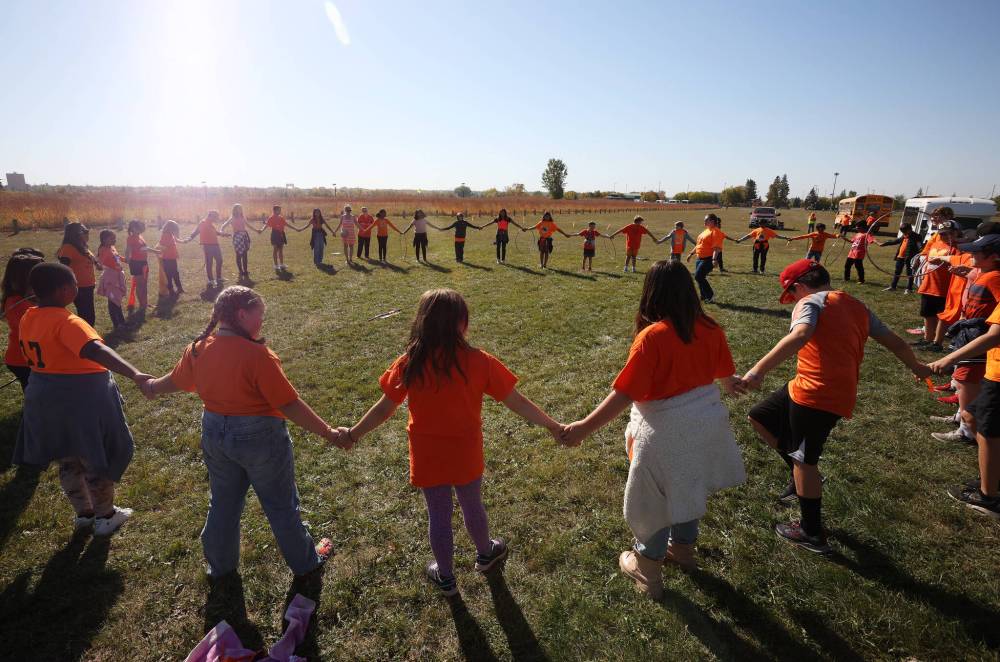
Brandon School Division students play a game passing hula hoops between each other in a circle without breaking the human chain during Truth and Reconciliation Week at the Riverbank Discovery Centre on Thursday. (Tim Smith/The Brandon Sun)
“Until … we meet or even exceed those socioeconomic indicators, we can’t say reconciliation has been successful,” Daniels said, adding he’s not sure how much of an impact truth and reconciliation has truly had on Canadians.
Yet, Daniels said he has witnessed a true “willingness” to change. The problem is, he explained, the change is happening far too slowly.
“[Things] need to change much more rapidly,” he said. What’s needed, he added, is a “worldview approach” to change.
One of the biggest and most important changes Daniels hopes to see is in the child welfare system across the country. Children should not be removed from their homes and families when their parent or guardian is facing addictions or mental health issues, he said. Instead, the individual facing the problems should be the one to leave the home to seek treatment.
“Children need to stop leaving the home,” Daniels said. “We have to provide support for families that are struggling.”
Keeping children at home is something that Cora Morgan, a First Nations family advocate with the Assembly of Manitoba Chiefs (AMC), said is vitally important in helping families follow healthy paths.
“It’s something we’re certainly working towards,” she said. This includes efforts to reinstate First Nations’ control over child and family services (CFS) in their communities.
As the Sun previously reported, provincial legislation was introduced on July 4, mandating the First Nations Dakota Tiwahe Services Agency as a CFS agency. The mandate was a step forward for Sioux Valley to gain full jurisdiction over CFS for nation members, and meant that Dakota Ojibway CFS would no longer operate in the community.
AMC is also working toward ending the practice of birth alerts, which are used to notify hospitals and CFS agencies that further assessment of the parent must be undertaken before a newborn is discharged to their care. While birth alerts were technically terminated in Manitoba in 2020, hundreds of babies are still being apprehended every year, according to a July report from The Canadian Press.
Canada has had more than 150 years of stolen children, Morgan said, citing residential and day schools, the ’60s Scoop and the CFS system. Ninety per cent of the 11,000 children in care in Manitoba are Indigenous, she added.
“We’re faced with a crisis. Those days of stolen children are not over.”
Understanding the intergenerational trauma that Indigenous families often face is the first step in changing the CFS system, said Arlene Stewart, chief executive officer of CFS of Western Manitoba, located in Brandon. From the moment new staff walk through the door, Stewart said, they are inundated with culturally sensitive education.
“We have a very dedicated approach to being trauma-informed,” she said. “We look at each family’s history, each family’s story.”
Many of those stories, she said, are “laden” with the negative impacts of multigenerational trauma. While Stewart’s agency is dedicated to working alongside First Nations agencies such as Dakota Tiwahe, sometimes CFS of Western Manitoba still has to get involved on an intake level with Indigenous families living on reserve. Up to 25 per cent of the families the agency works with are Indigenous, she added.
“Families still might see us first, through an intake process … then we help to transition them over to their culturally appropriate agency.”
The most important thing that a CFS agency can do, Stewart said, is prevent children from being removed from their families in the first place.
“We aim to … work with families to help them overcome issues that are creating concerns for child safety, child well-being, and overall how that family is functioning.”
For Kim Beaudin, vice-chief of the Congress of Aboriginal Peoples (CAP), another indicator of how far truth and reconciliation efforts have yet to go is the “mass incarceration” of Indigenous people in Canada.
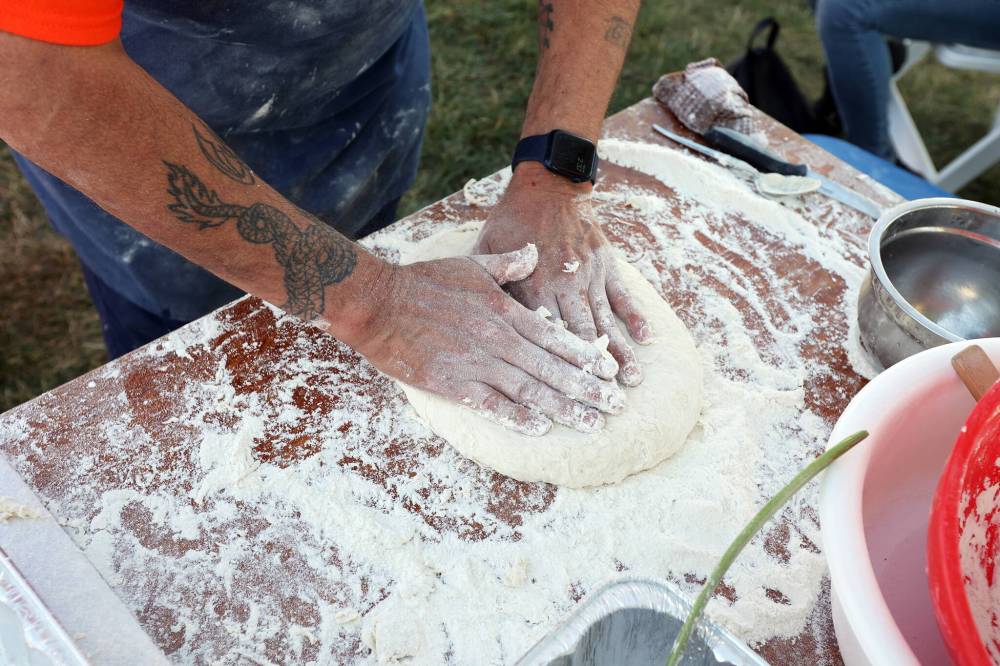
George Ducharme makes bannock for Brandon School Division students taking part in teachings as part of Truth and Reconciliation Week at the Riverbank Discovery Centre on Thursday. Ducharme has been making bannock for 41 years. (Tim Smith/The Brandon Sun)
According to the federal Department of Justice website, the 2017-18 annual report of the Office of the Correctional Investigator pointed to increasing numbers of incarcerated Indigenous people.
The report detailed that Indigenous inmates in federal institutions rose from 20 per cent of the total inmate population in 2008-09 to 28 per cent in 2017-18, while representing only 4.1 per cent of the overall Canadian population. The percentage of federally incarcerated Indigenous women rose from 32 per cent of the female inmate population to 40 per cent during that same time.
The numbers, Beaudin said, are “staggering.”
“It just gets worse and worse, and I don’t know when that’s going to end.”
When it comes to other issues facing Indigenous people, Beaudin said it’s concerning that despite Pope Francis’ apology, the Roman Catholic Church has been slow to offer any real compensation for the victims of residential schools.
The office of Marc Miller, the federal minister of Crown-Indigenous relations, didn’t immediately respond to a request for comment.
While the church has a long way to go and a lot of work to do, Beaudin said, it’s never a case of “too little, too late.” He hopes to see the church reach out to Indigenous people and communities to include them in any future reconciliation efforts.
Daniels agreed, saying that while it took a lot of commitment for the Pope to come to Canada and apologize, the changes that need to occur in the faith are “massive.”
“The compensation needs to be continuous … we’re talking about decades and decades of abuse. It’ll never be enough,” Daniels said.
Still, the church is focused on building relationships with Indigenous communities and moving forward in meaningful ways in partnership with them, said Janelle Lafantaisie, director of communications with the Winnipeg Roman Catholic Diocese.
“True reconciliation has to come from relationships,” she said.
Last year, the Roman Catholic Church agreed to distribute $30 million in compensation to Indigenous groups in Canada over five years. According to Lafantaisie, $600,000 of that will go to the Archdiocese of Winnipeg, which extends to western Manitoba.
Now, Lafantaisie said, the church plans to hold consultation meetings with Indigenous groups to find out how best to use the money to make real change.
Rev. Glenn Ball, minister at St. Andrew’s Presbyterian Church in Brandon, said his organization has worked closely in ministry with Birdtail Sioux Dakota Nation, such as funding part of the community’s healing garden. There’s still room for more outreach and reconciliation efforts to be made with Birdtail Sioux and other First Nations, he said.
“I would certainly like to see us have more discussion about what happened, about what we can do and about what help is needed,” Ball said.
Birdtail Sioux didn’t immediately respond to a request for comment by press time.
The large amount of work that some Brandon churches have been doing toward truth and reconciliation, including Knox United Church, is indicative of their willingness to work with Indigenous people on the road to healing, said Kris Desjarlais, a Brandon city councillor and member of the Brandon Urban Aboriginal Peoples’ Council (BUAPC).
“The reconciliation is really happening,” he said, noting the permanent teepee set up outside Knox United and the church’s efforts to include Indigenous spirituality into its liturgy. “They’re doing it in a quiet, humble way, which is the way it should be.”
While some people who have suffered trauma at the hands of churches may be able to move forward in faith, others may not, and both pathways need to be accepted, Desjarlais said.
“You have First Nations people who have found a way to balance their spirituality with Christianity … and then there are others who will probably never be able to reconcile with the church. And that’s OK, too.”
In a previous interview with the Sun, Rev. Craig Miller, minister at Knox United, said he hopes that, along with acknowledging the truth of how disastrous the residential school system was for Indigenous people and culture, through education, people will begin to understand why the trauma from such a system still exists today.
“We hope that people might have a more compassionate response … because this is all a part of our history.”
One thing Daniels, Beaudin and Desjarlais all agreed on is that in addition to the work churches are doing for truth and reconciliation, governments must make reconciliation efforts a priority as well.
On Thursday, Manitoba’s Progressive Conservative government voted against an NDP bill looking to make Orange Shirt Day, Sept. 30, a statutory holiday in the province.
Introduced by NDP MLA Ian Bushie, the Orange Shirt Day Statutory Holiday Act (Bill 200) was shot down by the PCs despite “overwhelming support” from families, labour and the business sector, Bushie said in a press release.
“This bill would have given Manitobans an opportunity to mark Orange Shirt Day with their families and their communities. It would have advanced our province’s reconciliation journey,” Bushie said. “By voting against this bill, the PCs have proved once again they are out of touch with Manitoba families.”
The PCs’ decision to vote down the bill was a “disappointing” mistake, NDP Leader Wab Kinew told the Sun. He hopes the province will change its mind and make Sept. 30 a statutory holiday in the future, noting it will bring reconciliation into focus for Manitoba families and communities.
“This is an important day to honour residential school survivors,” Kinew said. “If we have a stat holiday where people have more flexibility to spend the day with their families … I think that it will serve all of us tremendously well in the long run.”
The Manitoba government didn’t immediately respond to a request for comment by press time.
» mleybourne@brandonsun.com, with files from Colin Slark
» Twitter: @miraleybourne
Funding for The Brandon Sun’s Indigenous and rural beat reporter comes from the Government of Canada through the Local Journalism Initiative.