
City lays out planning, growth process
Advertisement
Read this article for free:
or
Already have an account? Log in here »
We need your support!
Local journalism needs your support!
As we navigate through unprecedented times, our journalists are working harder than ever to bring you the latest local updates to keep you safe and informed.
Now, more than ever, we need your support.
Starting at $15.99 plus taxes every four weeks you can access your Brandon Sun online and full access to all content as it appears on our website.
Subscribe Nowor call circulation directly at (204) 727-0527.
Your pledge helps to ensure we provide the news that matters most to your community!
To continue reading, please subscribe:
Add Brandon Sun access to your Free Press subscription for only an additional
$1 for the first 4 weeks*
*Your next subscription payment will increase by $1.00 and you will be charged $20.00 plus GST for four weeks. After four weeks, your payment will increase to $24.00 plus GST every four weeks.
Read unlimited articles for free today:
or
Already have an account? Log in here »
Hey there, time traveller!
This article was published 13/12/2022 (1208 days ago), so information in it may no longer be current.
The City of Brandon’s director for the planning and buildings department explained the history behind a controversial project in the city’s southwest at a special council meeting on Monday.
Ryan Nickel was the lead presenter for “Planning for Growth,” the first in a series of informational sessions and events that city staff are organizing to help explain why Brandon views the construction of two lift stations in southwest Brandon as necessary to continue growth.
“The goal of this series working with our council and our public is to improve understanding,” Nickel said.
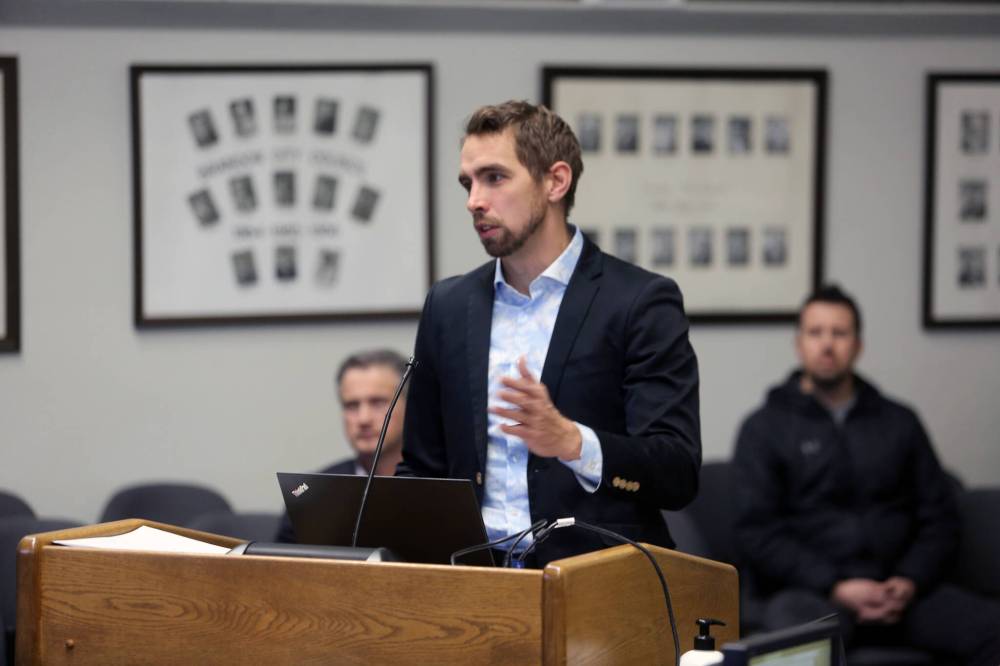
City of Brandon director of planning and buildings Ryan Nickel explains to city council how Brandon plans for growth during a special council meeting on Monday. (Colin Slark/The Brandon Sun)
This first presentation was focused on how the city’s past decisions led to this situation and what factors are accounted for when planning for Brandon’s growth.
The $30 million that the previous city council asked the Municipal Board for permission to borrow to construct the two lift stations was controversial. It even became an election issue between now-Mayor Jeff Fawcett and opponent Elliott Oleson.
The city said growth in the southwest essentially could not continue without the added wastewater utility capacity the lift stations would provide while opponents of the project accused it as being a subsidy for developers who will profit off the new developments built as a result of it going ahead.
With a new council having been elected in the interim and city officials having admitted that it could have done a better job at communication, Monday’s committee of the whole meeting was for the benefit of staff, councillors, representatives of developers and members of the public in council chambers.
That included Reeve Sam Hofer of the RM of Cornwallis, from which land will eventually be annexed if Brandon’s southern growth continues.
When talking about planning for growth, Nickel said there are three important questions to consider in city planning: how we grow, where we grow and when we grow.
Using a Powerpoint slide with an image of a stick figure walking a tightrope, Nickel said the process involves balancing the different needs and hazards within the community.
Decisions are made based on the interests of the city, of developers and of citizens. There’s also a need to understand the scale of a project, whether it’s for an individual site, neighbourhood, area, city or region.
In 2011, Nickel said the decision to pursue annexation of lands formerly within the RM of Cornwallis because the city was anticipating running out of land to grow on. When working through the process, plans for servicing the land had to be included and it was understood that it was land not particularly close to existing services.
At the time, that included the existing wastewater services available in the area.
Around that same time, Nickel said city council made political decision to focus on the North Hill for growth. After an election and the political decision makers changed, growth was once again focused on the city’s south.
By 2015, work on the Bellafield development in southwest Brandon had started. In 2018, the city was working on the Brookwood South neighbourhood plan in the same area.
Three years ago, in 2019, Nickel said the city worked out a capital budget for growth, which studied what was needed for these neighbourhoods to grow to their fullest extent.
That plan identified the need for expanded wastewater services and decided to focus the city’s efforts toward growth in that area.
According to Nickel, it was understood at the time that the city did not have the funds to pay for the necessary infrastructure on hand and would need to borrow money while development cost charges were collected.
In the last few years, the city has implemented development cost charges to make sure that developers are contributing to infrastructure upgrades and improvements that will benefit them, but not enough has been collected through the process to pay for anything.
However, a review is currently being carried out to see if the amount charged must be raised and the results are expected sometime next year.
Last year, the city completed a conceptual design of the lift stations and moved on to create detailed designs.
“Sometimes when things are in the planning stage, it takes a while for people to understand them because they don’t seem real,” Nickel said. “Sometimes you get to the implementation stage and things can be a bit surprising.”
When working on a project like this, the city must consider how many people the infrastructure will need to serve over time as the population grows as well as how long the facilities being built will last.
Over the last 10 years, Nickel stated that 51 per cent of the 2,927 residential units built locally have come in south Brandon, 26 per cent has come in the city’s established core, 17 per cent has come in the north end and six per cent has come in the west end.
Using that as a projection, the city estimates that Brandon will have a population of 63,000 to 65,000 people in the next 30 years and will need to build 7,700 to 8,000 residential units aimed at people of different income levels.
“We feel that the south will continue to be the target for growth going forward,” Nickel said. “We will see growth in other areas, especially the North Hill, but eventually places like the North Hill will be constrained by infrastructure limitations until they’re addressed.”
Nickel showed a map of lands available for development in the city’s current border in the south end. In the city’s southeast, there is some residential land available for growth above the planned orchid preserve near Patricia Avenue and First Street with a couple of chunks of commercial land.
In and around the Bellafield and Brookwood developments in the southwest, the land is targeted for residential development with the South Brandon Village at the city’s most southern extent is half commercial land available for development and half residential land.
Areas of future growth over the coming decades are to the south of the city’s current borders within the RM of Cornwallis on both sides of Highway 10 that would need to be annexed.
Highway 110, which allows motorists to bypass Brandon, is expected to eventually be extended from where it ends connecting to Highway 10 south of the city and go farther west.
Speaking on the right balance between social, environmental and economic needs, Nickel said that for example, choosing to build the city outward rather than also build up existing neighbourhoods at the same time could lead to the decline of those existing neighbourhoods.
However, “the economics of growth are not all equal,” according to Nickel.
The city’s director of economic development, Sandy Trudel, was brought to the podium to talk about how Brandon’s economic development strategy fits into this picture.
Serving a hub city with 200,000 people who depend on it, Trudel said it is the city’s responsibility to fulfil the expectations of both people in the city as well as regional considerations.
“In a healthy community where all your stars have aligned, you’d see most of your tax revenue coming from the commercial/industrial sector and not the residential sector,” Trudel said.
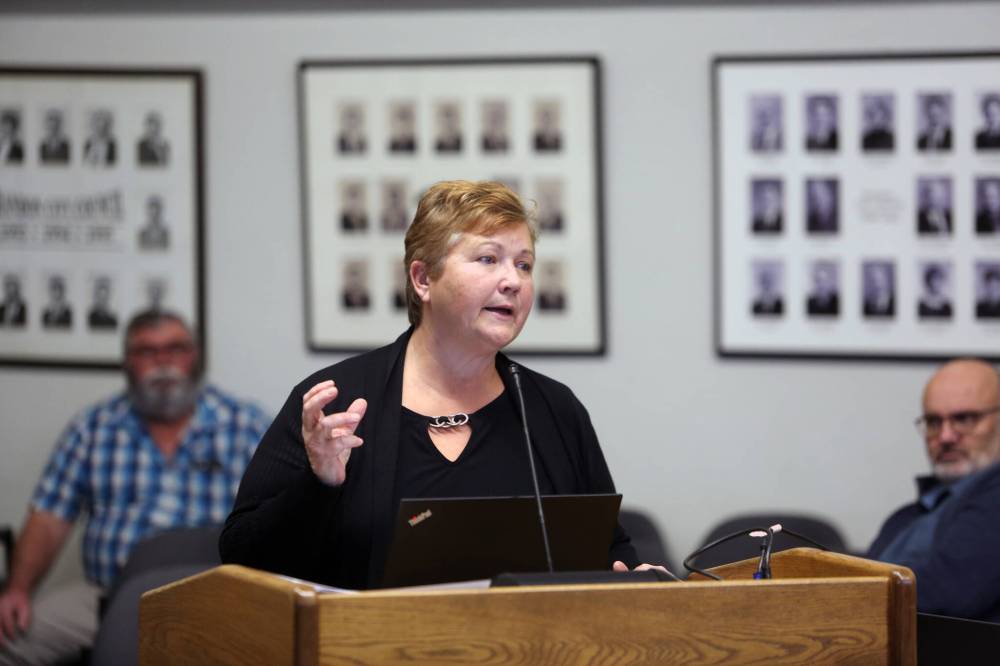
Currently, she said, the bulk of the revenue comes from residential taxes. Part of her job is to try to reverse that.
Part of the reason the city wanted to annex that land in the southwest in 2011, as Trudel explains it, is because it was determined that Brandon was unable to support any more development for businesses that would improve the regional economy.
In that South Brandon Village area, there is the potential for regional business roughly equivalent to the footprint taken up by the Corral Centre, she said.
Having developments like that in process stimulates the economy in a few ways. The construction itself benefits contractors and the businesses once established contribute to tax revenues and local employment.
Trudel also argued that it would allow the city to attract labour from elsewhere to have this kind of development, improve Brandon’s brand as an urban centre and have more money be spent within the community rather than leaking out.
Access to retail and to labour opportunities are two important factors in people rating their quality of life, she said.
“For development, it’s either go time or it’s not,” Nickel said. “Band-aids for growth only work so long and that’s what we’ve been doing.”
That’s why this new lift station, Nickel said, is a new system and wouldn’t have the same constraints as the current one.
Mayor Jeff Fawcett said he and Coun. Shawn Berry (Ward 7) were on council when some of those initial decisions were made in 2011.
He said that since they’ve been dealing with the issues for so long that while they might have understood the problems, city residents might not have following it with as much scrutiny.
Berry said a lot of his constituents have asked him why a lift station is needed now after the area has been developed for several years. What is the breaking point, when is it absolutely needed?
Wastewater capacity is only available for one more stage of development or approximately 50 units, Nickel said. Ideally, he said, new units constructed would be hooked up to the new system.
Failing to build the lift station would essentially mean the end of development in southwest Brandon, Nickel said.
The city’s engineering director, Mark Allard, talked about his department’s role in the planning process.
“We look at 30 years of growth, and part of the reason we look that far down the road is we have to determine the development charge rates we’re going to collect,” Allard said.
Then they look at the secondary plans for Brandon’s neighbourhoods and determine what those neighbourhoods will need over time. That includes drainage, water and wastewater services and traffic considerations.
The city manages development of arterial roads while collector roads are built by developers with guidance from the city.
Discussing the city’s handling of water distribution, Allard said the city is currently studying water pressures in different areas to see if a booster station is needed somewhere. Allard was not sure of the potential cost of a booster station on Monday.
To improve wastewater service, it was decided to build two new lift stations: the first on 34th Street near the city’s southwestern most point and the other on 18th Street near the city’s southernmost point.
Originally, it was the plan to build a single lift station to handle all the new capacity, but Allard said there were concerns that construction of a larger single station would require digging eight or nine metres into earth with a high water table and presented construction risk.
Instead, it was decided to split it into two stations and two phases, with the second expected to be tendered about a year after the first. The $30 million is likely to pay for both phases, minus the installation of gravity mains in the second phase.
The southeast lift station on First Street will be upgraded in phase one of the wastewater project, which will also include the construction of the 34th Street lift station and associated water mains. It will service Brookwood and the western half of Bellafield.
The second phase will see the 18th Street lift station built along with associated water mains. It would service the eastern half of Bellafield and commercial and residential land at the southern end of 18th Street.
For those who were unable to attend the session in person, it should be made available on the city’s YouTube channel soon.
The next meeting in the series is scheduled for the week of Jan. 9-13, 2023 and will be titled “Paying for Growth.”
Council voted in favour of holding a second public hearing on the $30-million debenture before October’s election. It’s scheduled to take place sometime in late January.
» cslark@brandonsun.com
» Twitter: @ColinSlark