
Grain production likely to jump in Europe, Canadian farmers needn’t worry
Advertisement
Read this article for free:
or
Already have an account? Log in here »
We need your support!
Local journalism needs your support!
As we navigate through unprecedented times, our journalists are working harder than ever to bring you the latest local updates to keep you safe and informed.
Now, more than ever, we need your support.
Starting at $15.99 plus taxes every four weeks you can access your Brandon Sun online and full access to all content as it appears on our website.
Subscribe Nowor call circulation directly at (204) 727-0527.
Your pledge helps to ensure we provide the news that matters most to your community!
To continue reading, please subscribe:
Add Brandon Sun access to your Free Press subscription for only an additional
$1 for the first 4 weeks*
- Enjoy unlimited reading on brandonsun.com
- Read the Brandon Sun E-Edition, our digital replica newspaper
*Your next Free Press subscription payment will increase by $1.00 and you will be charged $20.95 plus GST for four weeks. After four weeks, your payment will increase to $24.95 plus GST every four weeks.
Read unlimited articles for free today:
or
Already have an account? Log in here »
Hey there, time traveller!
This article was published 07/01/2023 (1327 days ago), so information in it may no longer be current.
Although a European agriculture group is predicting grain production to rise this year, Manitoba farmers shouldn’t be concerned, says the National Farmers Union.
Grain industry lobby group Coceral, a European association representing trade in cereals, rice, feedstuffs, oilseeds, olive oil and other oils and fats, based out of Brussels, Belgium, said grain production in both the European Union and the United Kingdom is expected to rebound this year after suffering from crop damage due to dry and hot weather last growing season.
Although European grain markets are still feeling the effects of the war in Ukraine through supply-chain uncertainty, Coceral has predicted that soft wheat production in the EU and UK will come in at 143.2 million tonnes this year, up 2.5 million tonnes from last year’s 140.7 million.
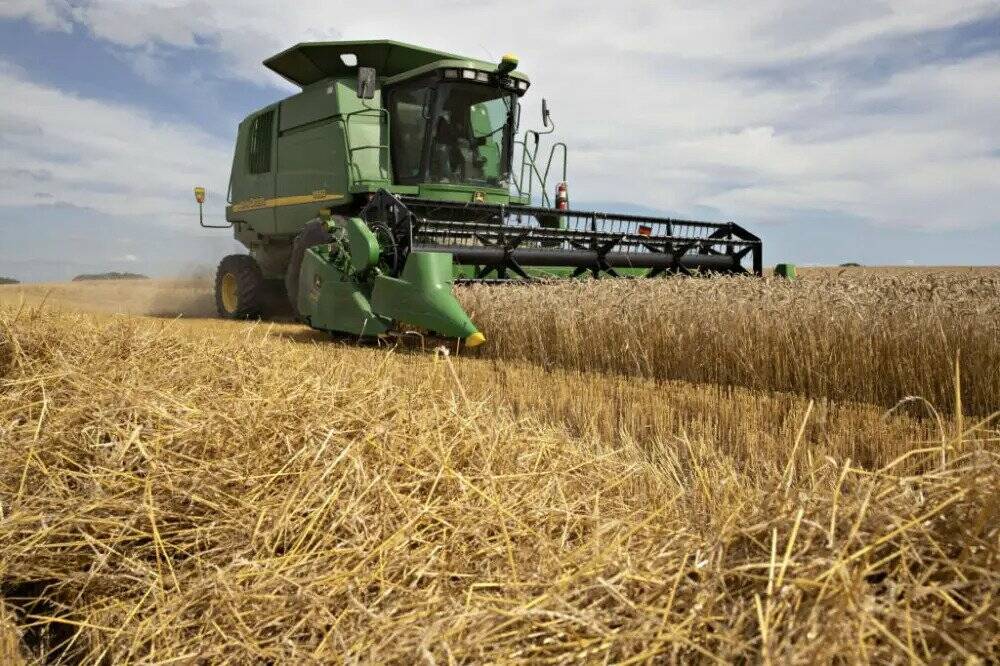
Grain industry lobby group Coceral, a European association representing trade in cereals, rice, feedstuffs, oilseeds, olive oil and other oils and fats, based out of Brussels, Belgium, said grain production in both the European Union and the United Kingdom is expected to rebound this year after suffering from crop damage due to dry and hot weather last growing season. (File)
France, which is the EU’s biggest producer of wheat, is projected to harvest 34.1 million tonnes in 2023, compared to the 33.6 million tonnes harvested last year.
Germany, the EU’s second-biggest wheat producer, is forecast to produce 22.9 million tonnes this year, a rise from 2022’s 22.5 million.
Across all grains, EU and UK production is projected to reach 304.4 million tonnes, up from 285.1 million in 2022.
Although Coceral’s predictions look rosy for the EU and UK markets, that doesn’t necessarily mean exports from the Prairies will suffer, said Cathy Holtslander, director of research and policy at the National Farmers Union.
Though there is a tendency for prices to go down due to more grain in the market, total amount of exports are usually related to how much Canadian farmers produce, not how much other countries put out.
“The global agricultural system, I don’t think, would be particularly affected by a poor or good growing year in Europe, because of all the other countries that are also producing and importing and exporting,” Holtslander said.
And although Coceral is hopeful for the 2023 growing year, Italy’s national farming union said the country’s unusually warm and dry winter could harm its agricultural sector. The union said the warm winter weather, which followed record-breaking heat and drought conditions over the summer, has left natural water supplies worryingly low. Less rainfall so far this winter means drought-stricken crops will not have had the chance to rehydrate during the colder months.
It’s not just the poor weather experienced in the UK and EU that has impacted global grain markets. The effects of the war between Russia and Ukraine led to Canadian farmers facing increased pressure to grow larger crops to counter potential food shortages by the fighting between two of the world’s largest wheat exporters.
Last April, Cornie Thiessen, general manager of ADAMA Canada, a global crop protection company, said world crop rises rose since Russia invaded Ukraine in February 2022, because of the inability to have grain exported from Ukraine. Due to trade embargoes and sanctions, many countries also refrained from purchasing crops from Russia.
“The removal of a portion of Russian and Ukraine supplies really exasperates an existing tightness in global stock for grains, primarily wheat,” Thiessen said.
The Canadian Press reported that since Russia’s attack on Ukraine, global wheat prices rose to levels not seen since 2008.
» mleybourne@brandonsun.com
» Twitter: @miraleybourne