
Rural school divisions grappling with low funding
Advertisement
Read this article for free:
or
Already have an account? Log in here »
We need your support!
Local journalism needs your support!
As we navigate through unprecedented times, our journalists are working harder than ever to bring you the latest local updates to keep you safe and informed.
Now, more than ever, we need your support.
Starting at $15.99 plus taxes every four weeks you can access your Brandon Sun online and full access to all content as it appears on our website.
Subscribe Nowor call circulation directly at (204) 727-0527.
Your pledge helps to ensure we provide the news that matters most to your community!
To continue reading, please subscribe:
Add Brandon Sun access to your Free Press subscription for only an additional
$1 for the first 4 weeks*
*Your next subscription payment will increase by $1.00 and you will be charged $20.00 plus GST for four weeks. After four weeks, your payment will increase to $24.00 plus GST every four weeks.
Read unlimited articles for free today:
or
Already have an account? Log in here »
Hey there, time traveller!
This article was published 21/01/2023 (1200 days ago), so information in it may no longer be current.
Between inflation and uncertainty around government funding, rural school divisions are struggling to make ends meet.
Fort la Bosse school board chairperson Craig Russell said so far, they’ve managed to handle dwindling revenue by cutting items that don’t affect teaching and learning, areas such as operations and maintenance.
“We haven’t had to cut programs, we haven’t had to layoff teachers to this point to the extent that it’s affecting regular classroom instruction,” Russell said.
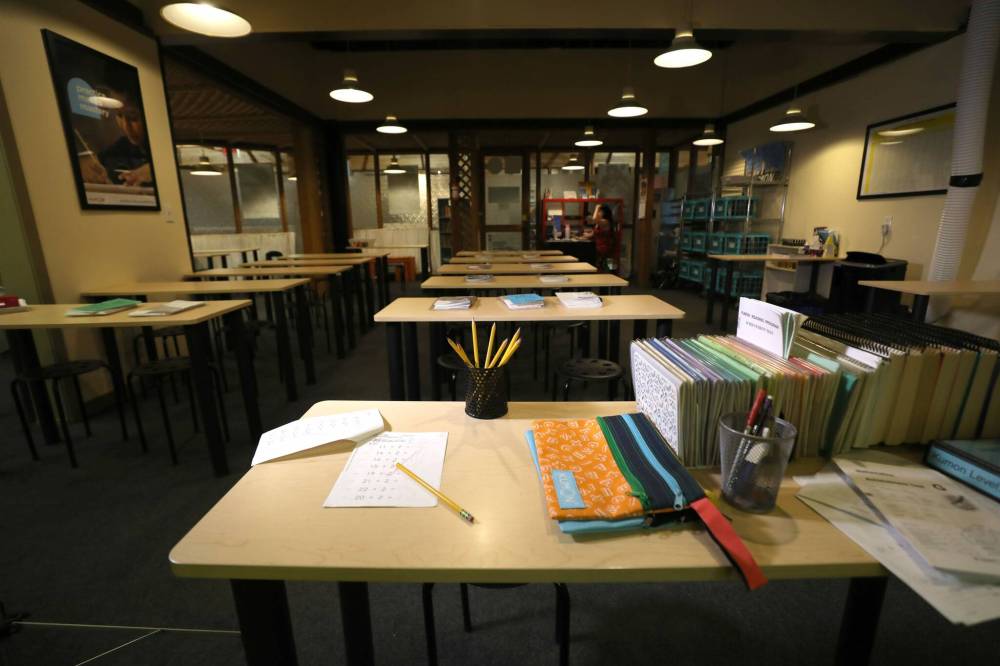
According to recent data, out of 35 school divisions in Manitoba, only nine saw an overall increase in base funding between 2012 and 2022, when adjusted for inflation. Manitoba's education minister says that data doesn't consider other funding, though. (File)
But, he said, there isn’t room left to cut outside of the classroom so, depending on how much the government will fund education for the 2023-24 school year, an announcement that’s expected next month, the board may have to consider cuts inside the classroom.
It’s too early to tell, Russell said, but that could include loss of teaching-related positions.
“I think all options are on the table at this point,” Russell said.
Many school divisions have already faced a reduction in funding compounded by inflation.
A concerned accountant, Michael Harder, analyzed kindergarten to Grade 12 budgets across the province for the years 2012-13 to 2021-22. He found that, out of 35 school divisions, only nine saw an overall increase in base funding during that time, when adjusted for inflation. Overall, the province’s school divisions have received 6.4 per cent less funding when inflation is factored in, Harder’s figures show.
According to Harder’s number crunching, all but two of the school divisions that cover the Westman region — Fort la Bosse, Southwest Horizon, Turtle Mountain, Park West, Rolling River, Prairie Spirit, Pine Creek and Mountain View, Beautiful Plains and Brandon — saw a decrease in funding with inflation.
As the exceptions to the funding fall, Beautiful Plains received a 29 per cent increase when inflation was considered while the Brandon School Division benefited from an increase of nearly 15 per cent.
Even without inflation dragging on their income, six of those 10 Westman school divisions would have seen a funding reduction, Harder’s numbers show.
However, provincial Education Minister Wayne Ewasko said those numbers, which use school divisions’ budget reports that reflect funding available at the start of the school year, don’t take into account money provided by the government during the year.
As such, Ewasko indicated in a statement emailed to the Sun by his press secretary, they don’t consider wage assistance or funding provided to help divisions address the pandemic.
The province allocated $185 million to public and independent schools for COVID-19 expenditures, he said. In January 2022, it provided $80 million to schools for incremental wage costs and other expenses, an investment also not contained in Harder’s numbers, Ewasko said.
With 30 of the province’s 37 school divisions considered rural, many that have grappled with reduced funding are also rural.
Ewasko says the Funding of Schools program contains a variety of grants that target the unique characteristics of school divisions across the province, including rural ones. Many are eligible for support that offsets lower enrolment numbers (enrolment being a factor on which funding is based).
Rural divisions also benefited from funding adjustments made to mitigate the impact of the pandemic on enrolment-based funding, he said.
Adding to uncertainty, the provincial government is phasing out local school boards’ power to raise education property taxes, and have already taken steps toward that by offering an education property tax rebate.
On Thursday, the NDP stated that, according to a draft framework for the Progressive Conservative government’s new funding model for K-12 education, the funding model review wouldn’t determine where or if funds would be found to compensate for education property taxes.
“The PCs plan to eliminate the education property taxes will clearly leave school without adequate funding from the classroom,” an NDP news release stated.
Also, on Friday, the Canadian Centre for Policy Alternatives announced the results of Probe Research survey that it said shows 58 per cent of Manitobans want the province to cancel property tax rebates, which were introduced in 2021, and spend the money on public services. The organization asserted that the Manitoba government should cancel rebate cheques and use the money to stop cuts to public education.
Manitoba Teachers’ Association president James Bedford said removing school divisions’ ability to collect local property taxes leaves a billion-dollar hole in education funding, and the provincial government hasn’t been clear about whether it is going to make up the difference.
“One of the big concerns about the elimination of the local property tax … is what is it going to be replaced by,” Bedford said. “We’re still waiting for a clear plan from the province.”
The effects of reduced funding varies from division to division, Bedford said, but he’s already seen bigger class sizes and the loss of full-day kindergarten, pre-kindergarten and teacher librarians.
He said funding has failed to keep pace with inflation and if divisions are unable to collect taxes, they’re in a crunch.
“Then you have to look at your operations,” he said. “So, what does that mean? It can mean any number of things in any number of school divisions.”
He said possibilities include larger classes, staff reductions for positions such as resource teachers, or the loss of a dedicated music teacher in a school.
“The bottom line is, all these things are services to students in classrooms, and it means you’re reducing services to students in classrooms who desperately need them and depend on them,” Bedford said.
In the Prairie Spirit School Division, board of trustees chairperson Jan McIntyre said the division has run deficit budgets for two years, covering the shortfall with its surplus, to maintain basic services.
In recent years, McIntyre said, the province has frozen raises to local education property taxes at two per cent and covered that raise with a grant to school divisions, a move intended to protect taxpayers.
“The funding for the last two years hasn’t been enough to provide basic services,” she said.
McIntyre said investing in students now can prevent problems it will take more money to remedy later. Students need to be viewed as an investment rather than an expense, she said.
» ihitchen@brandonsun.com, with files from the Winnipeg Free Press