
Visually impaired man fights for ID changes
Advertisement
Read this article for free:
or
Already have an account? Log in here »
We need your support!
Local journalism needs your support!
As we navigate through unprecedented times, our journalists are working harder than ever to bring you the latest local updates to keep you safe and informed.
Now, more than ever, we need your support.
Starting at $15.99 plus taxes every four weeks you can access your Brandon Sun online and full access to all content as it appears on our website.
Subscribe Nowor call circulation directly at (204) 727-0527.
Your pledge helps to ensure we provide the news that matters most to your community!
To continue reading, please subscribe:
Add Brandon Sun access to your Free Press subscription for only an additional
$1 for the first 4 weeks*
*Your next subscription payment will increase by $1.00 and you will be charged $20.00 plus GST for four weeks. After four weeks, your payment will increase to $24.00 plus GST every four weeks.
Read unlimited articles for free today:
or
Already have an account? Log in here »
Hey there, time traveller!
This article was published 04/02/2023 (1177 days ago), so information in it may no longer be current.
A Brandon man continues to fight to have his identification issued by the Canadian National Institute for the Blind recognized by the province.
Mike Thiessen, who is visually impaired, said he continues to advocate for regulation changes while his Manitoba Human Rights Commission complaint drags out for almost three years. As the Sun previously reported, Thiessen launched a complaint after his CNIB ID was not accepted as identification to enter a Liquor Mart location at the corner of Victoria Avenue and 10th Street in Brandon.
A CNIB card, given out by the charitable organization, contains much of the same information as a driver’s licence, which is one of the accepted pieces of ID for purchasing liquor in Manitoba, including a photo, name and address. Thiessen said the denial of CNIB ID at Liquor Marts is an accessibility issue that discriminates against him and others who are visually impaired.
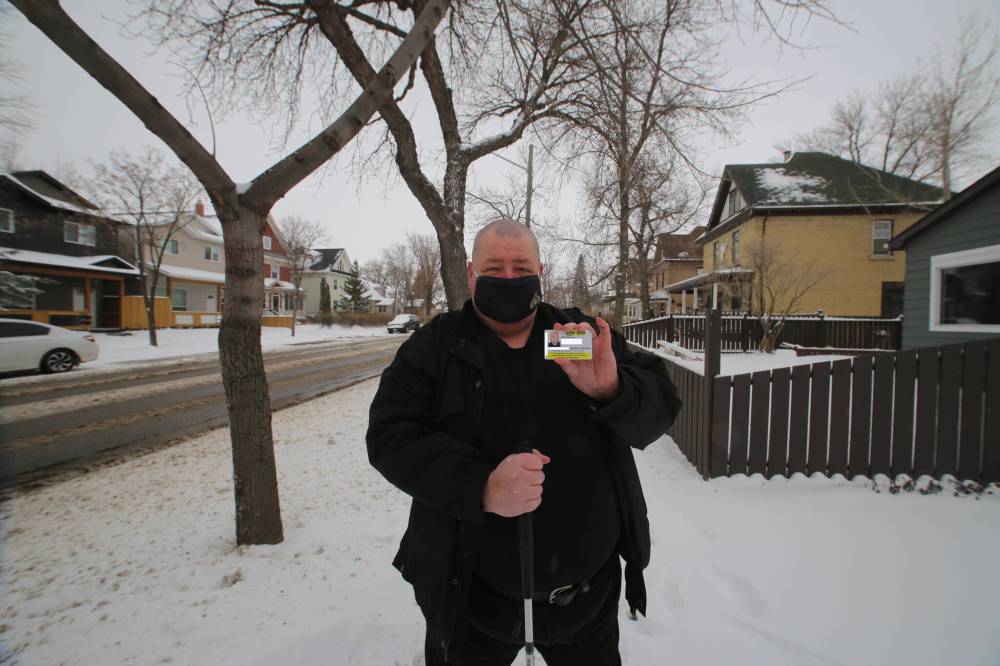
Mike Thiessen holds up his ID card issued by the Canadian National Institute for the Blind after the Manitoba government announced that it is expanding ID requirements for purchasing liquor to include Manitoba Métis Federation citizenship cards. (File)
Unable to hold a driver’s licence due to his visual impairment, Thiessen said he uses his CNIB ID card for many routine identification purposes, including voting. “If it’s good enough for the Progressive Conservative’s election, why is it not good enough for me to use it to buy liquor?”
The Manitoba government recently announced changes to the ID requirements set out in the Liquor, Gaming and Cannabis Authority of Manitoba, allowing Manitoba Métis Federation citizenship cards to be recognized as a form of identification for purchasing liquor, cannabis and gaming products. Though Thiessen wholeheartedly agrees with the government’s changes to accept MMF cards, he wonders why there haven’t been movement on changes to improve access for other groups as well.
“What I have major concerns with is how inequitable it is that I have been fighting this battle for over three years without any progress and within 30 days of the problems of the Métis cards being announced, the government changed its policy. That proves to me that the disabled are lesser than anyone else.”
Thiessen said in addition to his complaint with the commission, he has spoken with Brandon East MLA Len Isleifson about the issue, but feels his concerns haven’t been heard.
In a statement to the Sun, Isleifson wrote: “I have been working with constituents on this matter and have already brought this concern to the minister’s attention. This topic remains an active file within my office and I will continue to work with the minister responsible for Manitoba Liquor and Lotteries Corporation on a resolution.”
A spokesperson from the LGCA said they consulted on the MMF citizenship cards extensively prior to the announcement and there are other forms of ID that are accepted such as a passport or two pieces of government issued ID along with a photo. “Our primary goal is to ensure public safety,” she said. “We’re trying to resist access of age-restricted products to minors.”
The LGCA currently has a liquor modernization project which is looking at regulations surrounding types of ID, though the spokesperson did say the LGCA was not specifically looking at CNIB ID cards.
“Some of the wording around ID might change and there are currently other forms of ID that we’re specifically looking into, but the ID requirement in general and how it’s worded in the regulations.”
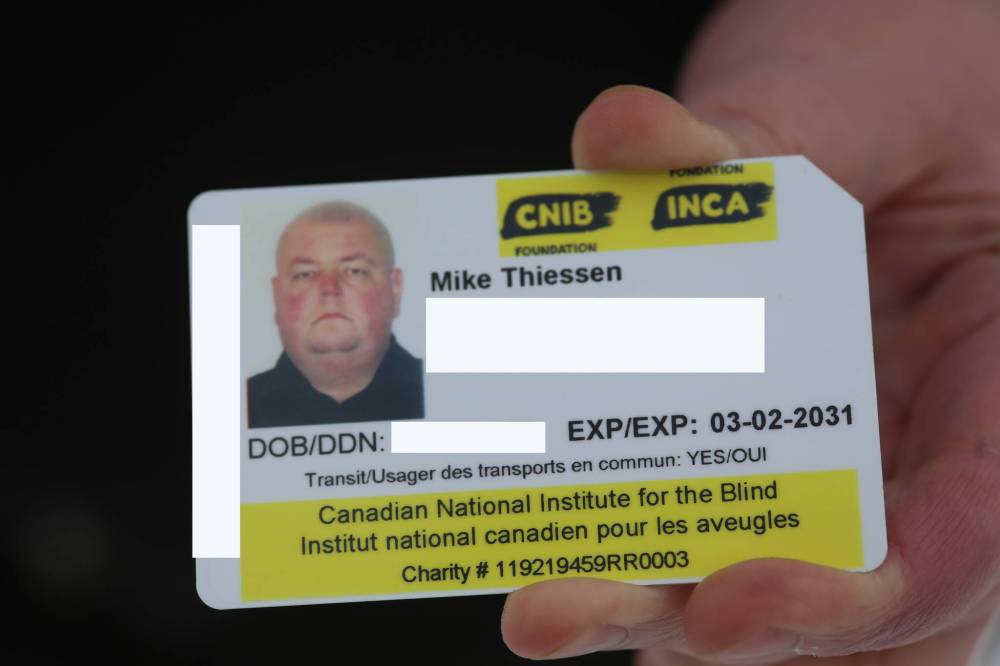
Mike Thiessen wants his CNIB ID to be included as a form of ID at liquor stores. (File)
While Thiessen knows that other forms of government ID are accepted at Liquor Marts, not being able to use his CNIB ID is another hurdle he faces navigating everyday life with a visual impairment. He became visually impaired in 2019 after a bout of inflammation in his optical nerves, which caused him to lose most of his vision in his right eye and become completely blind in his left eye.
“It’s a brand-new reality for me. You wake up everyday and being treated as a secondary citizen from the government the way they have just adds to the stress and the feeling of not being worthy.”
» gmortfield@brandonsun.com
» Twitter: @geena_mortfield