
Local soldier key figure in queer history study
Advertisement
Read this article for free:
or
Already have an account? Log in here »
We need your support!
Local journalism needs your support!
As we navigate through unprecedented times, our journalists are working harder than ever to bring you the latest local updates to keep you safe and informed.
Now, more than ever, we need your support.
Starting at $15.99 plus taxes every four weeks you can access your Brandon Sun online and full access to all content as it appears on our website.
Subscribe Nowor call circulation directly at (204) 727-0527.
Your pledge helps to ensure we provide the news that matters most to your community!
To continue reading, please subscribe:
Add Brandon Sun access to your Free Press subscription for only an additional
$1 for the first 4 weeks*
- Enjoy unlimited reading on brandonsun.com
- Read the Brandon Sun E-Edition, our digital replica newspaper
*Your next Free Press subscription payment will increase by $1.00 and you will be charged $20.95 plus GST for four weeks. After four weeks, your payment will increase to $24.95 plus GST every four weeks.
Read unlimited articles for free today:
or
Already have an account? Log in here »
Hey there, time traveller!
This article was published 06/02/2023 (1218 days ago), so information in it may no longer be current.
East Coast researcher Sarah Worthman is hoping to shine a light on a largely unexplored period in Canadian history through her upcoming report, which examines the persecution gay and bisexual soldiers faced during the First World War.
Pte. Frederick Lea Hardy of Brandon is one of the central figures highlighted in Worthman’s study, since she discovered he was thrown into a British prison for eight months after being convicted of committing an act of “gross indecency” with another man.
Hardy was only released from prison early to help bolster Canadian forces on the frontlines, eventually losing his life on Aug. 15, 1917, during the Battle of Hill 70.
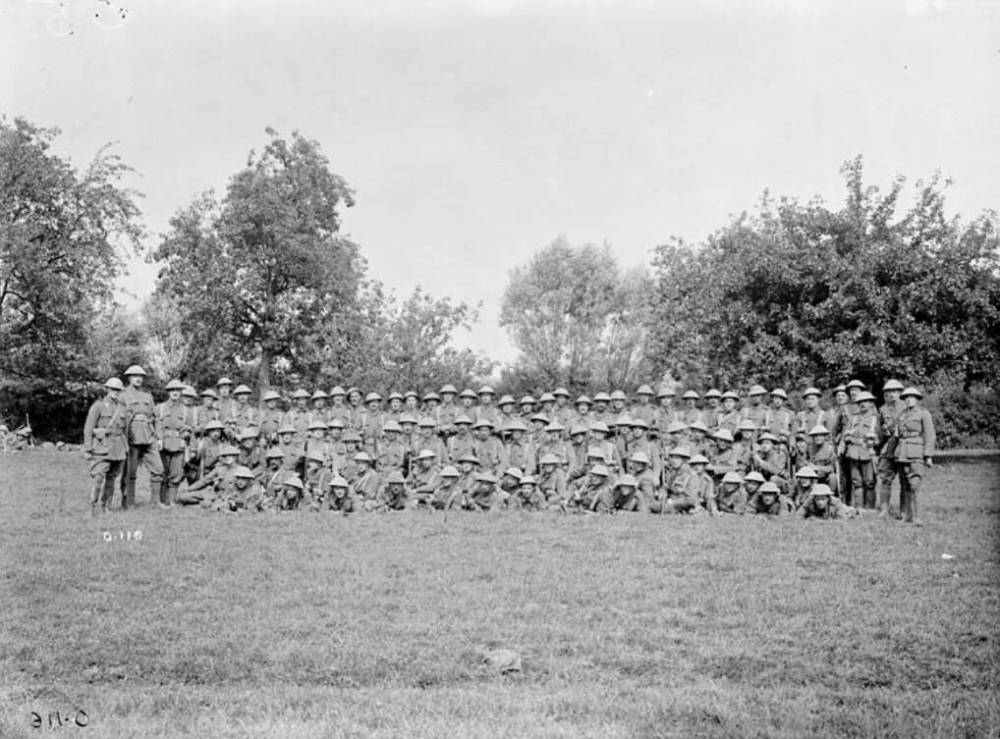
A photo of the Canadian Expeditionary Force’s 8th Infantry Battalion (A company) dated June 1916. The use of war gaming as a tactical, operational and strategic exercise has been a hallmark of advanced militaries since the First World War. (Submitted)
While Hardy’s body was never recovered, his name is etched into the Vimy Ridge war memorial in France, making him the only known queer soldier to be commemorated at this famous site.
Talking to the Sun over the weekend, Worthman said that Hardy was one of the first cases she was able to extensively research when she began this project as an employee of Veterans Affairs Canada.
She even got the opportunity to fly overseas and see Hardy’s name on the Vimy Ridge memorial in person, which encouraged her to dig deeper and find out more about his story.
“Frederick just has such a special place in my heart after researching him for the past almost two years now,” Worthman said on Saturday.
Although historical records from that period are notoriously shoddy, particularly during wartime, Worthman managed to piece together some basic details of Hardy’s life before his wrongful imprisonment and death on the battlefield.
Despite being born in Strathroy, Ont., on Nov. 17, 1898, Hardy grew up in the Brandon area, later dropping out of school to help out on the family farm.
In 1915, a teenage Hardy enlisted to fight the Central Powers in Europe and was sorted into the 8th Battalion of the Canadian Expeditionary Force.
After an intense round of combat in Belgium, members of the battalion were treated to a rest period in the summer of 1916. Hardy and another male soldier decided to attend a town establishment for some drinks. The pair eventually wandered off to a field, where they became intimate.
Some superior officers staying at a nearby farmhouse spotted Hardy and his companion in the act and placed them both under arrest.
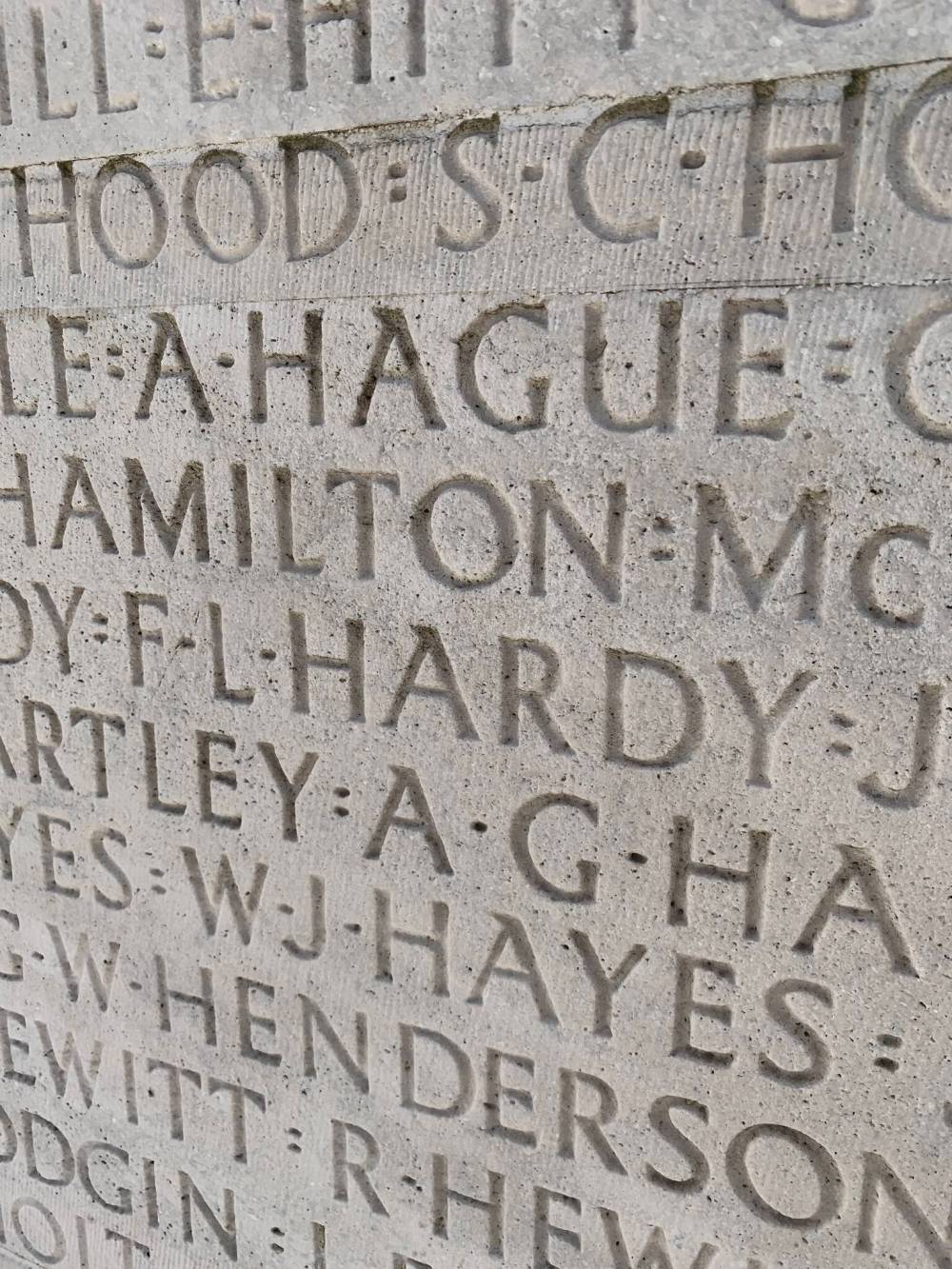
Pte. Frederick Lea Hardy’s name is carved into the Vimy Ridge war memorial in France. Hardy was killed at the Battle of Hill 70 on Aug. 15, 1917. (Submitted)
Outside of the indignity of being publicly tried and convicted because of his sexuality, Worthman’s research revealed that Hardy also had to endure horrendous conditions during his eight-month sentence at HM Prison Winchester, where inmates were required to perform hard labour for 10 to 12 hours a day and sleep in cells that measured seven by 12 feet.
“They didn’t even have beds. They just had plank boards,” she said.
“And food in these prisons was systemically designed to make them ill because it was seen as an extension of the punishment, as a way to destroy the morale of those who were imprisoned.”
Through her research, which involved combing through hundreds of court martial files from that period, Worthman determined that at least 35 Canadian Expeditionary Force members were charged with “gross indecency” during the First World War.
Of those 35, she determined that 19 soldiers were tried for being in a consensual queer relationship, with 12 ultimately being imprisoned on that basis.
For Worthman, who identifies as a queer person herself, the act of unearthing all this information about an untold chapter in Canadian history evoked mixed emotions.
On one hand, discovering the existence of any queer soldiers was elating, since Worthman, who worked as a tour guide in Newfoundland, was always perplexed by the absence of LGBTQ+ representation throughout important parts of Canadian history.
However, the sheer level of discrimination these individuals faced because of their identity was hard to stomach, especially with their struggle being outright ignored by future generations.
“It’s also so sad to read this [information] and to know that still, 100 years later, these men haven’t even been recognized for what they faced,” Worthman said. “All of them died without any apology or recognition of their wrongful imprisonment and trials, where they were publicly outed to everyone.”
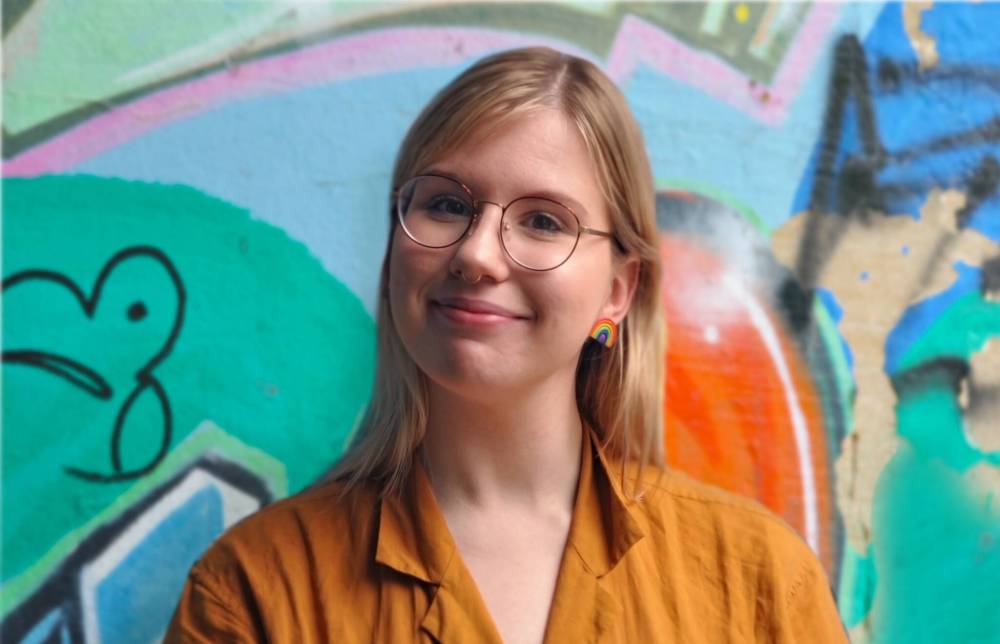
Sarah Worthman has spent the last couple of years researching Canadian soldiers who were persecuted for their sexuality during the First World War and is getting ready to publish her findings next month. (Submitted)
Aly Wowchuk has faced similar kinds of LGBTQ+ erasure in the research she has conducted as a local history buff and as the current chair of Brandon Pride.
In fact, this issue was broached during a recent general meeting with the Manitoba Historical Society, where someone pointed out that there are only two profiles on the group’s extensive website that mention queer people.
“And the Manitoba Historical Society [members] said ‘we’re always looking for more volunteers, more stories,’” Wowchuk said. “And so I’m trying to add onto that, I’m trying to develop profiles to submit and have more representation that’s always been there.”
For this reason, Wowchuk was more than happy to help Worthman with her research into queer soldiers during the First World War.
She even managed to supply Worthman with some clippings from old editions of the Brandon Daily Sun, which reported that Hardy’s memorial service took place at the First Baptist Church on Sept. 9, 1918.
But outside of Hardy’s name being listed on key memorials at Vimy Ridge and the Brandon Armoury museum, both Wowchuk and Worthman admit the details surrounding his life are still hard to come by.
To date, the pair haven’t even managed to find a photo of Hardy.
While the process of investigating a person who died over a century ago is always challenging, Worthman said it is particularly difficult when their queer identity is factored into the equation.
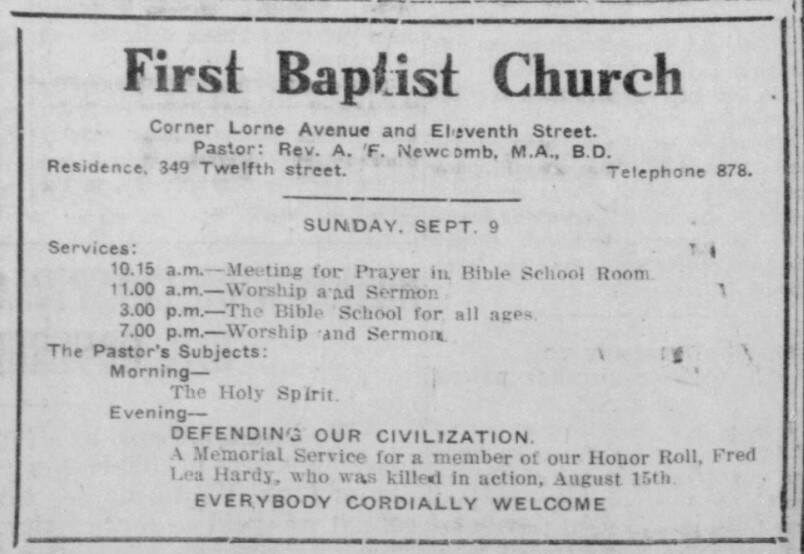
A clipping from the Sept. 8, 1917 edition of the Brandon Daily Sun, which is advertising a memorial service for Pte. Frederick Lea Hardy that took place the following day. (Submitted)
Throughout the course of researching some of the other soldiers referenced in her report, Worthman has hit numerous roadblocks with uncooperative family members, who did not react positively to the idea that their heroic ancestor could be categorized under the LGBTQ+ umbrella.
The historian even received some pushback following a management shuffle at Veteran Affairs, which stopped her project dead in its tracks.
“There’s a certain image that comes to everyone’s minds when they think of the First World War and the Second World War,” she said.
“You don’t ever imagine people dressing up in drag, you don’t imagine there ever being queer soldiers falling in love. We’ve never heard those stories. And so, I think this story is important now more than ever … to help counteract that narrative.”
Thankfully, Worthman continued her work through the LGBT Purge Fund, a not-for-profit group dedicated to the collection and preservation of historical records related to queer folks who were discriminated against in Canada’s military, police force and federal public service.
Due to their support, Worthman’s report, titled “2SLGBTQ+ Persecution in the First World War: The Untold History of the Canadian Expeditionary Force,” is set to be released sometime next month.
Following its publication, Worthman will take part in some cross-country presentations to signal boost her findings, with this campaign involving more collaboration with Brandon Pride.
The young historian is also going to be featured on a full episode of journalist Shawn Dearn’s “Queer Legends” podcast, having already appeared in a “quickie” instalment of the show to discuss the Hardy case specifically.
Outside of presenting a different side of history, Worthman hopes that her research also fights against an old flavour of anti-LGBTQ+ rhetoric that has started to resurface in certain parts of North America, where queer people are being accused of indoctrinating young people into becoming gay, bisexual or even transgender.
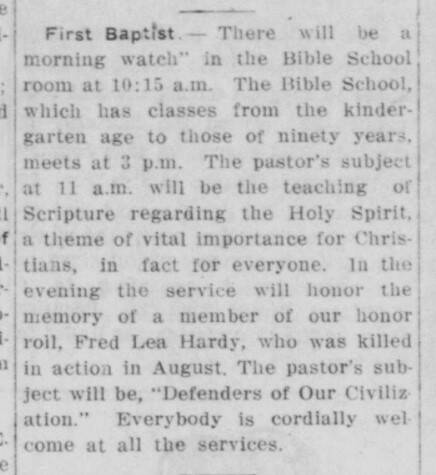
A clipping from the Sept. 8, 1917 edition of the Brandon Daily Sun, which is advertising a memorial service for Pte. Frederick Lea Hardy that took place the following day. (Submitted)
“This [research] shows that even when it was illegal to be in a queer relationship or to dress as your desired gender identity, people were still doing it,” she said.
“What’s important about these stories is that people were brave enough then and they’re brave enough now to authentically be themselves.”
Last year, Worthman founded the Newfoundland and Labrador Queer Research Initiative to help collect and preserve LGBTQ+ historical materials across the province.
» kdarbyson@brandonsun.com
» Twitter: @KyleDarbyson