
CWD detected in pair of white-tailed deer
Advertisement
Read this article for free:
or
Already have an account? Log in here »
We need your support!
Local journalism needs your support!
As we navigate through unprecedented times, our journalists are working harder than ever to bring you the latest local updates to keep you safe and informed.
Now, more than ever, we need your support.
Starting at $15.99 plus taxes every four weeks you can access your Brandon Sun online and full access to all content as it appears on our website.
Subscribe Nowor call circulation directly at (204) 727-0527.
Your pledge helps to ensure we provide the news that matters most to your community!
To continue reading, please subscribe:
Add Brandon Sun access to your Free Press subscription for only an additional
$1 for the first 4 weeks*
*Your next subscription payment will increase by $1.00 and you will be charged $20.00 plus GST for four weeks. After four weeks, your payment will increase to $24.00 plus GST every four weeks.
Read unlimited articles for free today:
or
Already have an account? Log in here »
Hey there, time traveller!
This article was published 07/03/2023 (1121 days ago), so information in it may no longer be current.
A disease that had previously only been detected in mule deer in Manitoba has now been identified in two white-tailed deer through testing for chronic wasting disease, as confirmed by Manitoba Natural Resources and Northern Development.
Chronic wasting disease (CWD) is a highly contagious, fatal condition, but the way it is spread is unknown. It affects members of the cervid species, including all deer, moose and elk. Animals with CWD may exhibit excessive salivation, sudden weight loss and paralysis.
The disease was first detected in Manitoba in 2021, when five cases were confirmed in the mule deer population, but there has been a surveillance program in place since 1997, with specific zones where it’s mandatory for hunters to submit samples of harvested mule and white-tailed deer, moose and elk.
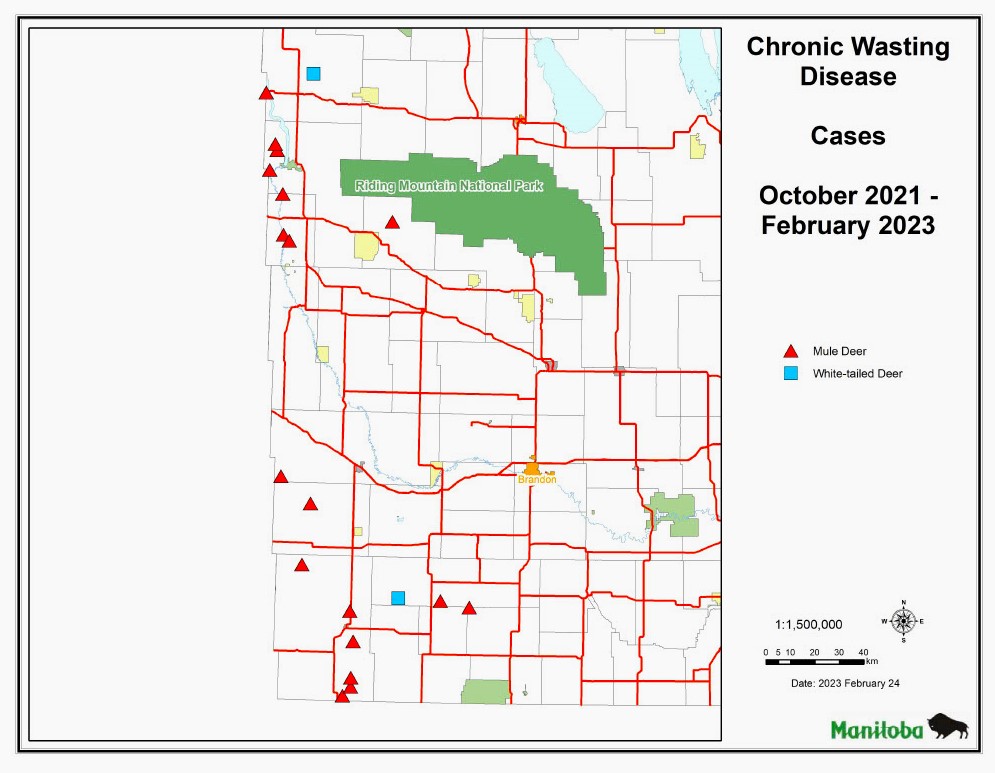
In early January, the zones were expanded to include areas along the Manitoba-Saskatchewan border, between Manitoba and North Dakota, the southwest corner of Ontario and around the edges of Riding Mountain National Park.
Of the two cases of CWD detected in the white-tailed deer population, one was found about 180 kilometres northwest of Brandon, and the other about 130 kilometres southwest of the city, both located within the expanded zones.
The 18 mule deer that tested positive were in various locations, including half a dozen found near the Manitoba-Saskatchewan border west of Riding Mountain National Park, and three along Manitoba’s border with North Dakota.
Hunters are still submitting their samples, or animal heads, but there is a backlog in testing at the provincial lab in Dauphin, with wait times estimated at 16 to 20 weeks.
Because of the volume of samples and lack of space, officials told the Sun in early January they had been using other labs across the country, including the Canadian Food Inspection Agency near Ottawa, the University of Guelph in Ontario and Saskatoon-based Prairie Diagnostic Services.
Although CWD is not a known health risk to humans, it is recommended not to eat meat from a known CWD-infected animal.
» The Brandon Sun