
Light, sound show transforms Berlin museum’s exhibits
Advertisement
Read this article for free:
or
Already have an account? Log in here »
We need your support!
Local journalism needs your support!
As we navigate through unprecedented times, our journalists are working harder than ever to bring you the latest local updates to keep you safe and informed.
Now, more than ever, we need your support.
Starting at $15.99 plus taxes every four weeks you can access your Brandon Sun online and full access to all content as it appears on our website.
Subscribe Nowor call circulation directly at (204) 727-0527.
Your pledge helps to ensure we provide the news that matters most to your community!
To continue reading, please subscribe:
Add Brandon Sun access to your Free Press subscription for only an additional
$1 for the first 4 weeks*
- Enjoy unlimited reading on brandonsun.com
- Read the Brandon Sun E-Edition, our digital replica newspaper
*Your next Free Press subscription payment will increase by $1.00 and you will be charged $20.95 plus GST for four weeks. After four weeks, your payment will increase to $24.95 plus GST every four weeks.
Read unlimited articles for free today:
or
Already have an account? Log in here »
Hey there, time traveller!
This article was published 04/04/2023 (1264 days ago), so information in it may no longer be current.
BERLIN (AP) — Hadad, the ancient weather god at Berlin’s Pergamon Museum, growls deeply as he casts his neon-blue gaze on visitors, his body bathed in pulsating orange light.
What seems like a scene from a horror movie is in fact the product of a light and sound installation by British contemporary artist Liam Gillick, part of the show Filtered Time that opened Tuesday at one of the German capital’s most popular museums.
The exhibition at the Museum of the Ancient Near East in the south wing of the Pergamon Museum uses unexpected layers of sound, light and color to breathe new life into iconic sculptures and artifacts that are thousands of years old.
It comes as the Pergamon Museum, which is based on the city’s famous Museum Island, prepares to close its gates for several years on October 23 for renovation. The show Filtered Light will end a week before the museum’s closure.
While the north wing of the Pergamon Museum is expected to open again in 2027, the south wing will only be open to the public again in 2037.
The weather god from Sam’al in what is today Turkey’s Gaziantep Province, is 3.4 meters (11 feet) tall and was created from black basalt in the 8th century BC. It is the first object to capture visitors with its unusual colors and sounds as they enter the museum’s galleries.
Gillick, who was present at the opening of his show, said he wanted to bring “an emotional quality to life in this object and gently bring warmth back,” as originally the weather god would have been standing outside in the sun.
He created the soundscape with the noise of shipping and construction from contemporary Syria and Iraq.
“But it’s slowed down. It’s made unclear. It’s sort of rendered into this soundscape, which becomes more emotional, suggestive of movement of machinery, of construction,” Gillick explained.
“But it could also be the sounds of an ancient God moaning and murmuring,” he added.
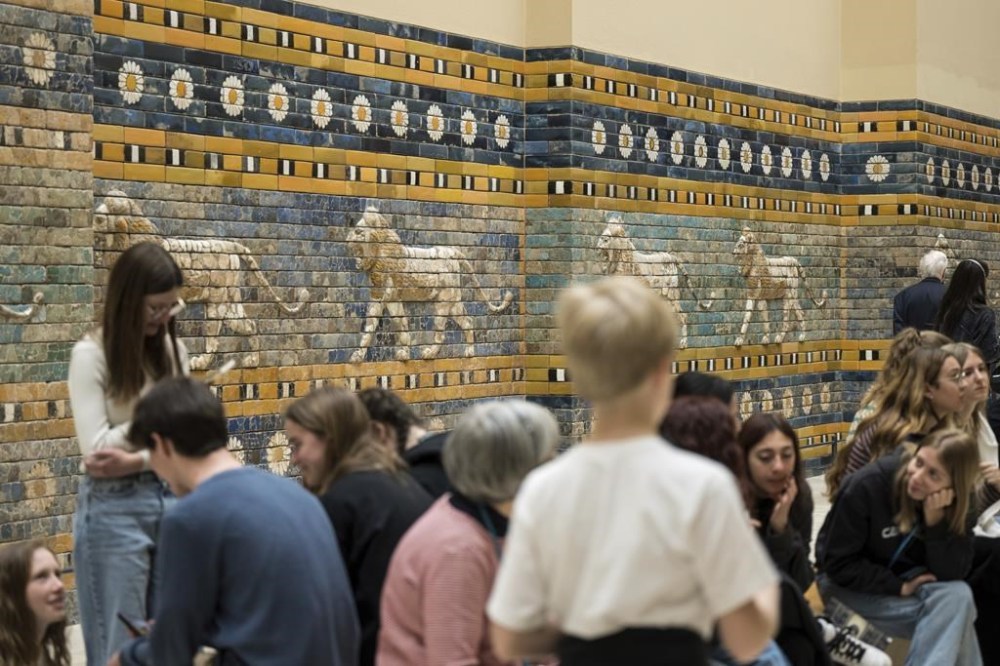
Gillick also attached a shining blue light above the museum’s renowned Ishtar Gate from the ancient city of Babylon with its characteristic blue-glazed bricks and depictions of lions, bulls and dragons. The light rises and fades while faint thunderclaps can be heard — sounds that in fact are a slowed-down recording of clay being knocked out of brick molds, the artist explained.
Gillick’s show was curated by the Museum of the Ancient Near East in cooperation with the city’s museum for contemporary art, the Hamburger Bahnhof.
Sam Bardaouil, the director of the Hamburger Bahnhof, explained how the sound installations help bring back energy to some of the antique objects.
“Many times when we come to these museums, the objects, unfortunately, become relics,” though they once existed in cities as living space, on avenues where people used them in different ways, walked through them or sat on them, Bardaouil said.
“So the sound, in a sense, is a way of bringing back some of the commotion, some of the energy, some of the life in which these objects existed,” he added.
The curators of the exhibition said they also wanted to make a point of showing that the artifacts Gillick engaged with come from places such as Syria and Iraq to which civilization owes much — even if today they’ve become associated with conflict and grief.
Visitors planning to catch a glimpse of Gillick’s show and the Pergamon’s treasures before it closes for renovation should book online tickets as waiting times can last up to two hours, according to the museum.
Built between 1910 and 1930, the museum and four others nearby were designated a UNESCO World Heritage site in 1999.
Even before the Pergamon Museum’s temporary closure was announced, it attracted more than a million visitors each year. During the renovation period, the museum is planning to show some of the objects in other exhibition spaces and will also offer virtual tours.
However, the Ishtar Gate, which was built in 575 BC, will be wrapped up and closed to the public until 2037.