
Saskatchewan community groups lead charge on safe consumption sites
Advertisement
Read this article for free:
or
Already have an account? Log in here »
We need your support!
Local journalism needs your support!
As we navigate through unprecedented times, our journalists are working harder than ever to bring you the latest local updates to keep you safe and informed.
Now, more than ever, we need your support.
Starting at $15.99 plus taxes every four weeks you can access your Brandon Sun online and full access to all content as it appears on our website.
Subscribe Nowor call circulation directly at (204) 727-0527.
Your pledge helps to ensure we provide the news that matters most to your community!
To continue reading, please subscribe:
Add Brandon Sun access to your Free Press subscription for only an additional
$1 for the first 4 weeks*
- Enjoy unlimited reading on brandonsun.com
- Read the Brandon Sun E-Edition, our digital replica newspaper
*Your next Free Press subscription payment will increase by $1.00 and you will be charged $20.95 plus GST for four weeks. After four weeks, your payment will increase to $24.95 plus GST every four weeks.
Read unlimited articles for free today:
or
Already have an account? Log in here »
Hey there, time traveller!
This article was published 04/04/2023 (1295 days ago), so information in it may no longer be current.
REGINA – Emile Gariepy usually supervises people using drugs inside one of Saskatchewan’s overdose prevention sites but says it’s those in the nearby parking lot who often need his attention.
Gariepy, the harm reduction manager at the Newo Yotina Friendship Centre in Regina, says he regularly helps people overdosing in the parking lot behind the centre, administering naloxone to prevent what could be another death.
“We just did that last week. It happens all the time,” Gariepy said in an interview. “A lot of the overdoses … are outside because of people smoking outside.”
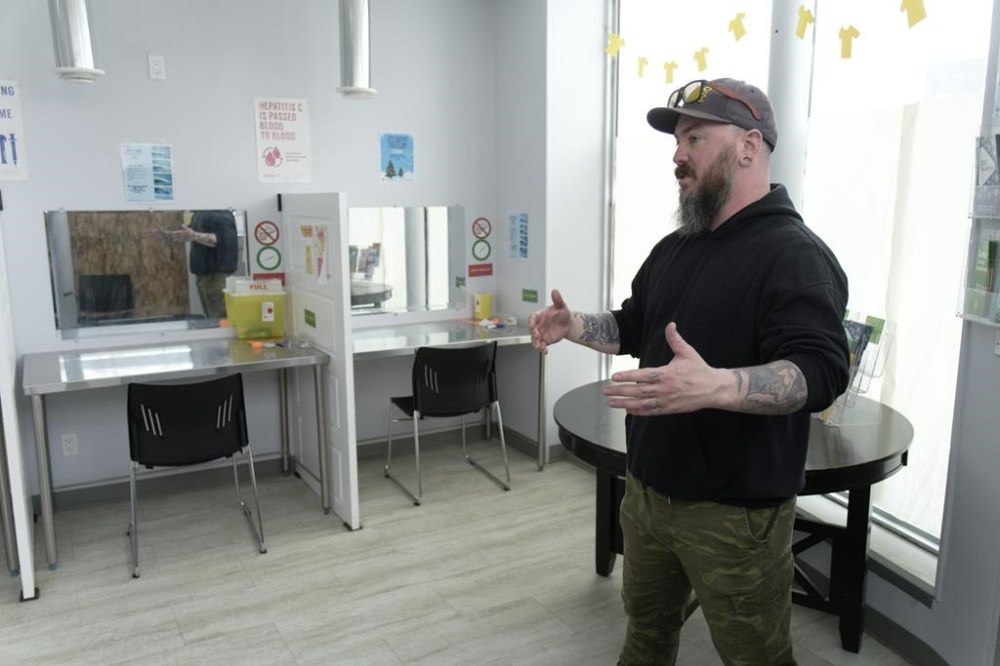
The centre can only offer supervision of injected drugs. But if it could provide a supervised smoking room, Gariepy said, it would give those who smoke a safe place.
Getting that room, let alone any additional harm reduction measures, is expected to be an uphill battle.
Unlike other provinces that offer safe consumption sites, the Saskatchewan government does not fund those services. Community organizations, such as the Newo Yotina Friendship Centre, have taken on the work and rely on grants.
Prairie Harm Reduction in Saskatoon is a second site in the province that offers such services.
The organizations have long asked for provincial funding, saying the money would keep doors open longer and provide clients with more safe resources.
Gariepy said that would help prevent overdose deaths, as well as save time for first responders who are already strained.
“It saves the community and the health-care system money,” he said, noting that the Newo Yotina Friendship Centre has received some funding from the City of Regina.
“In here, if someone does overdose, we’re watching it in real time. It’s a lot easier to reverse that than if someone is on the streets.”
Supervised consumption sites have grown in popularity across Canada as provinces and cities look to reduce the number of overdose deaths and spread of diseases, such as HIV.
Trained staff supervise in a hygienic environment, providing clean equipment and connecting users with services.
Alberta, British Columbia and Ontario provide funding for such sites. Manitoba does not have a stand-alone location, but that province recently introduced legislation that would require organizations to apply for provincial licences.
In Saskatchewan, Mental Health and Addictions Minister Everett Hindley has questioned the effectiveness of the sites, pointing to the overdose crisis in Vancouver.
British Columbia leads the country in overdose deaths per capita, followed by Alberta then Saskatchewan.
In 2022, Saskatchewan had 245 confirmed drug toxicity deaths and 159 suspected deaths. In 2016, there were 109 confirmed drug toxicity deaths.
Hindley has said the government is focusing on treatment and recovery. There is funding for new detox beds, he said, and the province is making drug testing strips and naloxone kits more available.
However, advocates in Saskatchewan say what’s lacking are “earlier” services, like safe consumption sites.
Barb Fornssler, a professor at the University of Saskatchewan who studies harm reduction and substance use, said many people can’t access services.
“(The government) has been asked for years now to provide additional services that they might find morally objectionable, but it’s not about our morality as leaders,” Fornssler said. “It’s about what the research evidence says works, and harm reduction works. And it’s less expensive and it saves lives.”
She said more education on prevention is also needed, where youth can learn how to cope with stress without having to turn to drugs or alcohol.
Since December, the Newo Yotina Friendship Centre said staff have seen 924 drug consumptions with 13 overdoses. Of those overdoses, 12 required naloxone. No one died.
“We’re not enabling people to use drugs. People are already using drugs and there’s already a crisis,” Gariepy said.
“People are already dying all over Regina and Canada, and we’re having the worst drug death rates we’ve had ever. Why can’t we meet people and help them to use safely and maybe lower those numbers a little bit?”
Advocates have said the services have eventually directed some toward a path of recovery.
Gariepy said the centre calls those cases a “small win.”
“Recently one guy kind of vanished from the scene and I found out he’s somewhere up north trying to get clean and trying to get off the streets of Regina. Those are just small good things that happen,” he said.
“If we can have more resources, more people coming in, we may see more of those more often.”
This report by The Canadian Press was first published April 4, 2023.