
Ghost gun, cyberattacks land man in prison
Advertisement
Read this article for free:
or
Already have an account? Log in here »
We need your support!
Local journalism needs your support!
As we navigate through unprecedented times, our journalists are working harder than ever to bring you the latest local updates to keep you safe and informed.
Now, more than ever, we need your support.
Starting at $15.99 plus taxes every four weeks you can access your Brandon Sun online and full access to all content as it appears on our website.
Subscribe Nowor call circulation directly at (204) 727-0527.
Your pledge helps to ensure we provide the news that matters most to your community!
To continue reading, please subscribe:
Add Brandon Sun access to your Free Press subscription for only an additional
$1 for the first 4 weeks*
- Enjoy unlimited reading on brandonsun.com
- Read the Brandon Sun E-Edition, our digital replica newspaper
*Your next Free Press subscription payment will increase by $1.00 and you will be charged $20.95 plus GST for four weeks. After four weeks, your payment will increase to $24.95 plus GST every four weeks.
Read unlimited articles for free today:
or
Already have an account? Log in here »
Hey there, time traveller!
This article was published 05/04/2023 (1262 days ago), so information in it may no longer be current.
A Brandon man who used his tech savvy to manufacture a 3D-printed gun and operate a business that launched thousands of cyberattacks against companies across North America will spend the next three years in a federal penitentiary.
In addition to his prison sentence, the 19-year-old man will be under a three-year probation term upon release after pleading guilty last year to various charges, including identity fraud and theft, unauthorized use of a computer, manufacturing a firearm, mischief to data and possession of cocaine.
While the man is now an adult, most of his charges fall under the Youth Criminal Justice Act, so the Sun can’t publish his name.
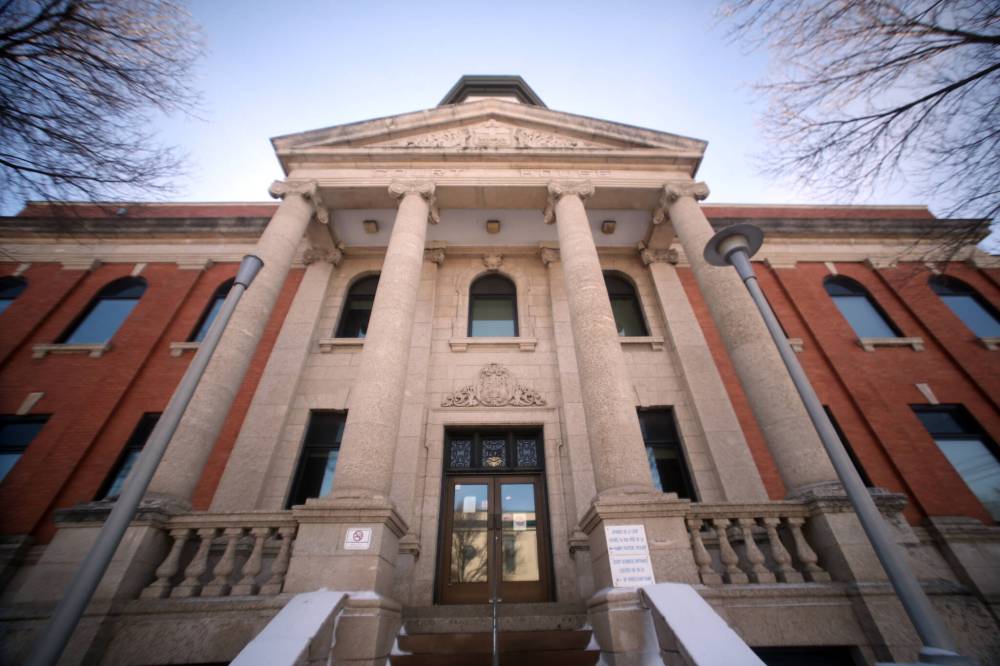
The Brandon courthouse. (File)
Between Aug. 16, 2019, and Nov. 18, 2021, before he turned 18, the man collaborated with his co-accused, a man in Texas, to create a company that allowed customers to pay for a service that carried out online cyberattacks, called distributed denial-of-service (DDoS) attacks.
A DDoS attack sends an abundance of web traffic to a targeted system that causes it to become unreachable and eventually shut down.
The Brandon man was first arrested in March 2021 after the U.S. Federal Bureau of Investigation linked him to a series of DDoS attacks and alerted Brandon Police Service.
Crown attorney Rich Lonstrup told the court that the attacks can result in downtime for the company as it must stop its online services to deal with the attack, expenses and reputational losses.
The man and his co-accused’s company, called Supreme Security Team, marketed multiple tiers of service, which offered different rates for continued attacks on a given company.
“Pay more and the company you are targeting will get far more harassed over a longer period of time with a greater extent of potential harm,” Lonstrup explained.
While it was the customer that chose the victims of the cyberattacks, many of them were politically motivated, Lonstrup said. A Black Lives Matter website, a women’s resource centre, school boards and police forces were among the 97,115 attacks carried out by the company.
“He put a terrible tool right in the hands of terrible actors,” the Crown attorney said.
The man also operated a money-laundering website to avoid detection by authorities. He stole a woman’s identity, which he then used to open a bank account in her name and withdraw funds. That money was used by the man to drive his illegal activities.
The exact amount of money the man made from the DDoS attacks is unclear. While more damaging attacks would result in additional money for the man, prosecutors said they don’t know which customers paid their bills, nor do they know the overhead costs for running the service.
However, Lonstrup said text messages involving the man indicated he was making large amounts of money and using it to fund his 3D printer, which was being used to manufacture untraceable “ghost guns.”
In March 2022, after a search warrant was conducted on the home where the man was living, police found a 3D printer actively producing what officers believed to be the lower receiver of a handgun. A second search warrant resulted in the seizure of a completed firearm — which was loaded with a high-capacity magazine that had most parts created with a 3D printer — alongside a large collection of ammunition and gun parts that had yet to be fully assembled.
“At the end of the day, whether this was for money or for the thrill of it, it is senselessly and shockingly callous to be indifferent and indifferent to the harms caused,” Lonstrup said.
The Crown attorney recommended that the man be sentenced to three years in prison — a mandatory minimum for the manufacture of guns — and an 18-month custody and community combined sentence as well as a two-year probation for his cybersecurity attacks.
But the man’s defence lawyer, Mike Cook, asked the court that the man receive no jail time for the youth offences, suggesting instead a probation term.
“I want to get this young man out of the correctional system as soon as possible … the crimes — they’re bad, they did have the potential of absolute devastation to companies,” Cook said. “They didn’t though. They didn’t take down a company, they didn’t cause a company to close their doors.”
Cook detailed the young man’s life to the court. Born and raised in Brandon by a single mom, as a boy, instead of playing sports, he would work on electrical projects. The defence lawyer said that at a young age, the man showed interest in computers and cellphones, first teaching himself how to build computers and later how to code.
The man has been diagnosed with Asperger’s syndrome, ADHD and increased separation anxiety, which Cook said contributed to his client’s fixation with technology. The defence lawyer told the court about the potential the man has to use his tech skills for better ends.
“This is not a bad guy who did some bad stuff,” Cook said of his client. “This is a really good guy who did some bad things.”
The man gave a tearful apology to the court for what he has put his family and friends through, especially his mom.
“I’ve dragged her through a lot,” he said.
The man’s mom and three friends were in the courtroom for the sentencing. Throughout the proceedings, the man’s mother frequently dabbed tears from her eyes with a tissue.
Judge Donovan Dvorak focused on the young man’s potential, stating that he has heard of hackers turning their life around and using their computer skills to benefit society.
“So, rather than using your gift for the benefit of people, you used it to cause harm to others and to profit yourself,” Dvorak said.
The judge shared a personal story with the man about how a member of his family had been diagnosed with Asperger’s, and he encouraged the man to use the positive side of his condition — his “gift” with technology — to finish his high school courses. He advised the man to then get a university degree in computer science as he could be an asset to many companies.
“What you have that most of the graduate, computer scientists don’t have, and I’m not going to say that it’s a great thing, but you have some practical experience that others don’t have,” he said.
Ultimately, Dvorak sentenced the man to three years in prison and a three-year supervised probation for the youth charges.
The man has been behind bars for 15 months and one year of his time in custody will be portioned to his sentence, meaning he will serve two years in prison as well as a three-year supervised probation order. He was also sentenced to a 10-year weapons prohibition.
» gmortfield@brandonsun.com