
Research station dedicated to egg production
Advertisement
Read this article for free:
or
Already have an account? Log in here »
We need your support!
Local journalism needs your support!
As we navigate through unprecedented times, our journalists are working harder than ever to bring you the latest local updates to keep you safe and informed.
Now, more than ever, we need your support.
Starting at $15.99 plus taxes every four weeks you can access your Brandon Sun online and full access to all content as it appears on our website.
Subscribe Nowor call circulation directly at (204) 727-0527.
Your pledge helps to ensure we provide the news that matters most to your community!
To continue reading, please subscribe:
Add Brandon Sun access to your Free Press subscription for only an additional
$1 for the first 4 weeks*
- Enjoy unlimited reading on brandonsun.com
- Read the Brandon Sun E-Edition, our digital replica newspaper
*Your next Free Press subscription payment will increase by $1.00 and you will be charged $20.95 plus GST for four weeks. After four weeks, your payment will increase to $24.95 plus GST every four weeks.
Read unlimited articles for free today:
or
Already have an account? Log in here »
Hey there, time traveller!
This article was published 21/04/2023 (1252 days ago), so information in it may no longer be current.
WINNIPEG — A new window into the world of egg production is opening this month.
Windows, actually — looking into two different styles of hen barns, in the Manitoba Egg Farmers Learning and Research Centre in Glenlea, just south of Winnipeg.
“People want to know where their food comes from,” said Catherine Kroeker-Klassen, chair of the Manitoba Egg Farmers. “We’re not hiding anything … we’re throwing open the barn doors, so to speak.”
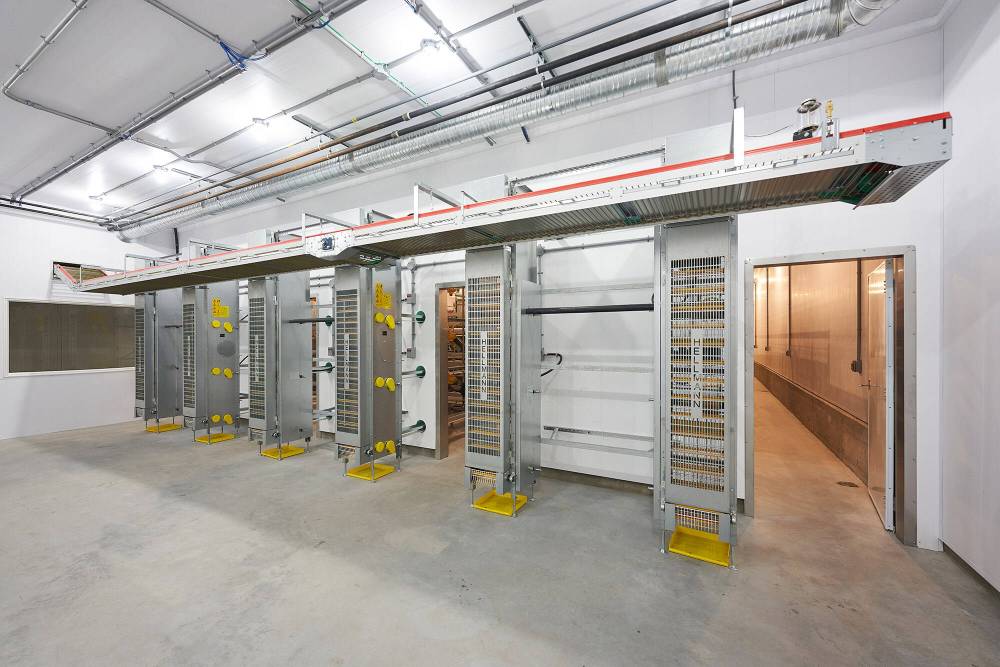
The egg conveyor belt system that connects to the packing room from the barns at the Manitoba Egg Farmers Learning and Research Centre in Glenlea, just south of Winnipeg. (David Lipnowski)
The learning and research centre will be unveiled on April 26. Public tours will begin May 1.
The new space is part of the Bruce D. Campbell Farm and Food Discovery Centre, which houses hog and beef barns, and the Dairy Farmers of Manitoba’s learning complex in the hamlet, located 15 kilometres south of the city.
Manitoba Egg Farmers began talks with the University of Manitoba about a new facility roughly five years ago.
“It’s on a different scale, but we’re not doing anything different in that barn than we would already be doing on our farms here in Manitoba,” Kroeker-Klassen said.
The roughly 22,000-square-foot site contains 4,400 hens, displays describing the farm-to-table process and a conveyor belt shuttling eggs from nest boxes to a packing machine.
Visitors will be able to see birds scratching, perching and dust bathing in an aviary system — where cage-free eggs come from — and an enriched system, which produces the “most economical eggs” for grocery-store shelves, Kroeker-Klassen said.
Eggs from the $4-million centre will be sent to Steinbach for grading before being sold in stores or used for processing. The provincial government allocated $1.5 million for the site; Manitoba Egg Farmers and producers paid the rest, according to Kroeker-Klassen.
“We want people to enjoy [eggs] and feel good about the choices that they’re making,” she said. “With social media and the internet, you can find all kinds of information out there, but it’s not all credible.”
Rarely do egg farmers open their barns to visitors, Kroeker-Klassen noted. It requires outfitting people in biosecurity equipment — plastic booties, coveralls, hair nets, gloves and masks. Despite the precautions, the risk of contaminating flocks is heightened.
Last year, avian influenza was reported at several Manitoba commercial poultry sites. It can spread when sick and healthy birds interact, or when fowl come into contact with infected birds’ feces.
“The possibility of … disease going through the barn so quickly is so high, and we just don’t want to take those chances,” Kroeker-Klassen said.
Busloads of pupils regularly visit the Bruce D. Campbell centre. University of Manitoba graduate students and staff also frequent the site, for research.
The egg centre’s formation involved about a dozen researchers from a variety of backgrounds, including animal science, biosystems engineering and agribusiness.
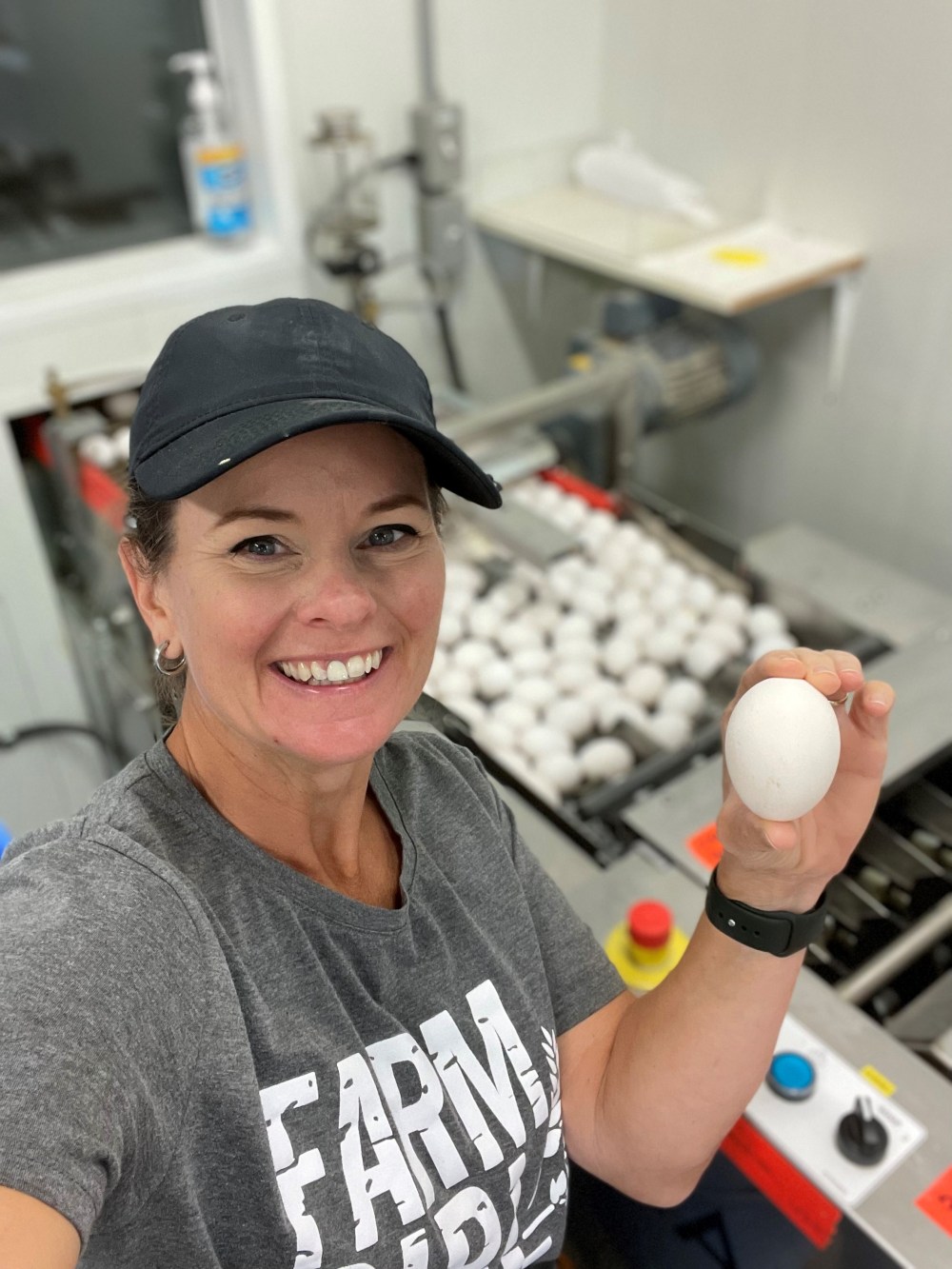
Catherine Kroeker-Klassen, the chair of the Manitoba Egg Farmers. (Submitted)
“Our goal is to make [this] a nationally leading livestock campus,” said Nazim Cicek, the University of Manitoba’s associate dean (research) of agriculture and food sciences.
The faculty has about 300 graduate students, Cicek said. Some will use the new space to test hen feed and eggs’ nutritional value.
Behind the scenes, there’s an egg quality lab, a feed kitchen and smaller rooms for research.
“For us to do really timely, current research, we needed upgraded facilities that would allow us to have birds in different settings,” Cicek said.
The centre replaces an egg-layer barn on the university’s Fort Garry campus.
“It’s critical that people know that food doesn’t come from the grocery store,” Cicek said, adding the new site might generate interest in future agriculture students.
Manitoba’s egg industry adds $115 million to the province’s economy annually, according to the Manitoba Egg Farmers. The province’s producers gather about 76 million dozen eggs per year.
Admission to the Bruce D. Campbell Farm and Food Discovery Centre is $6 for adults and $5 for youths age three to 17.
» Winnipeg Free Press