
Biodiversity under attack in Duck Mountain, ecologists say
Advertisement
Read this article for free:
or
Already have an account? Log in here »
We need your support!
Local journalism needs your support!
As we navigate through unprecedented times, our journalists are working harder than ever to bring you the latest local updates to keep you safe and informed.
Now, more than ever, we need your support.
Starting at $15.99 plus taxes every four weeks you can access your Brandon Sun online and full access to all content as it appears on our website.
Subscribe Nowor call circulation directly at (204) 727-0527.
Your pledge helps to ensure we provide the news that matters most to your community!
To continue reading, please subscribe:
Add Brandon Sun access to your Free Press subscription for only an additional
$1 for the first 4 weeks*
- Enjoy unlimited reading on brandonsun.com
- Read the Brandon Sun E-Edition, our digital replica newspaper
*Your next Free Press subscription payment will increase by $1.00 and you will be charged $20.95 plus GST for four weeks. After four weeks, your payment will increase to $24.95 plus GST every four weeks.
Read unlimited articles for free today:
or
Already have an account? Log in here »
Hey there, time traveller!
This article was published 05/05/2023 (1223 days ago), so information in it may no longer be current.
It was the biggest black spruce tree Eric Reder had ever seen. It measured 57 centimetres in diameter — more than double the average for the usually narrow conifer — and towered above the other spruces dotting the Duck Mountain forest, some of which is protected by the Manitoba government as a provincial park.
“As far as I can tell, this is the biggest black spruce we have recorded in the province,” Reder, a campaign leader for the Manitoba Wilderness Committee, recalls.
“It’s in a logging area.”
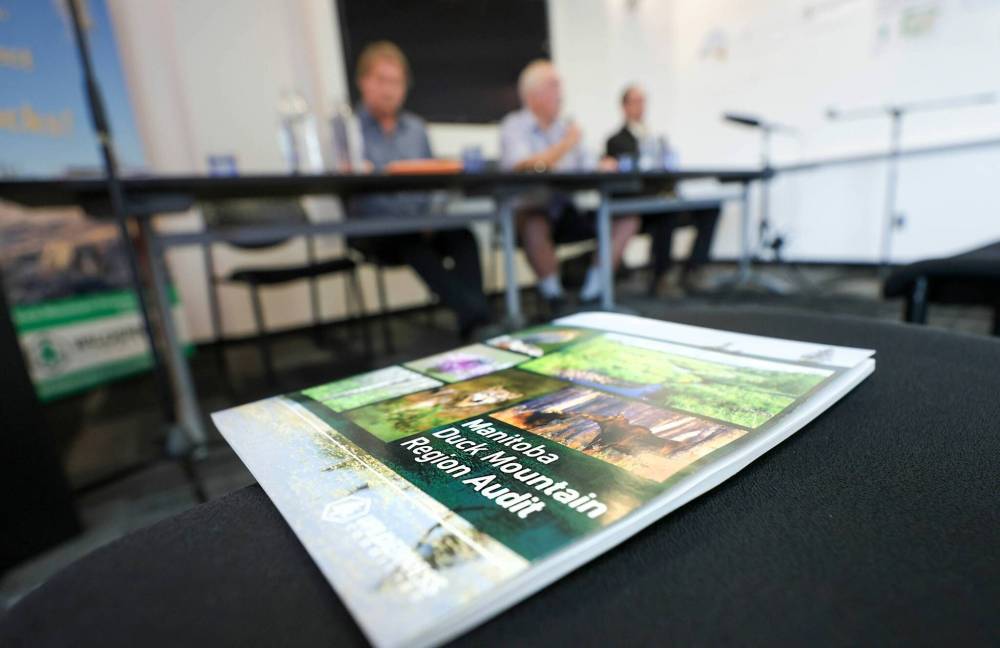
Members of the Wilderness Committee released a scathing new report on the condition and future of one Manitoba's beautiful provincial parks and Boreal Forest area, Duck Mountain, at a press conference held at the Alt Hotel Wednesday. (Ruth Bonneville/Winnipeg Free Press)
Reder stumbled upon the record-breaking spruce last summer at the edge of a logging site inside the boundaries of western Manitoba’s Duck Mountain Provincial Park, home to some of Manitoba’s oldest forests — and one of just two parks in Canada still subject to commercial forestry.
Over 11 days in 2021 and 2022, Reder surveyed the forests in the park and surrounding Duck Mountain region to assess the effect of logging. His findings — including biodiversity loss, violations of provincial forestry rules and decimation of the park’s recreation trails — were released in a wilderness committee audit this week.
As Louisiana-Pacific, the Tennessee-based company that holds logging rights and operates a timber mill in the region, seeks provincial approval for its 20-year forest management plan and the rights to keep logging the forests, Reder and the wilderness committee hope to protect the region’s biodiversity and put a stop to park logging for good.
LOGGING BREAKS RULES, THREATENS ECOSYSTEM: STUDY
In the summer of 2022, Reder packed cameras, drones, cooking equipment and solar panels into an old touring van, then set out for a seven-day field excursion in the nearly 5,000-square-kilometre Duck Mountain ecodistrict, about four hours northwest of Brandon. He hiked more than 40 kilometres through the bogs, wetlands, forests and bush; he spoke to local residents and farmers; he visited dozens of clearcuts and logging roads in the provincial park and surrounding region.
When he got home, Reder set up a two-metre whiteboard and began listing his concerns. By the time he finished, the whiteboard was full.
“The entire region is now sliced up by all-season logging roads, including virtually all portions of Duck Mountain Provincial Park,” Reder says. “It’s just astonishing to imagine that we’ve allowed this to happen to a provincial park.”
He found fields covered in piles of woody debris, which violates Manitoba’s forest use regulations, and clearcuts that edged too close to wetlands and waterways. Reder said he found trees felled by the wind after their neighbours were clear-cut away, missing barricades, washed out culverts and overly wide access roads that damaged park trails. Virtually every section of the Ducks, barring a small northern stretch of forest that’s slated for logging next year, has been cross-hatched by logging access roads and clear-cut fields littered with felled trees, Reder says.
“There’s so much waste, there’s so many trees that should never have been knocked down,” Reder says in an interview after a press conference for the audit’s release. “We’re caring for our provincial park as a wood fibre lot — as a tree plantation.”
The company is currently allowed to harvest 350,000 cubic metres of lumber from the Duck Mountain region every year — the equivalent of about 500,000 average-sized mature aspen or black spruce trees. They’re also required to re-plant at least 80 per cent of what they harvest. Louisiana-Pacific wasn’t able to respond to a request for comment by publication time.
The wilderness committee audit lists 41 concerns and several recommendations to better protect the ecodistrict by expanding the existing Duck Mountain protected area (a 500-square-kilometre backcountry zone where development is barred), enforcing logging rules and putting an end to commercial forestry inside the boundaries of the provincial park.
“This isn’t about stopping logging,” Reder says. “It’s about putting areas aside that shouldn’t be impacted by logging and making sure the logging has a minimal impact.”
LICENCE WENT DECADES WITHOUT REVIEW
Reder cut his teeth in environmental advocacy with a campaign to ban logging in Manitoba’s provincial parks. The first Manitoba Wilderness Committee campaign rallied 23,000 Manitobans to write to the government and oppose park logging between 2007 and 2008, backed by a 1992 provincial clean environment commission decision that recommended phasing out logging and commercial forestry in parks. Thanks to that “swell of support,” Reder says, the Manitoba government banned logging in 12 of the 13 provincial parks by 2009.
Duck Mountain was the only exception.
“It was socioeconomic. [The government] said it was about not being able to remove that much wood fibre from the mill’s supply,” Reder recalls.
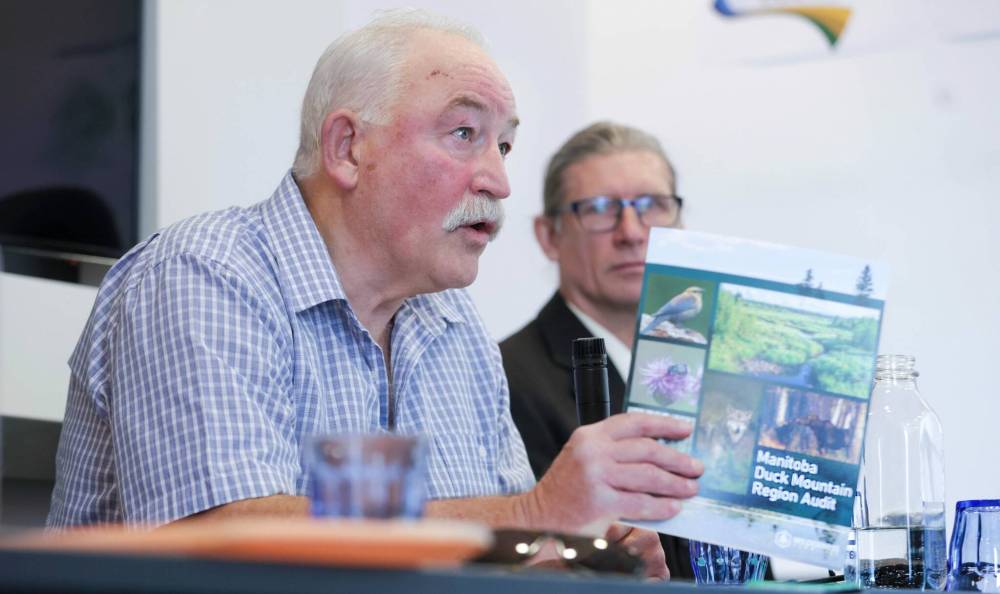
"This is the biological study equivalent of a huge, irredeemable mess," says Dan Soprovich, a wildlife ecologist who used to work for Manitoba Natural Resources and helped present the wilderness committee audit this week. (Ruth Bonneville/Winnipeg Free Press)
By that point, Louisiana-Pacific had been logging in the region for a little over a decade. Their original forest management plan — a long-term guiding document required for a forestry licence — had expired in 2006, and a new one was expected that same year.
Louisiana-Pacific didn’t submit the new plan until the end of 2019, and it still hasn’t received final approval from the provincial government.
In the interim, the company’s logging licence was extended three times, most recently until March 2024, despite the missing management plan and allegations the province had failed to consult the five First Nations within the logging area as required for licence extensions.
Two Nations, the Minegoziibe Anishinabe (Pine Creek First Nation) and Wuskwi Sipihk First Nation have filed lawsuits to that effect. Wuwski Siphihk First Nation declined to comment. Pine Creek was unable to respond to an interview request.
A spokesperson for the minister of natural resources said in an email the company’s licence has been extended on a “short-term basis” to support ongoing consultations with Indigenous Peoples and “keep more than 500 people working.”
To those who have followed these logging activities since the beginning, the lack of provincial attention on the forests of the Duck Mountain region are a significant oversight.
“This is the biological study equivalent of a huge, irredeemable mess,” says Dan Soprovich, a wildlife ecologist who used to work for Manitoba Natural Resources and helped present the wilderness committee audit this week.
“It cries out for the need for independent assessment. Not company assessment, not their consultants and not the government.”
According to Soprovich, the province’s understaffed conservation branch lacks the scientific expertise and resources to make a good decision about forest management. As a result, he says, there has been a lack of balance in how projects like the Louisiana-Pacific logging are assessed.
“They need to have scientists that are dedicated to the task, because they don’t have that now,” Soprovich says. “I saw the deterioration, the inability for the branch to be able to do its job. It’s in chaos.”
For its part, the provincial spokesperson said “there are well-established policies and procedures to review and permit activities within provincial parks,” adding harvests “must adhere to strict provincial standards and are monitored.”
The spokesperson was unable to confirm how frequently conservation staff conduct inspections or other monitoring activities.
PROTECT BIODIVERSITY, ADVOCATES SAY
The forests in the Duck Mountain region provide habitat for a variety of species; there are fish in the waterways and rare birds in the skies. Notably, the region is home to a dwindling moose population.
While moose aren’t a protected species in Manitoba, the population in the Duck Mountain region saw such a severe decline in the late 2000s that moose hunts — including for First Nations and Métis hunters who have traditionally harvested in the region — were cancelled outright. The Manitoba Métis Federation resumed a limited number of Duck Mountain moose hunts in 2021 after going toe-to-toe with the province over harvesting rights. The Métis Federation was not able to provide a response by publication time.
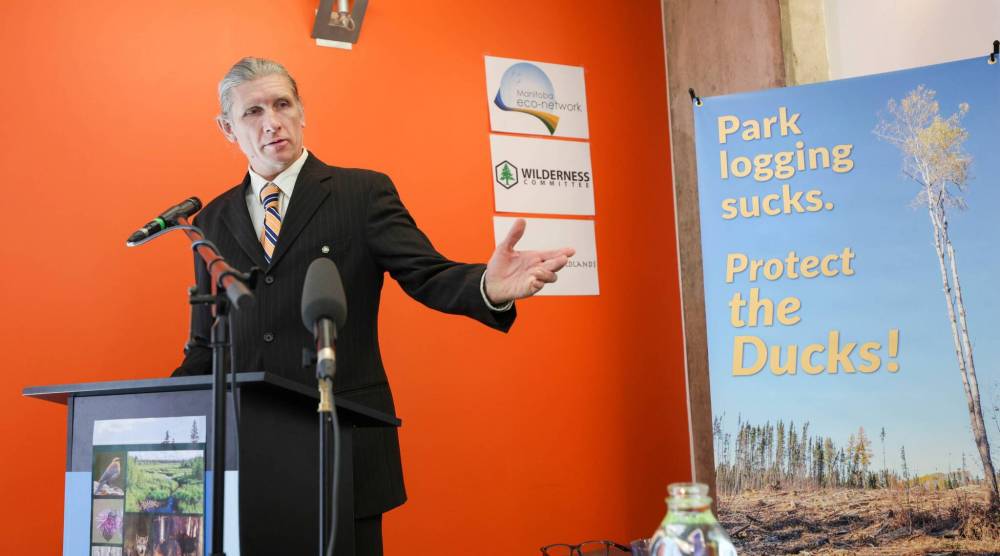
Eric Reder, a campaign leader for the Manitoba Wilderness Committee, explains that a decline in safe habitat caused by commercial forestry leaves moose vulnerable to predators like wolves. (Ruth Bonneville/Winnipeg Free Press)
“The decline in the moose population parallels the establishment of industrial clear-cut logging by Louisiana-Pacific,” Reder says.
Reder explains that a decline in safe habitat caused by commercial forestry leaves moose vulnerable to predators like wolves.
Beyond the moose, Reder says several at-risk species that make their home in the Duck Mountain forests have been conspicuously absent from the company’s proposed forest management plans. Two species of endangered bats, the endangered red-headed woodpecker and other at-risk bird species live among the trees, yet none have been accounted for in the company’s new forest management plan, he says. If they are not addressed, the company could be in violation of the federal Species at Risk Act, the audit notes.
Soprovich said the values of wildlife, of biodiversity and of old forests haven’t been given nearly the same weight as the economic value of the forestry industry.
“It’s focused too much on fibre economic return and not enough on all the other values,” he says.
As climate change leads to more severe and frequent events like forest fires, Soprovich suggests the value of maintaining and protecting old forests — and the biodiversity they support — becomes all the more important.
Canada has joined countries around the world in committing to protecting 30 per cent of lands and waters by 2030 to better support and protect biodiversity. While industrial activity is barred from about 10 per cent of Duck Mountain Provincial Park, reaching 30 per cent protection, the audit notes, would mean keeping another 1,000 square kilometres of park land free of industrial activity.
“We need to find balance,” Soprovich says.
While that balance could come in the form of expanded protected areas, Reder and the wilderness committee believe the time has come to listen to decades of advice and put an end to logging in Manitoba’s parks.
“We have the public, we have the government and we have the highest environmental voice in the land saying we need to end this,” Reder says.
“This region is in trouble and it needs to change.”
» Winnipeg Free Press and The Narwhal