
Brandon’s aquifer replenishing over time
Advertisement
Read this article for free:
or
Already have an account? Log in here »
We need your support!
Local journalism needs your support!
As we navigate through unprecedented times, our journalists are working harder than ever to bring you the latest local updates to keep you safe and informed.
Now, more than ever, we need your support.
Starting at $15.99 plus taxes every four weeks you can access your Brandon Sun online and full access to all content as it appears on our website.
Subscribe Nowor call circulation directly at (204) 727-0527.
Your pledge helps to ensure we provide the news that matters most to your community!
To continue reading, please subscribe:
Add Brandon Sun access to your Free Press subscription for only an additional
$1 for the first 4 weeks*
*Your next subscription payment will increase by $1.00 and you will be charged $20.00 plus GST for four weeks. After four weeks, your payment will increase to $24.00 plus GST every four weeks.
Read unlimited articles for free today:
or
Already have an account? Log in here »
Hey there, time traveller!
This article was published 17/05/2023 (1054 days ago), so information in it may no longer be current.
While the Assiniboine River carries a significant amount of water through Brandon, even more of it is hidden away below the surface.
At Monday’s Brandon City Council meeting, hydrogeologist Jeff Bell of Steinbach-based Friesen Drillers provided an update on the status of the Brandon Channel Aquifer and the local companies that draw on it as a water source.
The aquifer runs through the Assiniboine River Valley in a channel cut into the rock beneath the city thousands of years ago before glaciers formed over what eventually became Brandon. An aquifer is a body of rock or sediment containing groundwater.
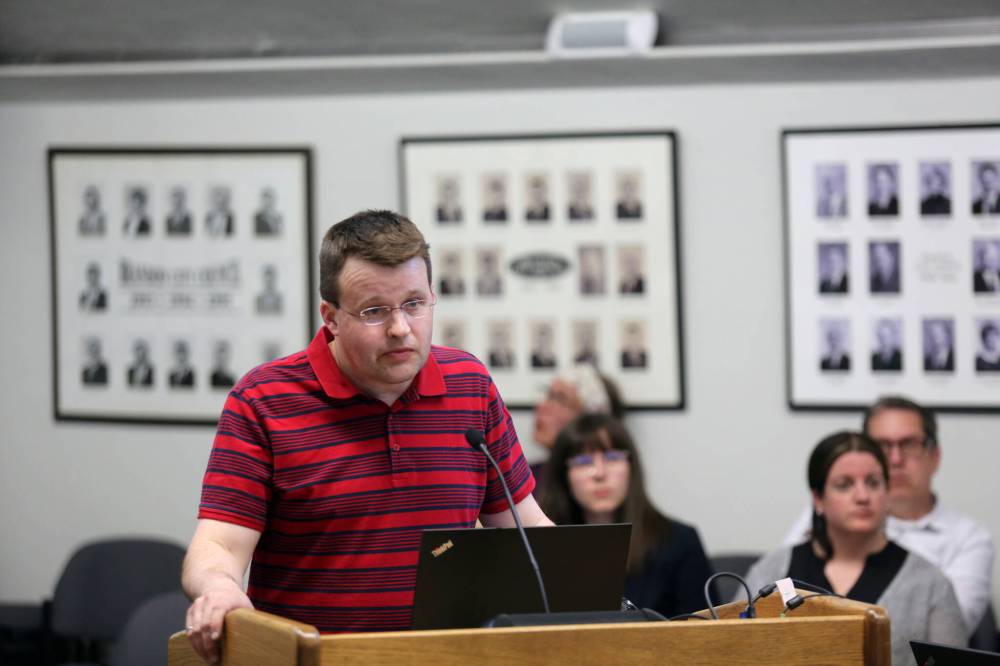
“It’s a buried valley that’s fed through a whole bunch of other different buried valleys,” Bell said. “Much of the drainage of North America went through the Brandon area at one point and cut all of these channels. There are wells at Koch Fertilizer pumping brackish water — meaning slightly saline — that’s 8,000 years old.”
At points, moving a hundred feet can cause someone looking for the aquifer to miss it, but it is the location of some of the highest capacity wells in the entire province.
The presentation included a rough map of the aquifer’s location, which is largely along the river’s path through the city but extends as far south as the rural municipality of Cornwallis.
In some areas, the aquifer is just 50 to 60 feet below ground. However, near the Koch Fertilizer Canada plant in Brandon’s industrial area in the east end, Bell said it takes a “Niagara Falls” level drop to 300 feet below the surface.
Most of the groundwater is deep enough that it is unlikely to be affected by use of chemicals or other products at surface level.
“The Chemtrade plant has been pumping water since 1969. That water has never varied from pre-glacial 8,000-year-old water, and that is quite a shocking result.”
Within the last 60 years, water in the aquifer has been replenishing from the Assiniboine River. Water drawn at the fertilizer plant’s well is typically that older source, but another well a few hundred feet away might draw primarily from fresher evaporitic water from the river.
Managed by the province, Bell said the largest users of water from the aquifer are Koch Fertilizer, which draws approximately eight million cubic metres per year, Chemtrade (1.68 million cubic metres per year) and the City of Brandon (1.9 million cubic litres of water a year).
According to Bell, Koch Fertilizer has the largest groundwater licence in all of Manitoba. Maple Leaf Foods’ pork processing plant used to draw a lot of water, but not as much in recent years.
The city drilled two emergency wells in 1996 in case water from the Assiniboine became inaccessible, but Bell said the problem with those is that water recovery in that part of the aquifer is very poor. Over the years, Bell said the city has drawn less and less from those wells.
Because of concerns over the long-term sustainability of Brandon’s groundwater, major users of the aquifer banded together six or seven years ago to form a group. Bell said they get together every six months or so to go over the results of monitoring tests.
“Things have stabilized quite well on the aquifer over the past several years,” Bell said. “Use has also sort of flatlined. Everybody’s sharing information. It’s a very positive thing.”
A contributing factor to the replenishment of the aquifer has been floods in recent years. Bell said he knows that’s not something people dealing with surface water like to hear, “but in hydrogeology, we sometimes love those events because they provide that instantaneous recharge.”
» cslark@brandonsun.com
» Twitter: @ColinSlark