
Couple draw attention to missing, murdered Indigenous people
Advertisement
Read this article for free:
or
Already have an account? Log in here »
We need your support!
Local journalism needs your support!
As we navigate through unprecedented times, our journalists are working harder than ever to bring you the latest local updates to keep you safe and informed.
Now, more than ever, we need your support.
Starting at $15.99 plus taxes every four weeks you can access your Brandon Sun online and full access to all content as it appears on our website.
Subscribe Nowor call circulation directly at (204) 727-0527.
Your pledge helps to ensure we provide the news that matters most to your community!
To continue reading, please subscribe:
Add Brandon Sun access to your Free Press subscription for only an additional
$1 for the first 4 weeks*
- Enjoy unlimited reading on brandonsun.com
- Read the Brandon Sun E-Edition, our digital replica newspaper
*Your next Free Press subscription payment will increase by $1.00 and you will be charged $20.95 plus GST for four weeks. After four weeks, your payment will increase to $24.95 plus GST every four weeks.
Read unlimited articles for free today:
or
Already have an account? Log in here »
Hey there, time traveller!
This article was published 01/06/2023 (1253 days ago), so information in it may no longer be current.
Living with not knowing the fate of a missing loved one is the reality Charity and Cameron West deal with every day.
The Wests — who are walking across the country to raise awareness of missing and murdered Indigenous people — live along the Highway of Tears, a stretch of Highway 16 that runs for 720 kilometres across northern B.C. where 18 girls and women have gone missing or been murdered since 1969, though Indigenous groups fear the number is closer to 50.
The newlywed couple, who started their cross-country journey in Alberta in May, also have first-hand experience of the devastation that follows when a family member goes missing. The father of Charity’s son Tyrrehz, Barry Blaine Thomas Seymour from Kwadacha Nation, went missing from Prince George, B.C. in May of 2012, and still hasn’t been found.
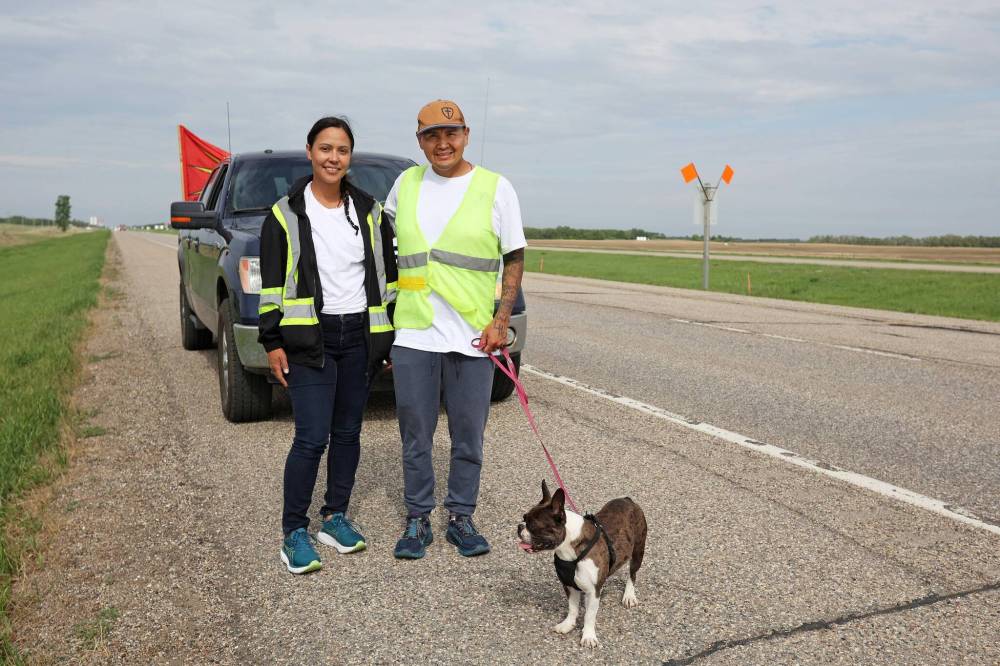
Charity and Cameron West, photographed on the Trans-Canada Highway just west of Carberry with their French bulldog Gretchen, are walking across Canada to draw attention to missing and murdered Indigenous people. They began their first leg of the walk in Siksika Nation in southern Alberta and are walking to St. John's, N.L. From there they will begin their second leg in Prince Rupert, B.C., and walk the Highway of Tears on Highway 16, where several Indigenous Canadians have gone missing, home to Prince George. They average approximately 40 to 50 kilometres a day. (Photos by Tim Smith/The Brandon Sun)
Seymour was visiting for his son’s birthday, then headed up further north to visit more family members. He was never heard from again, Charity said.
“It’s been 11 years on the 23rd of May since anyone has last seen him,” she said. “It’s taken me a long time just to be able to talk about it.”
Indigenous women represent 10 per cent of the total population of women in Canada missing for at least 30 days even though, as of 2011, Indigenous women only made up 4.3 per cent of Canada’s overall female population, a report by the Royal Canadian Mounted Police (RCMP) states. Of these, many women are identified as missing due to “unknown” circumstances or suspected foul play.
The report also notes that Indigenous women are over-represented when it comes to homicide victims. Overall in Canada, between 1980 and 2012, 16 per cent of female homicide victims were Indigenous compared to non-Indigenous (83 per cent) and those of unknown ethnic background (1.5 per cent). In Manitoba, the proportion of female homicide victims who were Indigenous was 49 per cent for the same period.
And while it’s important to raise awareness of the issue of missing and murdered Indigenous women, girls and two-spirited people, Indigenous men who go missing also deserve attention, Charity said.
“It doesn’t matter if you’re a man or a woman or you’re two spirited — your life is irreplaceable,” she said.
Indigenous men are disproportionately murdered at a per-capita rate about six to seven times higher than non-Indigenous men and three times that of Indigenous women, Statistics Canada reports.
When someone first goes missing, it’s “all hands on deck,” Cameron said. Unfortunately, in the Wests’ experience and that of many of their family and friends, that enthusiasm quickly dies down as time goes by without any leads.
Jessica Patrick, Cameron’s cousin and a member of Lake Babine Nation in B.C., was 18 when she went missing from Smithers, B.C., on Aug. 31, 2018. She was found on the morning of Sept. 15 of that year after the search party dwindled to members of Patrick’s close family.
“The only way they found her was because they saw, on the [Hudson Bay] mountain, a bunch of birds flying above. They went up to see and they looked down the mountain and that’s where they found her,” Cameron said. “That’s why we’re trying to bring awareness to this. There are so many cases.”
The first leg of the couple’s journey will take them all the way to St. John’s, N.L. The second will see them walk along the Highway of Tears from Prince Rupert to Prince George, B.C.
During their stop in Brandon on Saturday, the Wests took part in CFB Shilo’s Indigenous Peoples Awareness Week and a feast and ceremony honouring missing and murdered Indigenous women and girls at the Riverbank Discovery Centre.
While on a work trip to Regina several days before, Florence Halcrow of Brandon’s Ask Auntie program noticed the Wests on their trek and stopped to talk with them. When she heard about what they were doing — each taking turns walking or running while the other drove a safe distance behind — she offered them immediate camaraderie and support.
“We support all the walkers coming through that are walking across Canada to raise awareness about Indigenous issues, whether it’s murdered and missing people, residential schools, we support them,” Halcrow said. “We show them Brandon cares.”
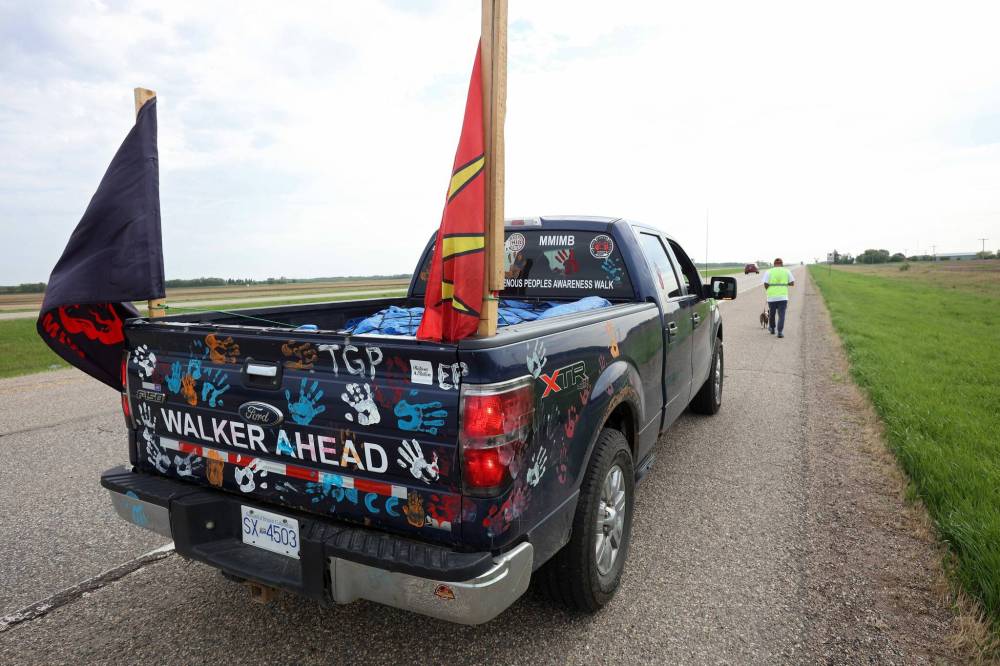
Cameron West walks east along the Trans-Canada Highway toward Carberry with Gretchen the French bulldog while Charity takes her turn driving the support vehicle on Monday.
The personal stories the Wests shared with Halcrow echo the stories she has heard both in her personal life and as a part of the Ask Auntie project, which was developed at the Brandon Neighbourhood Renewal Corporation during the height of the COVID-19 pandemic in March of 2021 as a response to a lack of resources that left vulnerable and homeless people out in the cold.
“It’s true for a lot of Indigenous people across Canada, not just in Brandon. On First Nations, off First Nations, [missing and murdered Indigenous people] is just a deep trauma that affects all First Nations people in one way or another,” Halcrow said.
The Wests, who said they are supported by the Tsay Keh Dene First Nation, Kwadasha Nation, Takla Lake Nation and Lake Babine Nation in their home province, hope that the people they encounter along their trek — regardless of race, gender, or background — will be motivated to learn more about the issue of missing and murdered Indigenous people.
Charity hopes the stigma associated with having a loved one who has gone missing or has been murdered will be reduced by their efforts as well, and that non-Indigenous people won’t let their fears of not understanding the Indigenous experience stop them from being allies.
“It’s kind of sad that it’s not being talked about more,” she said. “We know we can all do better. All of us, we can do better.”
A common theme the Wests have heard from people who have first-hand experience with a loved one going missing is that often the burden of finding the missing person falls on the family as the case grows cold. Raising awareness in all levels of society through walking across Canada is their way of trying to ensure that doesn’t continue to happen, the couple said.
“We want to blur the lines of race. It doesn’t matter if you’re Caucasian or Indigenous or any other background. We’re all one when it comes to human rights,” Cameron said.
The Wests, who will go back to their everyday lives after their cross-country walk and their walk along the Highway of Tears, encourage anyone moved by their stories, or inspired by their walk across the nation, to donate to a local charity in their community that positively impacts Indigenous people.
» mleybourne@brandonsun.com
» Twitter: @miraleybourne