
Monument to residential school survivors, victims to be built on Parliament Hill
Advertisement
Read this article for free:
or
Already have an account? Log in here »
We need your support!
Local journalism needs your support!
As we navigate through unprecedented times, our journalists are working harder than ever to bring you the latest local updates to keep you safe and informed.
Now, more than ever, we need your support.
Starting at $15.99 plus taxes every four weeks you can access your Brandon Sun online and full access to all content as it appears on our website.
Subscribe Nowor call circulation directly at (204) 727-0527.
Your pledge helps to ensure we provide the news that matters most to your community!
To continue reading, please subscribe:
Add Brandon Sun access to your Free Press subscription for only an additional
$1 for the first 4 weeks*
- Enjoy unlimited reading on brandonsun.com
- Read the Brandon Sun E-Edition, our digital replica newspaper
*Your next Free Press subscription payment will increase by $1.00 and you will be charged $20.95 plus GST for four weeks. After four weeks, your payment will increase to $24.95 plus GST every four weeks.
Read unlimited articles for free today:
or
Already have an account? Log in here »
Hey there, time traveller!
This article was published 20/06/2023 (1210 days ago), so information in it may no longer be current.
OTTAWA – A survivor-led steering committee announced Tuesday that a tribute to survivors and victims of residential schools will be built on the west side of Parliament Hill.
Ottawa appointed the committee in April 2022 to select a site for a national residential schools monument in keeping with one of the Truth and Reconciliation Commission’s calls to action.
Gov. Gen. Mary Simon, Canada’s first Indigenous governor general, said at a ceremony Tuesday morning that the monument is a “significant” step towards reconciliation..
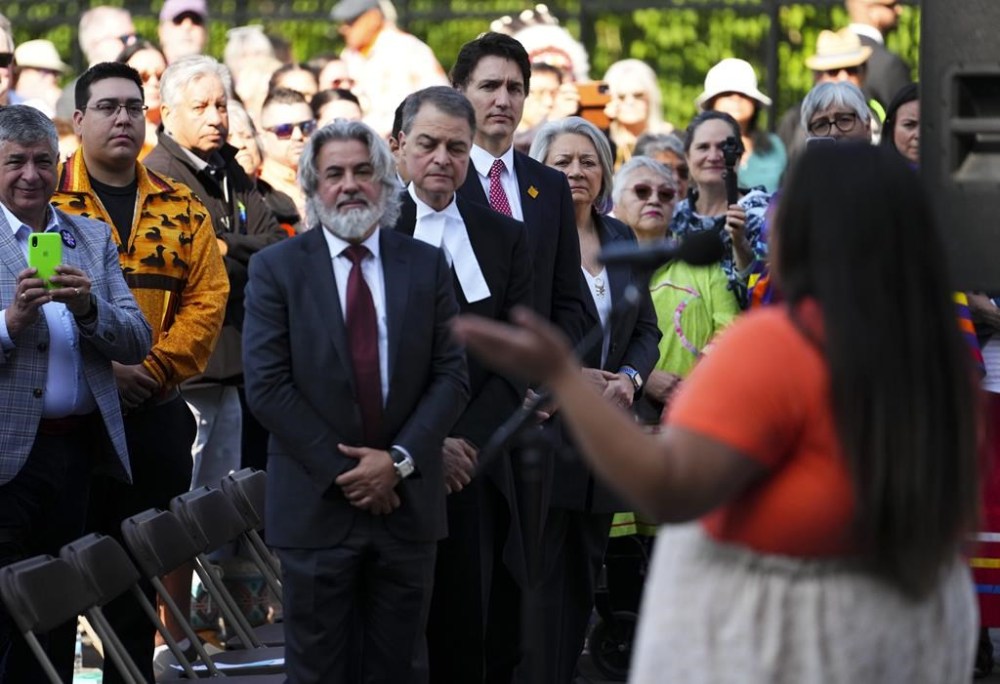
“While reconciliation and healing has no end date, and it doesn’t involve just one act or project, I would like you to remember every act is important. And this act is significant,” Simon said in her speech at the ceremony.
“The site selection on Parliament Hill allows as many Canadians as possible the opportunity to see this monument. It represents our history,” she said.
“So near to the House of Commons, it will serve as a constant reminder to parliamentarians that the policies and laws they create, debate, legislate and enforce have consequences.”
The steering committee said it worked in collaboration with the Algonquin Anishinabe Nation and residential school survivors to determine a location for the monument.
Prime Minister Justin Trudeau and Heritage Minister Pablo Rodriguez both attended the ceremony.
Jimmy Durocher, a Métis residential school survivor and member of the steering committee, said it was important that the monument encapsulate the effects residential schools have had on Canada’s past, present and future.
“This is not finished,” Durocher said during the ceremony.
“This business of finding unmarked graves is not done.”
Durocher said Canadians need to acknowledge the history of residential schools and know the truth.
“The truth is sometimes very, very difficult. I know it’s hard for me. I’m an elder. I’m 83 years old, and I find it very difficult to imagine something like this could happen to us here in Canada. But it happened. But you want to know the positive side of it? We’re still here.”
The last remaining residential school closed in 1996.
The Truth and Reconciliation Commission of Canada, which launched in 2008 and delivered its final reports in 2015, called the Canadian residential school system a government-supported form of “cultural genocide.”
The commission estimated that more than 4,000 Indigenous children went missing from the schools across Canada.
Murray Sinclair, the former judge and senator who chaired the commission, has said he believes that figure was an underestimate and suggested the missing children could number “well beyond” 10,000.
Kimberly Murray, Canada’s special interlocutor on unmarked graves, raised concerns in an interim report this week about increasing attacks from “denialists” who challenge communities when they announce the discovery of possible unmarked graves.
The Liberal government created her role as it looked for ways to respond to First Nations from across Western Canada and in parts of Ontario using ground-penetrating radar to search former residential school sites for possible unmarked graves.
Murray’s final report is due next year and is expected to contain recommendations on how the federal government can help communities search for the children who died and disappeared.
This report by The Canadian Press was first published June 20, 2023.
———
This story was produced with the financial assistance of the Meta and Canadian Press News Fellowship.