
Mosquito counts remain low
Advertisement
Read this article for free:
or
Already have an account? Log in here »
We need your support!
Local journalism needs your support!
As we navigate through unprecedented times, our journalists are working harder than ever to bring you the latest local updates to keep you safe and informed.
Now, more than ever, we need your support.
Starting at $15.99 plus taxes every four weeks you can access your Brandon Sun online and full access to all content as it appears on our website.
Subscribe Nowor call circulation directly at (204) 727-0527.
Your pledge helps to ensure we provide the news that matters most to your community!
To continue reading, please subscribe:
Add Brandon Sun access to your Free Press subscription for only an additional
$1 for the first 4 weeks*
*Your next subscription payment will increase by $1.00 and you will be charged $20.00 plus GST for four weeks. After four weeks, your payment will increase to $24.00 plus GST every four weeks.
Read unlimited articles for free today:
or
Already have an account? Log in here »
Hey there, time traveller!
This article was published 29/07/2023 (979 days ago), so information in it may no longer be current.
If the numbers of mosquitoes remain low in Brandon, this could be the first time in three years that work crews won’t have to fog the city’s neighbourhoods, according to the city’s manager of parks.
There are five mosquito traps within city limits that have been checked once a week since the beginning of May, and all have continuously shown low counts, said Bryce Wilson with the City of Brandon.
“We’ve seen less activity of the nuisance mosquitoes and less complaints from citizens,” Wilson said. “Most traps have had lower numbers around the city with one trap near normal, but all in all, there’s been a lot less activity in the water.”
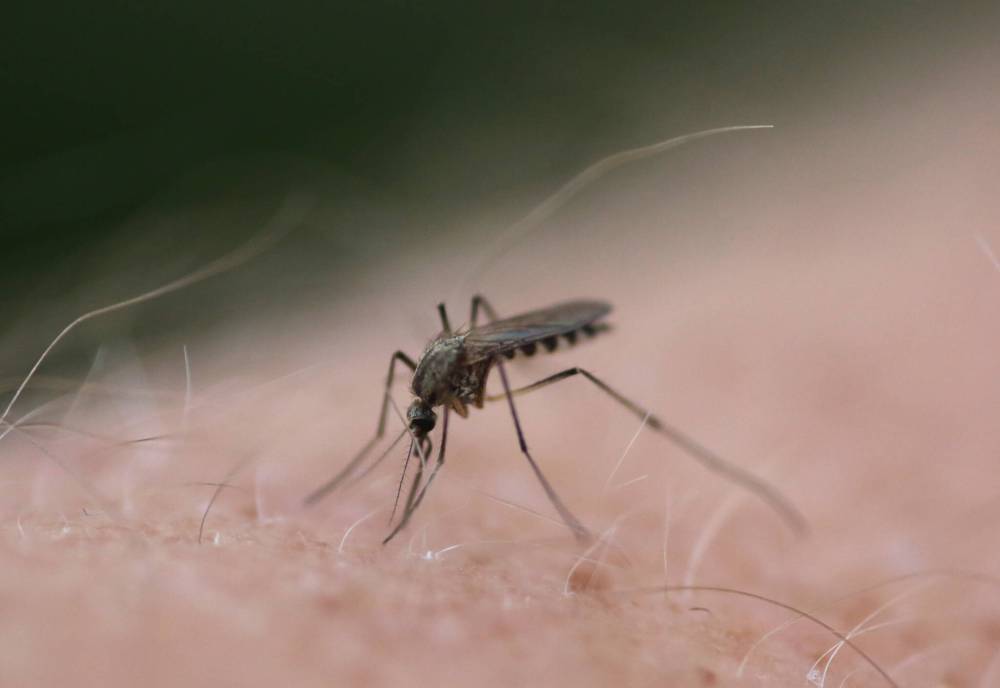
A female mosquito plunges its sharp proboscis into a human arm. (File photos)
The traps are in tall grass or attached to a tree in short grass, said Wilson. Every Sunday or Monday, one person checks the five locations using a standard CO2 trap with a clear tube and a funnel-shaped net on the bottom that attracts mosquitoes.
The samples are then sent to Winnipeg.
“We don’t physically count the traps; we collect them and drive them into Winnipeg, where a scientist conducts the counts. And when we get our numbers from the City of Winnipeg, that’s when we post them on our website,” Wilson said.
And so far, this year, the numbers haven’t been high enough for Wilson’s department to make the call to start fogging for mosquitoes.
Mosquito fogging is triggered when the number of mosquitoes in the city’s traps are in the high category for two consecutive counts, if the average number of mosquitoes in traps exceeds 1,000 or if any individual trap contains more than 2,000 mosquitoes.
The city conducted fogging last year as well as 2021 and 2020, but not for the years from 2015 to 2019.
In the last two months, just one of the five traps in Brandon has seen more than 1,000 mosquitoes, but only on three occasions.
And since mid-May, half of the counts have been classified as low and the other half as medium, according to the city’s website.
“I highly anticipate we won’t be fogging this year because it’s late in the season now. We usually fog around the July long weekend,” Wilson said.
In addition to checking the city’s five mosquito traps, staff members have been using larvicide on areas of standing water as part of the city’s mosquito surveillance and abatement program.
Larvicide is a type of insecticide that kills mosquito larvae before they can grow into adults.
“We have two crews in two trucks that cover 102 square miles (264 square kilometres) every day on public property, checking standing pools of water, even ditches, looking for mosquito eggs. If there’s heavy activity, they add the granular chemical,” Wilson said.
Mosquitoes need standing water to complete their life cycle, laying their eggs in still water, hatching within five to seven days.
For May, June and the first 27 days of July, Brandon has had below normal precipitation, according to climate data information from Environment and Climate Change Canada.
The normal precipitation for the month of May is 56.5 millimetres, compared to the actual amount of 25.2 mm.
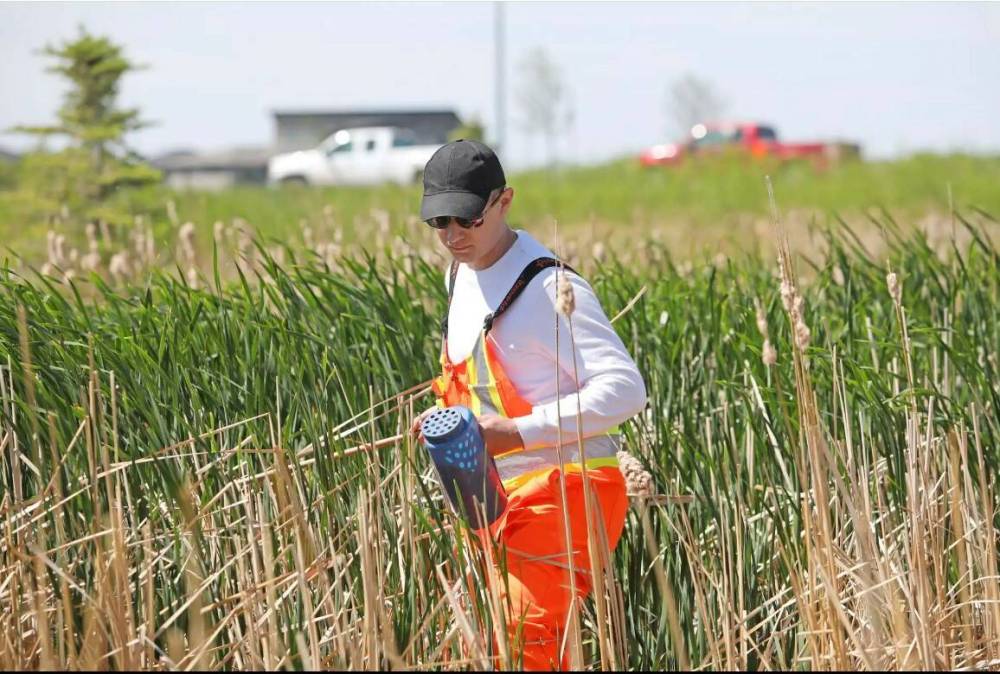
An employee with the City of Brandon checks for mosquito larvae in a marsh in southwest Brandon while conducting mosquito abatement.
Precipitation measurements for June show 44.7 mm fell, compared to the normal figure of 79.6.
And so far, since July 1, the city has received 25.2 mm, in comparison to the normal for the entire month, which is 68.2 mm.
A weather system that was sitting over southwestern Manitoba created warm and dry conditions for most of the last few months, said Natalie Hassell, warning preparedness meteorologist with Environment and Climate Change Canada.
“June and July are our wettest months. So, the fact that we’ve had very little precipitation in July is kind of unusual, at least in your part of the province. Up until now, except for a good chunk of July, we saw a ridge of high-pressure kind of sitting over the area. And under those circumstances, we haven’t had a lot of precipitation,” Hassell said.
The only possibility that mosquito fogging will happen in the Wheat City is if the West Nile virus is detected, said Wilson.
“The only reason I could see us conducting the fogging is because of West Nile, and if the province — under a health order, tells us to spray. And in that case, we would go out immediately and not provide our citizens with 24-hour notice, Wilson said.
There have been no confirmed cases of the West Nile virus in any Manitoban so far this year, but mosquitoes collected from a community just north of Winnipeg tested positive, according to Manitoba Health.
The mosquito-borne virus can cause severe illness, including swelling of the brain. Most people who are infected don’t have any symptoms, while others may have a headache, fever, fatigue and body aches.
To protect yourself against the virus, the province recommends reducing the amount of time spent outdoors during peak mosquito hours from dusk to dawn, eliminating standing water around the home, and using mosquito repellent.
» mmcdougall@brandonsun.com
» Twitter: @enviromichele