
Junior national coach scouts U15 nationals
Advertisement
Read this article for free:
or
Already have an account? Log in here »
We need your support!
Local journalism needs your support!
As we navigate through unprecedented times, our journalists are working harder than ever to bring you the latest local updates to keep you safe and informed.
Now, more than ever, we need your support.
Starting at $15.99 plus taxes every four weeks you can access your Brandon Sun online and full access to all content as it appears on our website.
Subscribe Nowor call circulation directly at (204) 727-0527.
Your pledge helps to ensure we provide the news that matters most to your community!
To continue reading, please subscribe:
Add Brandon Sun access to your Free Press subscription for only an additional
$1 for the first 4 weeks*
*Your next subscription payment will increase by $1.00 and you will be charged $20.00 plus GST for four weeks. After four weeks, your payment will increase to $24.00 plus GST every four weeks.
Read unlimited articles for free today:
or
Already have an account? Log in here »
Hey there, time traveller!
This article was published 10/08/2023 (999 days ago), so information in it may no longer be current.
An interested spectator at Softball Canada’s under-15 girls national championship in Brandon on Wednesday and Thursday was Keith Mackintosh.
The head coach of Canada’s junior women’s national team was doing some early scouting as he looks to assemble the country’s entry into the World Baseball Softball Confederation’s U18 World Cup in 2025. He’s encouraged by what he’s seeing as the sport grows and grows.
“Softball is rated like a secondary sport,” the Melfort product said. “I think now with the national team doing well at the Olympics, NCAA is now more accessible on TV, kids are starting to go to national championships, there are more teams, I think the exposure to the sport and ability to go down to the States on scholarship is even greater than before.
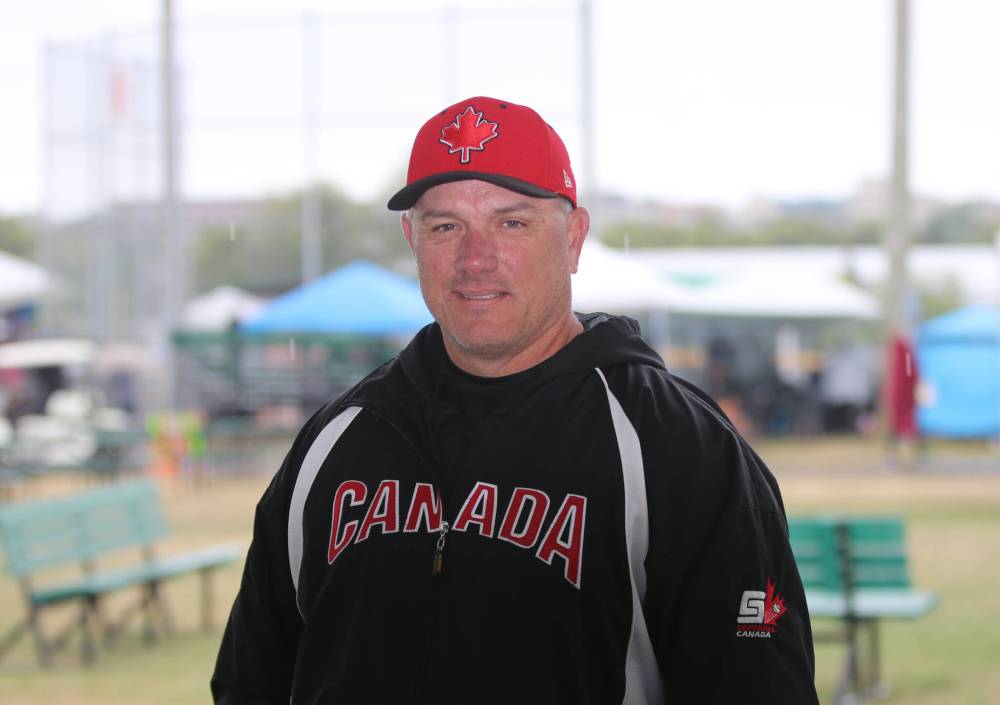
Canadian junior women's national team head coach Keith Mackintosh attended Softball Canada's under-15 girls national championship in Brandon to get a look at some of the top 2007- and 2008-born players across the country. (Perry Bergson/The Brandon Sun) Aug. 10, 2023
“I think the sport itself is starting to gain recognition and as soon as it starts to pull away from that secondary sport status and starts to become a primary sport, that’s when kids will really take off.”
Mackintosh will scout all three national women’s events this month, including the U19s in Victoria last week and the U15s in Brandon and the U17s in Saskatoon this week.
Mackintosh is in his fifth cycle with the junior women’s team, serving as an assistant coach in 2013 and 2015. He became head coach in 2017 and led Canada to its first-ever junior women’s medal when they earned bronze in 2019. In 2021, the WBSC went to a new competition format called “Two-Stage World Cup,” moving from a two-year cycle to a four-year cycle.
The group stage, which includes 18 teams in three groups, will be played in 2024. The top two teams from each group, plus a pair of wild cards, advance to the World Cup final in 2025.
“The reason we’re looking at this championship (in Brandon) is that in 2025, the (2007-born players) are at the top of the age group, so it’s the 2007s and 2008s we really focus on,” Mackintosh said.
The route into Softball Canada’s pathway begins at identification camps held across the country to give the national organization a sense of where the talented players were. They also attend the Canada Cup and national and provincial championships to get more views on players.
“It’s not just one look at somebody with these kids,” Mackintosh said. “But with kids this age, we’re looking a couple years down the road. It’s a little bit of an adjustment for us because normally it’s been ID, pick, play. Now it’s ID, keep IDing, and hopefully by 2025 we have a really good understanding of where everybody is at.”
Mackintosh looks at the same five tools that Major League Baseball scouts use — speed, power, hitting for average, fielding and arm strength — but his analysis goes well beyond those metrics.
Intangibles such as softball IQ and the ability to respond to low points play a massive role too.
“There are probably 10 kids here that are the exact same player at the top,” Mackintosh said. “Personally, I look to see how they handle failure at this age because they can really get into a funk that really drives them into a downward spiral.
“I’m looking at little things like are they picking up their teammates? How do they react when they strike out or make an error? Do they get right back in there or do they go back into their shell?”
That’s important to him because as big as nationals might be, the stakes are incrementally higher when a player has the Maple Leaf stitched on their jersey and are competing in an international event.
The game is now being coached very differently at the top levels and with the evolution of analytics, the sport is changing. Part of that wave comes in the move toward the 12-month softball player, who concentrates on one sport to the exclusion of all others.
Mackintosh, who runs the 222 program out of Saskatoon that helps develop softball players across the Prairies, has mixed feelings about it.
“Multisport is huge, especially at this age when they’re developing,” Mackintosh said. “I do know it doesn’t have to be softball, softball, softball, but there has to be some softball element.
“If they’re a hockey player but they’re still trying to find time to get to the (batting) cage a couple times a week or if they’re pitchers and throwing a little bit, that to me is what has to happen in that development.
“You are seeing kids who are doing it 12 months a year, and whether it’s right or wrong, it’s an advantage. If you have a bat in your hand or a ball in your hand more, you’re going to be better.”
That’s why the COVID-19 lockdowns were so harmful.
Mackintosh said players in some key age groups lost irreplaceable experience, which set back their development. He noted individual skills like batting and throwing will improve, but there was damage to the game readiness and softball IQ that can’t be replaced as quickly.
He added the U15 group is a little different.
“This group that’s here right now is probably affected less because they were much younger,” Mackintosh said. “I’m really seeing it with the 17s and 19s … I think teams from pre-COVID compared to teams now, the pre-COVID teams were better and that’s only because of their development.
“There’s such a spread because of those games they didn’t get to play.”
» pbergson@brandonsun.com
» Twitter: @PerryBergson